
Polyamory and polygamy both involve more than two people, so it is easy to confuse them. However, they are not interchangeable.
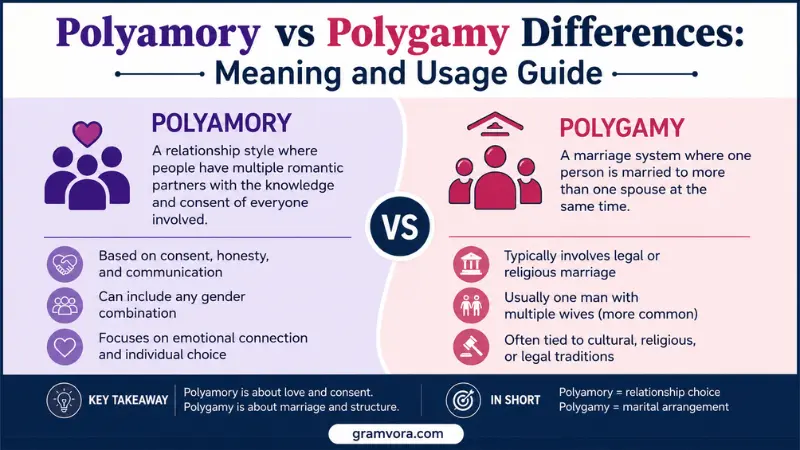
The clearest difference is this: polygamy is specifically about having more than one spouse, while polyamory is about having more than one romantic relationship at the same time.
Marriage is therefore the key dividing point. A person can practice polyamory without having multiple spouses. Polygamy, by definition, involves multiple spouses.
Quick Answer
Both polyamory and polygamy are correct words, but they describe different relationship arrangements.
Use polygamy when you mean marriage involving more than one spouse at the same time.
Use polyamory when you mean multiple open romantic relationships at the same time.
For example:
- Polygamy: A person has two or more spouses.
- Polyamory: A person has two or more romantic relationships, with the people involved aware of the arrangement.
So, if marriage is the main point, polygamy is usually the more precise choice. If multiple romantic relationships are the main point, polyamory is the better choice.
Why People Confuse Them
The words look and sound similar. Both begin with poly-, which relates to the idea of “many.”
They also describe relationship structures involving more than two people. That shared idea makes the terms easy to mix up.
The important difference comes from the rest of each word.
Polygamy centers on marriage or spouses. Polyamory centers on love and romantic relationships.
That means two people can discuss multiple relationships without talking about multiple marriages at all. In that situation, polyamory is the more accurate word.
Key Differences At A Glance
| Context | Best Choice | Why |
|---|---|---|
| More than one spouse | Polygamy | The word specifically concerns multiple spouses. |
| More than one romantic relationship | Polyamory | The focus is on multiple romantic relationships. |
| Multiple marriages | Polygamy | Marriage is central to the meaning. |
| Multiple open romantic relationships without multiple spouses | Polyamory | Marriage is not required. |
| Describing a person who practices multiple-spouse marriage | Polygamy | It identifies the marital arrangement. |
| Describing a person with multiple consensual romantic relationships | Polyamory | It identifies the relationship structure. |
Extra comparison:
| Feature | Polyamory | Polygamy |
| Main focus | Romantic relationships | Marriage and spouses |
| Marriage required by the word | No | Yes |
| Can involve multiple romantic partners | Yes | It may, but the defining feature is multiple spouses |
| Common grammatical form | Noun | Noun |
Meaning and Usage Difference
Polyamory is a noun for the practice or state of having more than one open romantic relationship at the same time. Modern definitions commonly emphasize openness, and many explanations also stress the knowledge and consent of the people involved.
For example:
She practices polyamory and is open about her relationships.
Here, the sentence does not say that she has multiple spouses. The focus is on having more than one romantic relationship.
Polygamy is a noun for marriage in which a person has more than one spouse at the same time.
For example:
The documentary examined a community where polygamy was practiced.
The important detail is that the relationships are described as marriages involving multiple spouses.
This distinction also explains why the words can overlap in some situations. A person could have a relationship structure that includes both multiple romantic relationships and multiple spouses. However, the two words emphasize different aspects of that situation.
Tone, Context, and Formality
Both words are standard nouns in American English.
Polyamory is especially common when discussing modern dating, romantic relationships, and relationship structures. It can appear in casual conversations as well as more formal writing.
Polygamy is more strongly associated with marriage, family structures, history, religion, culture, and law.
The tone depends more on the subject than on the words themselves. Neither term is inherently informal.
One useful distinction is that polyamory does not automatically describe marriage, while polygamy does.
For that reason, calling every relationship involving multiple romantic partners “polygamy” can make the description less precise.
Which One Should You Use?
Choose polyamory when the central idea is multiple romantic relationships.
- “They practice polyamory.”
- “She is in a polyamorous relationship.”
- “The article discusses polyamory and modern relationships.”
Choose polygamy when the central idea is multiple spouses or marriages.
- “The book discusses polygamy.”
- “The community has a history of polygamy.”
- “The report examined laws concerning polygamy.”
A simple test can help:
Ask whether multiple spouses are part of the meaning you need to express.
If yes, polygamy is likely the precise choice. If no, and you are talking about multiple romantic relationships, polyamory is usually better.
When One Choice Sounds Wrong
Using polygamy for every form of multiple-partner dating can sound inaccurate because the word specifically refers to multiple spouses.
For example:
Less precise:
“She practices polygamy because she dates two people.”
If neither relationship involves multiple spouses, polyamory is the more suitable word.
Better:
“She practices polyamory because she has two romantic relationships.”
The reverse mistake is also possible.
Less precise:
“He has three wives, so he practices polyamory.”
If the point is that he has multiple spouses, polygamy is the direct term.
Better:
“He practices polygamy and has three wives.”
The problem is not that one word is always “correct” and the other is always “wrong.” The problem is using a word that does not match the specific relationship structure being described.
Common Mistakes (and Quick Fixes)
Mistake 1: Treating the words as exact synonyms
They overlap, but they are not exact equivalents.
Fix: Use polygamy for multiple spouses and polyamory for multiple romantic relationships.
Mistake 2: Assuming polyamory requires marriage
It does not.
Fix: Remember that marriage is not required for the word polyamory.
Mistake 3: Assuming polygamy only means one specific gender arrangement
The broader word concerns having more than one spouse. It should not automatically be reduced to one particular arrangement.
Fix: Use the broader term when you are discussing multiple spouses generally.
Mistake 4: Thinking polyamory simply means dating casually
That is too narrow.
Fix: The word concerns multiple romantic relationships, not simply having several dates or casual encounters.
Mistake 5: Assuming multiple relationships automatically mean polyamory
The term is generally associated with open relationships in which the people involved know about and agree to the arrangement.
Fix: Do not use the word to describe a secret relationship arrangement automatically.
Everyday Examples
Here are some natural examples showing the difference:
- Polyamory: “Alex told his partner that he wanted to explore polyamory.”
- Polyamory: “Their polyamorous relationship depends on honest communication.”
- Polyamory: “She has two romantic partners and practices polyamory.”
- Polygamy: “The documentary focused on a community where polygamy was practiced.”
- Polygamy: “The history class discussed polygamy and marriage customs.”
- Polygamy: “The article used the word polygamy to describe a marriage involving multiple spouses.”
Compare these two sentences:
She practices polyamory.
This tells us that she has more than one romantic relationship.
She practices polygamy.
This tells us that she has more than one spouse.
That small difference in meaning can completely change how a reader understands the sentence.
Dictionary-Style Word Details
Verb
- Polyamory: Not commonly used as a verb in standard US English. The related adjective is polyamorous, as in “a polyamorous relationship.”
- Polygamy: Not commonly used as a verb in ordinary US English. The related adjective is polygamous, as in “a polygamous marriage.”
Noun
- Polyamory: A noun referring to the practice or state of having more than one open romantic relationship at the same time.
- Polygamy: A noun referring to marriage involving more than one spouse at the same time.
Both words are normally used as nouns when naming the relationship arrangement itself.
Synonyms
- Polyamory: There is no perfect one-word synonym in every context. Multiple romantic relationships is a close plain alternative.
- Polygamy: Multiple-spouse marriage is a close plain alternative when the meaning needs to be made especially clear.
The two words can appear as related words in dictionaries, but that does not make them interchangeable in every sentence.
Example Sentences
- Polyamory: “Jordan practices polyamory and has two committed romantic relationships.”
- Polyamory: “They talked openly about whether polyamory suited their relationship.”
- Polygamy: “The documentary explored the history of polygamy.”
- Polygamy: “The writer used polygamy to describe a marriage involving multiple spouses.”
Word History
- Polyamory: The modern word combines poly- with a form related to amorous. Merriam-Webster records a first known use of polyamory in 1992.
- Polygamy: The word comes through Latin from Greek and is built around elements associated with “many” and “marriage.” Merriam-Webster records a first known use of polygamy in 1538.
The words therefore share the idea of “many,” but their meanings developed around different relationship concepts.
Phrases Containing
- Polyamory: “practice polyamory,” “explore polyamory,” “polyamorous relationship,” “polyamorous partner”
- Polygamy: “practice polygamy,” “polygamous marriage,” “polygamous family,” “history of polygamy”
These common phrases reinforce the main distinction: polyamory usually describes multiple romantic relationships, while polygamy describes multiple-spouse marriage.
FAQs
1. What is the main difference between polyamory and polygamy?
Polyamory refers to having multiple romantic relationships at the same time, generally with openness and agreement among everyone involved. Polygamy refers specifically to marriage involving more than one spouse.
2. Is polyamory the same as polygamy?
No. The terms are related but not interchangeable. Polyamory focuses on multiple romantic relationships, while polygamy focuses on having multiple spouses.
3. Can you be polyamorous without being married?
Yes. Marriage is not required for polyamory. A person can have multiple romantic relationships without being married to any of their partners.
4. Does polygamy always involve marriage?
Yes. Marriage or multiple spouses is central to the meaning of polygamy. Simply dating multiple people does not automatically mean polygamy.
5. Can a person be both polyamorous and polygamous?
Potentially, yes. Someone could have multiple spouses while also having multiple romantic relationships. The terms describe different aspects of the relationship structure.
6. Is polyamory a type of polygamy?
Not exactly. Polyamory is broader in terms of romantic relationships but does not require marriage. Polygamy specifically concerns multiple spouses.
7. Does polyamory mean having multiple casual partners?
Not necessarily. Polyamory generally refers to multiple romantic relationships and is commonly associated with openness and agreement among the people involved. It does not simply mean casual dating.
8. What does polygamy mean in simple terms?
In simple terms, polygamy means being married to more than one spouse at the same time.
9. What does polyamory mean in simple terms?
Polyamory means having more than one romantic relationship at the same time, with the relationships being openly acknowledged by the people involved.
10. Which word should I use for multiple romantic relationships?
Use polyamory when you are talking about multiple romantic relationships rather than multiple spouses.
11. Which word should I use for multiple spouses?
Use polygamy when the defining feature is marriage to more than one spouse.
12. Is “polyamorous marriage” the same as “polygamous marriage”?
No. Polyamorous describes a relationship structure involving multiple romantic relationships, while polygamous specifically describes a marriage involving multiple spouses. A particular marriage arrangement can involve characteristics of both, but the terms are not automatic synonyms.
Conclusion
The main polyamory vs polygamy differences come down to what the word is emphasizing.
Polyamory describes multiple romantic relationships at the same time, generally with openness among the people involved.
Polygamy describes marriage involving more than one spouse at the same time.
So, use polyamory when you are talking about multiple romantic relationships. Use polygamy when multiple spouses or marriages are the defining feature.
Both words are correct. The right choice depends on the relationship structure you are describing.


