
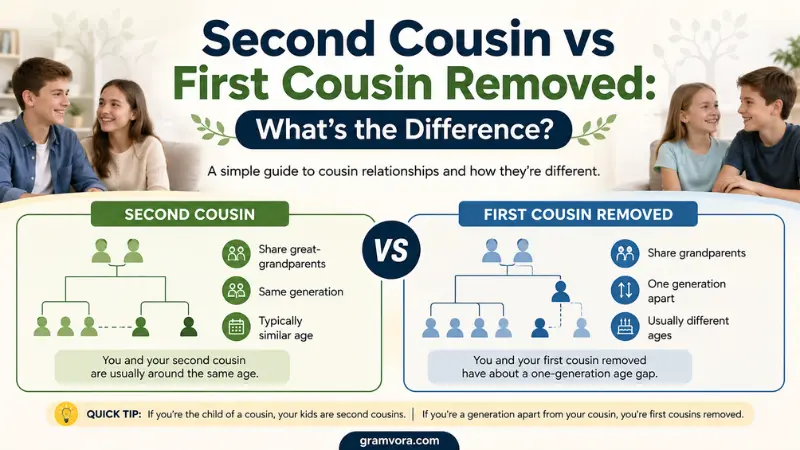
Second cousin and first cousin removed describe different family relationships. The key is that second identifies the cousin degree, while removed identifies a difference in generations.
There is also an important wording point: first cousin removed is less precise than first cousin once removed. In standard family-relationship terminology, the number of removals tells you how many generations separate the two people.
Understanding that difference makes cousin relationships much easier to follow.
Quick Answer
Use second cousin when two people are in the same generation and share great-grandparents.
Use first cousin once removed when two people are one generation apart in a first-cousin relationship.
So, these are not interchangeable.
For example:
- Your first cousin’s child is your first cousin once removed.
- Your first cousin’s child is not your second cousin.
- Your child and your first cousin’s child are second cousins.
If someone says first cousin removed, they may be using a shortened version of the fuller expression. For precision, say first cousin once removed when the generation difference is one.
Why People Confuse Them
The confusion usually comes from the idea that “first cousin” becomes “second cousin” when that person has a child.
That is not how the system works.
The number in a cousin relationship does not simply increase because someone has a child. Instead, the number identifies the cousin degree, while once removed describes a one-generation difference.
Imagine that you and your first cousin are in the same generation. Your first cousin has a daughter. That daughter is one generation below you. She is therefore your first cousin once removed.
Now compare her with your own daughter. Both girls are in the same generation, and they share the same great-grandparents. They are second cousins.
That distinction is the key to the whole comparison.
Key Differences At A Glance
| Context | Best Choice | Why |
|---|---|---|
| Same generation, shared great-grandparents | Second cousin | The cousin degree is second |
| Your first cousin’s child | First cousin once removed | The child is one generation below you |
| Your parent’s first cousin | First cousin once removed | That relative is one generation above you |
| Your child and your first cousin’s child | Second cousin | They are in the same generation and share great-grandparents |
Quick comparison:
- Second cousin: same generation + great-grandparent connection.
- First cousin once removed: one generation apart + first-cousin connection.
- Second cousin: describes the degree.
- Once removed: describes the generation gap.
Meaning and Usage Difference
Second cousin is a specific family relationship. Two second cousins normally share the same great-grandparents and are in the same generation.
A simple example is this:
Your grandmother and another person’s grandmother are sisters. Their children are first cousins. Their children, including you and the other person, are second cousins.
First cousin once removed describes a different arrangement. You and the other person are separated by one generation, but the underlying cousin relationship is first cousin.
There are two common directions:
- Your first cousin’s child is your first cousin once removed.
- Your parent’s first cousin is also your first cousin once removed.
The word removed does not mean that someone was excluded from the family. It refers to the generation difference.
The term first cousin removed can be understood in context, but it leaves out the number of generations. First cousin once removed is clearer and more precise.
Tone, Context, and Formality
Both expressions are standard family-relationship terms, but they are more common when people need to describe a family tree accurately.
Second cousin fits naturally into everyday conversation:
“Maria is my second cousin.”
First cousin once removed is more specific:
“Maria is my first cousin once removed.”
In casual conversation, many people simply say cousin if the exact relationship is not important.
When the exact relationship matters, however, the full label prevents confusion. This is especially useful when discussing genealogy, family records, or a complicated family tree.
There is no important pronunciation difference between these expressions. The challenge is understanding the relationship, not saying the words correctly.
Which One Should You Use?
Choose second cousin if:
- You and the relative are in the same generation.
- You share great-grandparents.
- Your parents are first cousins.
Choose first cousin once removed if:
- The person is your first cousin’s child.
- The person is your parent’s first cousin.
- You and the person are one generation apart in the first-cousin relationship.
A useful shortcut is to separate the two ideas:
Cousin number = degree of the relationship.
Removed number = generation difference.
That makes it much easier to choose the correct expression.
When One Choice Sounds Wrong
Calling your first cousin’s child your second cousin is the most common mistake.
For example:
“My first cousin has a son, so her son is my second cousin.”
That is incorrect when describing the relationship between you and the son.
The better wording is:
“My first cousin’s son is my first cousin once removed.”
The son may be a second cousin to your child, because your child and the son belong to the same generation.
Another mistake is saying only first cousin removed when the intended meaning is specifically one generation apart. The more complete expression is first cousin once removed.
Common Mistakes (and Quick Fixes)
Mistake: “My cousin’s daughter is my second cousin.”
Fix: “My first cousin’s daughter is my first cousin once removed.”
Mistake: “Removed means we are less related.”
Fix: “Removed means we are separated by a particular number of generations.”
Mistake: “Second cousin means my cousin’s child.”
Fix: “Second cousin describes people who share great-grandparents and are in the same generation.”
Mistake: “First cousin removed” always tells the exact relationship.
Fix: Use first cousin once removed, twice removed, or another specific number when precision matters.
Mistake: Assuming age determines the relationship.
Fix: Family relationship labels depend on family-tree position, not simply on whether one person is older or younger.
Everyday Examples
Example 1: Your first cousin’s child
Your aunt has a daughter named Emily. Emily is your first cousin. Emily has a son named Noah.
Noah is your first cousin once removed.
Example 2: Your parent’s cousin
Your mother has a first cousin named David. David is in your mother’s generation.
David is your first cousin once removed.
Example 3: Your second cousin
Your parent and another person’s parent are first cousins. You and that person are in the same generation.
You are second cousins.
Example 4: Your child and your first cousin’s child
Your first cousin has a daughter, and you have a daughter. The two girls are in the same generation and share great-grandparents.
They are second cousins.
Example 5: A simple family-tree test
Ask two questions:
- What is the closest shared ancestor?
- Are the two people in the same generation?
If the shared ancestor is a great-grandparent and the two people are in the same generation, the relationship is second cousin.
If the underlying relationship is first cousin but the people are one generation apart, it is first cousin once removed.
Dictionary-Style Word Details
Verb
- Second cousin: Not used as a verb in standard US English. It is a noun phrase.
- First cousin removed: Not used as a verb. It functions as a family-relationship noun phrase.
Noun
- Second cousin: A person who is in the second-cousin relationship with you, typically sharing great-grandparents.
- First cousin removed: A shortened expression referring to a cousin relationship with a generation difference. For a one-generation difference, the precise noun phrase is first cousin once removed.
Both expressions can appear after possessive words:
- “She is my second cousin.”
- “He is my first cousin once removed.”
Synonyms
There are no exact synonyms that preserve the full genealogical meaning of either expression.
- Second cousin: The closest plain alternative is relative who shares my great-grandparents, although this is a description rather than an exact substitute.
- First cousin removed: The clearest alternative is to describe the relationship directly, such as my first cousin’s child or my parent’s first cousin, depending on the direction of the relationship.
Example Sentences
- “Jordan is my second cousin.”
- “My second cousin lives in Arizona.”
- “My first cousin’s daughter is my first cousin once removed.”
- “My dad’s first cousin is my first cousin once removed.”
- “My daughter and my cousin’s daughter are second cousins.”
Word History
Second cousin is an established English family term with a long history of use.
First cousin removed is built from the established terms first cousin and removed. In precise relationship terminology, the full expression includes the number of generations: first cousin once removed, first cousin twice removed, and so on.
The important point is that removed describes a generational difference rather than separation from a family.
Phrases Containing
- Second cousin
- Second cousins
- First cousin once removed
- First cousin twice removed
- Second cousin once removed
- Second cousin twice removed
These phrases follow the same basic pattern: the cousin number identifies the relationship degree, while the removal number identifies the generation difference.
FAQs
Is a second cousin the same as a first cousin once removed?
No. A second cousin is generally in the same generation as you and shares your great-grandparents. A first cousin once removed is one generation above or below you in a first-cousin relationship.
What is the difference between a second cousin and a first cousin once removed?
The key difference is generation. “Second cousin” describes the degree of the cousin relationship, while “once removed” indicates that the two people are one generation apart.
Is my first cousin’s child my second cousin?
No. Your first cousin’s child is your first cousin once removed. Your child and your first cousin’s child are second cousins.
Is my parent’s first cousin my first cousin once removed?
Yes. Your parent’s first cousin is your first cousin once removed because that person is one generation above you.
What does “once removed” mean in a family relationship?
“Once removed” means that two relatives are one generation apart. It does not mean that they are less important to the family or less closely related in a general sense.
Are second cousins in the same generation?
Typically, yes. Second cousins share great-grandparents and are normally in the same generation.
Can second cousins be different ages?
Yes. Family relationship labels are based on family-tree positions, not simply on age. Two second cousins can have a significant age difference.
Is “first cousin removed” correct?
It can be understood, but first cousin once removed is the more precise expression when the relationship is one generation apart. The word “once” specifies the number of generations between the two people.
Are my child and my first cousin’s child second cousins?
Yes. Your child and your first cousin’s child are generally second cousins because they are in the same generation and share great-grandparents.
Which is closer: a second cousin or a first cousin once removed?
Neither label can be treated as simply “closer” based on the wording alone. They describe different family-tree relationships. A second cousin is in your generation, while a first cousin once removed is one generation above or below you.
How can I remember the difference?
Remember this simple rule: the number tells you the cousin degree, and “removed” tells you the generation difference. Thus, “second cousin” and “first cousin once removed” describe different relationships.
Conclusion
Second cousin and first cousin removed are not the same relationship.
A second cousin is generally someone in your generation who shares your great-grandparents. A first cousin once removed is one generation above or below you in a first-cousin relationship.
The easiest way to remember the difference is:
Second = cousin degree.
Once removed = one-generation difference.
If you want to be precise, use first cousin once removed rather than the shortened first cousin removed.


