
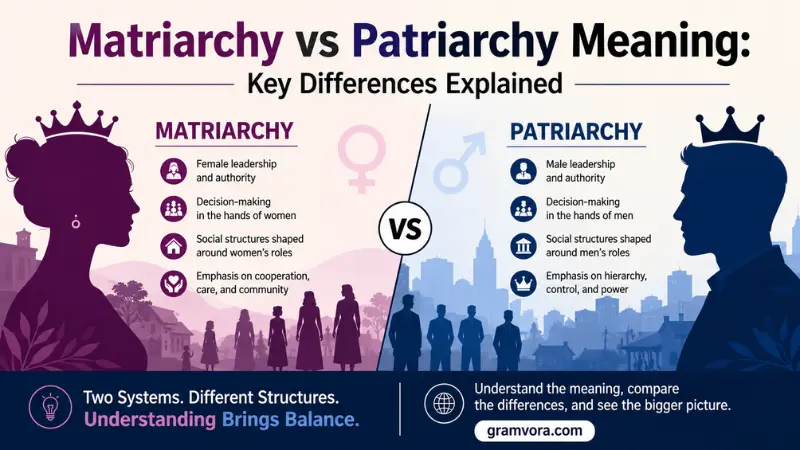
If you are comparing matriarchy vs patriarchy meaning, both words are correct. The difference is mainly about where authority and power are centered.
Matriarchy refers to a social or family structure in which women have the central authority or power. Patriarchy refers to a structure in which men, fathers, or male authority hold the dominant position.
The terms can describe families, communities, institutions, or larger societies. However, they should not be used simply because one woman or one man happens to be a leader.
Quick Answer
Use matriarchy when the system you are describing is centered on female authority.
Use patriarchy when the system is centered on male authority.
For example:
- Matriarchy: “The fictional kingdom is organized as a matriarchy led by senior women.”
- Patriarchy: “The novel examines how patriarchy shapes family expectations.”
Both words are nouns. Their related adjectives are matriarchal and patriarchal.
One important caution: matriarchy does not simply mean matrilineal. A matrilineal system traces descent or inheritance through the mother’s side of the family, but that alone does not establish that women hold the main authority.
Why People Confuse Them
The words look and sound like natural opposites.
The first part of matriarchy is associated with mothers or women, while patriarchy is associated with fathers or men. The shared -archy element relates to rule, authority, or leadership.
That makes this shortcut tempting:
- Matriarchy = women in charge
- Patriarchy = men in charge
The shortcut is useful for a basic definition, but real social structures can be more complicated.
For example, a family may pass property through the mother’s side while important decisions are still made mainly by men. Calling that arrangement a matriarchy would not necessarily be accurate.
Likewise, a woman can be the head of a household without the entire surrounding society being a matriarchy.
Key Differences At A Glance
| Context | Best Choice | Why |
|---|---|---|
| Women hold the central authority in a social system | Matriarchy | The system is centered on female authority |
| Men hold the central authority in a social system | Patriarchy | The system is centered on male authority |
| Descent or inheritance follows the mother’s line | Neither automatically | Maternal descent does not by itself establish female rule |
| One woman leads a family or group | Context-dependent | One leader does not necessarily define the whole system |
| A broader system gives men most authority | Patriarchy | The term describes male-centered social power |
The key question is how authority is organized, not simply whether a particular leader is male or female.
Meaning and Usage Difference
Matriarchy is a noun for a system in which women have the main authority or power. Some definitions also connect the term with female-centered inheritance or family organization.
Patriarchy is a noun for a system in which men or fathers hold primary authority. In broader modern discussions, the word can describe social structures in which men hold a disproportionate share of power.
This distinction is important because authority, descent, and residence are not the same thing.
A matrilineal family structure, for example, follows descent through the mother’s line. That does not automatically mean women make the main decisions.
Similarly, a society can have women in important leadership positions without every part of the society being organized around female authority.
The terms also have adjective forms:
- Matriarchal: relating to or characterized by matriarchy.
- Patriarchal: relating to or characterized by patriarchy.
For example:
“The story describes a matriarchal community.”
“The study examines patriarchal social structures.”
Tone, Context, and Formality
Both matriarchy and patriarchy are standard terms. They are appropriate in academic, educational, historical, cultural, and serious everyday writing.
Matriarchy may appear when discussing social organization, family authority, fictional societies, or debates about women’s social power. Because scholars do not always use the word in exactly the same way, context can matter.
Patriarchy is especially common in discussions of gender, social inequality, family roles, institutions, and power. In some contexts, it can carry a critical tone because writers use it to describe systems they believe favor male authority.
The words themselves are not automatically informal, offensive, or judgmental. The tone comes from the claim being made and the surrounding context.
Which One Should You Use?
Choose matriarchy if female authority is the central feature of the system you are describing.
Choose patriarchy if male authority is the central feature.
If you are only describing inheritance through the mother’s side, be more specific instead of automatically using matriarchy.
If you are only describing a household headed by a woman, you may also want to say female-headed household if that is all you mean.
The same principle applies to a male-headed household. A single male leader does not necessarily prove that the entire organization is patriarchal.
When One Choice Sounds Wrong
Matriarchy can sound inaccurate when the only evidence is that women are important, that a mother leads one household, or that inheritance follows the maternal line.
For example:
“The family is matriarchal because the grandmother makes most decisions.”
This may be reasonable if the discussion is specifically about that family’s authority structure. But if the statement is about a larger community, more evidence would be needed.
Patriarchy can also be too broad if the only fact is that a man is the leader.
For example:
“The company has a patriarchy because its CEO is a man.”
That conclusion does not follow from the leadership position alone. The term refers to a broader pattern of male-centered authority or control.
Common Mistakes (and Quick Fixes)
Mistake 1: Treating matriarchy as exactly the same as matrilineality
A matrilineal system traces descent through the mother’s line. That does not automatically mean women hold overall authority.
Quick fix: Use matriarchy only when female authority is actually the point.
Mistake 2: Calling any woman-led group a matriarchy
A woman can lead a group without the entire group’s structure being matriarchal.
Quick fix: Ask whether female authority is a broader organizing feature.
Mistake 3: Calling every male-led situation a patriarchy
One male leader does not automatically establish a patriarchal system.
Quick fix: Look for a wider pattern of male-centered authority.
Mistake 4: Assuming the two terms are perfect mirror images
They are commonly contrasted, but scholarly discussions of matriarchy involve additional questions about social organization, kinship, and what counts as female authority.
Quick fix: Use the basic contrast for ordinary writing, but avoid making claims that go beyond your evidence.
Everyday Examples
Here are some natural ways to use the terms:
- “The novel imagines a matriarchy in which senior women make the major political decisions.”
- “The documentary explores how patriarchy can shape expectations about family roles.”
- “The fictional island is organized as a matriarchy.”
- “The researcher studied patriarchal patterns in the institution.”
- “The family has a strong female leader, but that alone does not establish a matriarchy.”
- “Tracing inheritance through the mother’s family does not automatically make a society a matriarchy.”
- “The author contrasts a patriarchal system with a fictional matriarchal society.”
- “The course examines how authority can be organized differently across cultures.”
These examples show why the surrounding context matters. The words describe systems of authority, not simply the gender of an individual.
Dictionary-Style Word Details
Verb
- Matriarchy: Not commonly used as a verb in standard US English. It is a noun.
- Patriarchy: Not commonly used as a verb in standard US English. It is a noun.
Their related adjective forms are matriarchal and patriarchal, but those are not substitutes for the nouns.
Noun
- Matriarchy: A social, family, or organizational system in which women have central authority or power. It can also be used for a society or group organized around such authority. The plural is matriarchies.
- Patriarchy: A social, family, or organizational system in which men or fathers have central authority or power. The plural is patriarchies.
Both can be countable or uncountable depending on the sentence.
Synonyms
Exact synonyms do not always work in every context.
- Matriarchy: closest plain alternatives include female-led system, female-centered authority, or rule by women, depending on the intended meaning.
- Patriarchy: closest plain alternatives include male-led system, male-centered authority, or rule by men, depending on the intended meaning.
Patriarchy is commonly treated as the contrasting term for matriarchy, but the two concepts are not necessarily perfect mirror images in every academic discussion.
Example Sentences
- Matriarchy: “The science-fiction novel imagines a matriarchy governed by senior women.”
- Matriarchy: “The researchers debated whether the community could accurately be described as a matriarchy.”
- Patriarchy: “The book examines how patriarchy affects expectations about family life.”
- Patriarchy: “The historian described the political structure as patriarchal.”
Word History
Matriarchy and patriarchy are related words built around ideas of maternal and paternal authority.
Merriam-Webster records matriarchy as first known in 1885 and patriarchy as first known in 1632.
The historical development of the concepts is more complicated than simply creating one word as the exact opposite of the other. In particular, scholarly discussions of matriarchy have debated how the term should relate to female authority, kinship, and social organization.
Phrases Containing
Common phrases with matriarchy include:
- a matriarchal society
- a matriarchy
- under a matriarchy
- female-centered matriarchy
- a fictional matriarchy
Common phrases with patriarchy include:
- a patriarchal society
- a patriarchy
- under patriarchy
- patriarchal system
- the effects of patriarchy
Notice that the adjectives matriarchal and patriarchal are often more natural when directly modifying a noun such as society, system, or structure.
FAQs
What is the meaning of matriarchy?
Matriarchy means a social or family system in which women hold central authority or power. The term can describe a broader structure rather than simply one woman being a leader.
What is the meaning of patriarchy?
Patriarchy means a social or family system in which men or fathers hold central authority or power. It is often used more broadly to discuss male-centered social structures.
Is matriarchy the opposite of patriarchy?
They are commonly presented as contrasting terms: matriarchy centers authority on women, while patriarchy centers authority on men. However, they are not necessarily perfect mirror images in every academic context.
Are matriarchy and patriarchy nouns?
Yes. Matriarchy and patriarchy are both nouns.
- Matriarchy: “The story describes a matriarchy.”
- Patriarchy: “The book examines patriarchy.”
What is the difference between matriarchy and matrilineal?
Matriarchy concerns authority or power centered on women. Matrilineal concerns descent or family lineage through the mother’s side. A matrilineal society is not automatically a matriarchy.
What is the difference between matriarchy and matriarchal?
Matriarchy is a noun for a system or society centered on female authority. Matriarchal is an adjective used to describe something characterized by or related to matriarchy.
What is the difference between patriarchy and patriarchal?
Patriarchy is the noun for a male-centered system of authority. Patriarchal is the adjective describing something related to or characterized by patriarchy.
Can a family be called a matriarchy?
Yes, if the family is genuinely organized around female authority or leadership. Simply having a woman as the head of a household does not necessarily mean the entire family structure is a matriarchy.
Can a family be called patriarchal?
Yes. Patriarchal can describe a family structure in which men or fathers hold the main authority. The word should describe a broader pattern rather than merely the gender of one family member.
Is matriarchy the same as women being in charge?
Not always. The basic meaning involves female-centered authority, but the exact use can depend on the social structure being described. A single woman holding a leadership position does not automatically establish a matriarchy.
Conclusion
The simplest answer to matriarchy vs patriarchy meaning is this: matriarchy centers authority on women, while patriarchy centers authority on men.
Both are correct nouns, and the right choice depends on the system you are describing.
The most important caution is not to confuse authority with lineage. A society can trace descent through women without being a matriarchy, just as one male leader does not automatically make an entire organization patriarchal.


