
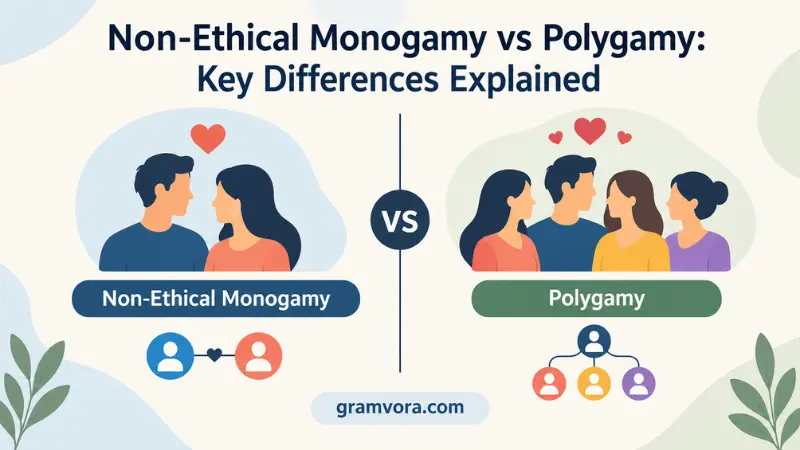
Non ethical monogamy vs polygamy compares two expressions that describe very different ideas.
The biggest issue is that non ethical monogamy is not a standard relationship term in major English dictionaries. The wording can be understood literally, but it is uncommon and can be confusing.
Polygamy, by contrast, is an established noun. It refers to having more than one spouse at the same time.
There is another important distinction. The phrase non ethical monogamy contains the word monogamy, which normally refers to having one spouse or one exclusive partner at a time. Adding non ethical changes the description of how that relationship is conducted, not the basic number of partners.
So these expressions should not be treated as direct synonyms.
Quick Answer
If you mean having more than one spouse at the same time, the established word is polygamy.
If you literally mean a monogamous relationship that is conducted in an unethical way, non ethical monogamy can be understood, but it is not a widely established standard term.
For example:
- Polygamy = having more than one spouse at the same time.
- Non ethical monogamy = a literal phrase suggesting a one-partner relationship that does not follow ethical expectations.
The two expressions describe different features of a relationship.
Polygamy focuses on marital structure. The phrase non ethical monogamy focuses on the ethical character of a monogamous arrangement.
Why People Confuse Them
The confusion comes partly from the words monogamy and polygamy.
Monogamy is associated with one spouse or one partner at a time. Polygamy describes more than one spouse at the same time.
The phrase non ethical monogamy can therefore sound as if it means the opposite of monogamy. But that is not what the words strictly say.
The word non modifies ethical in the phrase as written. It does not necessarily change monogamy into non-monogamy.
That distinction matters.
A person could have a monogamous relationship while breaking promises, hiding information, or acting dishonestly. The relationship could still be described as monogamous in terms of the number of partners, even though its conduct might be described as unethical.
Polygamy is different because the defining feature is the presence of multiple spouses.
Key Differences At A Glance
| Context | Best Choice | Why |
|---|---|---|
| More than one spouse at the same time | Polygamy | This is the established word for multiple-spouse marriage. |
| One spouse or partner, but the relationship is described as unethical | Non ethical monogamy | This is a literal descriptive phrase, not a standard technical label. |
| Multiple romantic or sexual relationships with everyone’s knowledge and agreement | Ethical non-monogamy | This is the established expression for that relationship category. |
| Hidden relationship outside an exclusive agreement | Cheating / infidelity | These terms describe a breach of an agreed relationship boundary. |
| Marriage to multiple people | Polygamy | The focus is specifically on multiple spouses. |
Compact comparison
- Non ethical monogamy: literal descriptive phrase; emphasizes an ethical problem within a monogamous arrangement.
- Polygamy: established noun; emphasizes having multiple spouses.
- Ethical non-monogamy: established relationship term; describes nonexclusive relationships based on knowledge and consent.
Meaning and Usage Difference
The most important difference is what each expression describes.
Non ethical monogamy
The phrase non ethical monogamy is made from familiar words, but it is not a common standardized label.
Monogamy refers to a relationship arrangement involving one spouse or one sexual or romantic partner at a given time. The addition of non ethical suggests that the arrangement is not being conducted according to some expected ethical standard.
For instance:
Their relationship was monogamous, but it involved repeated dishonesty.
Someone might describe that situation informally as non ethical monogamy, but the phrase is not as established as other relationship terms.
Polygamy
Polygamy is a standard noun describing the practice or custom of having more than one spouse at the same time.
It is therefore directly connected to marriage or spouses.
For example:
The article discusses the history of polygamy.
Or:
The community has a history of polygamous marriage.
The key idea is not whether the relationship is ethical, romantic, successful, or consensual. The basic definition concerns multiple spouses.
That makes polygamy fundamentally different from the literal phrase non ethical monogamy.
Tone, Context, and Formality
Polygamy is formal and established vocabulary. It appears in dictionaries, academic writing, legal discussions, history, sociology, and ordinary conversation.
The phrase non ethical monogamy is much less established. It may be understood from context, but readers may wonder whether the writer intended non-monogamy, unethical non-monogamy, or simply a description of an unhealthy or dishonest monogamous relationship.
That ambiguity makes the phrase less suitable for formal writing when a more precise established expression is available.
Context also matters.
Consider these two sentences:
The book examines polygamy in different societies.
This is clear because polygamy has a recognized meaning.
Now consider:
The book examines non ethical monogamy.
A reader may reasonably ask what the writer means by non ethical. Does it mean dishonesty? Infidelity? A relationship without mutual agreement? Or simply an arrangement that does not meet the writer’s personal idea of ethical behavior?
The second sentence therefore needs more explanation.
Which One Should You Use?
Use polygamy when you are talking specifically about having multiple spouses at the same time.
Use non ethical monogamy only when you intentionally mean a monogamous arrangement that you are describing as ethically problematic. Even then, a more direct explanation is often clearer.
For formal or educational writing, explain the behavior instead of relying on the uncommon phrase.
For example:
The couple remained monogamous but violated their agreement through deception.
That sentence tells the reader exactly what happened.
If the intended meaning is multiple romantic or sexual relationships with the knowledge and consent of everyone involved, ethical non-monogamy is the established expression instead.
This distinction prevents a major wording mistake: confusing non ethical monogamy with non-monogamy.
They are not automatically the same phrase.
When One Choice Sounds Wrong
Polygamy sounds wrong when the subject is simply an exclusive relationship between two people, even if that relationship has ethical problems.
For example:
They were married to each other and had no other spouses.
Calling that arrangement polygamy would not fit the ordinary definition.
On the other hand, non ethical monogamy can sound unclear when the writer actually means several romantic or sexual relationships.
For example:
She practices non ethical monogamy with three partners.
This sentence is confusing because monogamy normally points toward a one-partner arrangement.
If the intended meaning is several consensual relationships, the writer should use the established terminology that accurately describes that situation.
The problem is not merely grammar. It is precision.
Common Mistakes (and Quick Fixes)
Mistake 1: Treating polygamy as the opposite of ethical monogamy
Incorrect idea: Polygamy automatically means an unethical relationship.
Better understanding: Polygamy describes multiple-spouse marriage. The word itself does not provide a complete judgment about the people involved.
Mistake 2: Treating non ethical monogamy as another word for non-monogamy
These phrases are not automatically interchangeable.
Non ethical monogamy literally describes monogamy that is being characterized as non-ethical.
Non-monogamy describes arrangements that are not monogamous.
The missing hyphen and word placement can therefore change the intended meaning.
Mistake 3: Using polygamy for every relationship with several partners
Polygamy is specifically connected with multiple spouses.
A relationship involving several romantic or sexual partners does not automatically meet that definition.
Mistake 4: Assuming every non-monogamous relationship is polygamous
That is also inaccurate.
Non-monogamy is a broader idea. Polygamy specifically concerns multiple spouses.
Mistake 5: Assuming the phrase is a standard dictionary term
Non ethical monogamy is understandable as a combination of ordinary English words, but it should not be presented as though it has the same established status as polygamy.
Everyday Examples
Here are practical examples showing the difference.
Example 1 — Polygamy
The documentary examines communities where polygamy has been practiced.
The sentence focuses on a marriage structure involving multiple spouses.
Example 2 — Monogamy with unethical conduct
Their relationship was monogamous, but one partner repeatedly lied about important matters.
This clearly describes one relationship while identifying the ethical problem.
Example 3 — Multiple consensual relationships
They openly discussed having relationships with other people.
If the writer intends to describe a recognized consensual relationship structure, a specific established term may be more appropriate than non ethical monogamy.
Example 4 — Multiple spouses
The historical account describes a polygamous household.
The adjective polygamous correctly modifies the household or marriage structure.
Example 5 — Confusing wording
He is practicing non ethical monogamy with three wives.
This is internally confusing because monogamy and three wives point in opposite directions.
A writer should state the intended relationship structure directly.
Dictionary-Style Word Details
Verb
- Non ethical monogamy: Not commonly used as a verb in standard US English. The phrase functions as a noun phrase.
- Polygamy: Not commonly used as a verb. It is a noun. Related forms such as polygamous function differently, but polygamy itself does not act as a standard verb.
Noun
- Non ethical monogamy: A noun phrase that can be understood literally as a monogamous arrangement characterized as non-ethical. It is not a widely standardized relationship label.
- Polygamy: A standard noun referring to the practice or custom of having more than one spouse at the same time.
Synonyms
- Non ethical monogamy: There is no single exact synonym because the phrase itself is not a standardized technical category. Depending on the intended meaning, unethical monogamous relationship may be a clearer plain-language description.
- Polygamy: Closest plain alternatives include plural marriage or multiple-spouse marriage, although these expressions can have different contextual uses and should not automatically be treated as exact replacements.
Example Sentences
- Non ethical monogamy: “The writer used the phrase to describe a monogamous relationship involving dishonesty.”
- Polygamy: “The book discusses polygamy as a form of plural marriage.”
- Non ethical monogamy: “The phrase may confuse readers because its intended meaning is not immediately clear.”
- Polygamy: “Polygamy refers to having more than one spouse at the same time.”
Word History
- Non ethical monogamy: There is no well-established dictionary history for this exact phrase as a standardized term. The phrase can be understood compositionally from non, ethical, and monogamy.
- Polygamy: The word has a documented history going back to the late 16th century. It ultimately traces through French and Late Latin to Greek roots associated with having multiple marriages.
Phrases Containing
- Non ethical monogamy: This exact phrase is uncommon. Related wording may appear in discussions of dishonest or nonconsensual relationship behavior, but usage varies.
- Polygamy: Common related expressions include polygamous marriage, polygamous relationship, polygamous society, and practice of polygamy.
FAQs
Non ethical monogamy is a literal phrase suggesting a monogamous relationship that involves unethical behavior. Polygamy is an established term for having more than one spouse at the same time.
No. Non ethical monogamy and non-monogamy do not automatically mean the same thing. The first phrase suggests an ethical problem within a monogamous relationship, while non-monogamy refers broadly to relationships that are not exclusive to one partner.
Polygamy means having more than one spouse at the same time. It is a standard noun used in discussions of marriage, society, history, law, and relationships.
Yes, in the broad sense that polygamy involves more than one spouse. However, polygamy specifically concerns multiple spouses, while non-monogamy is a broader category that can include relationship arrangements that do not involve marriage.
Not necessarily. The defining feature of polygamy is multiple spouses. Having multiple romantic or sexual partners does not automatically mean that a person is practicing polygamy.
The exact phrase non ethical monogamy is not as established as terms such as monogamy, polygamy, or ethical non-monogamy. Because it can be interpreted in different ways, clearer wording may be preferable in formal writing.
Yes. A relationship can be monogamous in terms of having one partner while still involving dishonesty, broken agreements, or other behavior that the people involved consider unethical.
The established term is polygamy. An individual or marriage can also be described with the adjective polygamous when appropriate.
In terms of the number of spouses, they describe contrasting marriage structures: monogamy involves one spouse at a time, while polygamy involves more than one spouse at the same time.
Conclusion
Non ethical monogamy vs polygamy is not a comparison of two equivalent relationship terms.
Polygamy is an established noun for having more than one spouse at the same time.
Non ethical monogamy is a much less established phrase. Read literally, it suggests a monogamous arrangement that is being characterized as ethically problematic. It should not automatically be used to mean non-monogamy or multiple relationships.
For clear US English, choose the term that matches the actual situation. Use polygamy when the subject is multiple spouses. If you mean a monogamous relationship involving dishonesty or another ethical problem, describe that situation directly rather than assuming non ethical monogamy is a standard technical label.


