
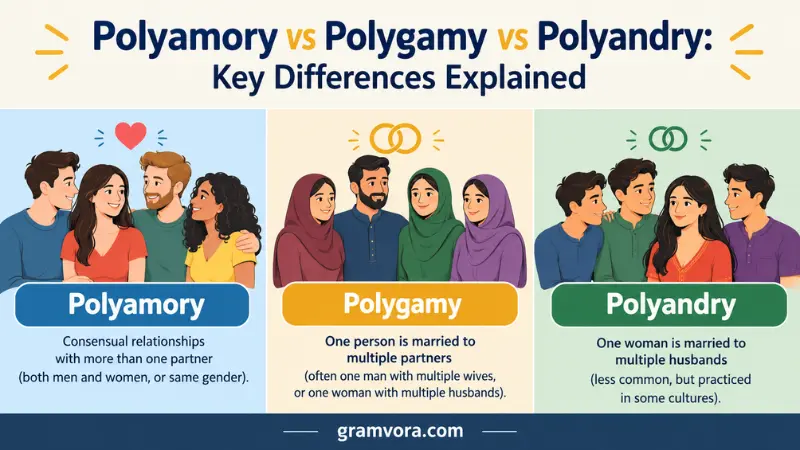
Polyamory, polygamy, and polyandry are related terms, but they do not mean the same thing. All three can involve more than two people, which is why they are often confused. The important difference is what kind of relationship or marriage the word describes.
Polyamory generally refers to having romantic or sexual relationships with more than one person at the same time, with the knowledge and consent of everyone involved.
Polygamy specifically refers to being married to more than one person at the same time.
Polyandry is a more specific term. It refers to a marriage or relationship arrangement in which one woman has more than one husband or permanent male partner at the same time.
The terms therefore overlap in subject matter, but they identify different relationship structures. Choosing the correct word depends on whether you are talking about romantic relationships generally, marriage specifically, or a particular marriage structure involving multiple husbands.
Quick Answer
The simplest distinction is:
- Polyamory = having multiple romantic or sexual relationships with the knowledge and consent of everyone involved.
- Polygamy = being married to more than one person at the same time.
- Polyandry = a form of multiple marriage in which a woman has more than one husband.
For example, someone who has two romantic partners but is not married to both may be described as polyamorous. Someone who has multiple spouses is described as practicing polygamy. If the specific arrangement involves one woman having multiple husbands, polyandry is the more precise term.
So, these words should not be treated as interchangeable.
Why People Confuse Them
The confusion mainly comes from the shared idea of “many.” Each word begins with poly-, a combining form associated with the idea of “many.”
However, the rest of each word points to a different concept.
In polyamory, “amory” relates to love or romantic relationships. The word therefore focuses on having multiple loving or intimate relationships.
In polygamy, the key idea is marriage. The term describes a marital arrangement involving more than one spouse.
In polyandry, the final part identifies the specific structure: one woman has multiple husbands or permanent male partners.
Another reason for confusion is that people sometimes use “polygamy” as a general label for any relationship involving more than two people. That usage can be too broad when the subject is actually consensual nonmarital relationships.
For accurate writing, it helps to ask one question: Are you talking about multiple relationships, multiple marriages, or a specific type of multiple marriage?
Key Differences At A Glance
| Feature | Polyamory | Polygamy | Polyandry |
|---|---|---|---|
| Main idea | Multiple romantic or sexual relationships | Marriage to more than one person | One woman with multiple husbands |
| Marriage required? | No | Yes, by definition | Yes, in the marital sense |
| Number of partners | Two or more | More than one spouse | One woman and two or more husbands |
| Focus | Romantic or intimate relationships | Marriage | Specific marital structure |
| Consent | Generally central to the way the term is used | The word itself does not define consent | The word itself describes the marriage structure |
| Grammatical role | Noun | Noun | Noun |
| Typical context | Relationships and personal identity | Marriage, family, social science | Marriage, anthropology, social science |
The biggest difference is that polyamory does not require marriage, while polygamy and polyandry are specifically connected with marriage.
Polyandry is also narrower than polygamy. It identifies a particular direction of multiple marriage: one woman with multiple husbands.
Meaning and Usage Difference
Polyamory
Polyamory is the practice of having romantic or sexual relationships with more than one person at the same time. The term is commonly associated with relationships in which the people involved know about and agree to the arrangement.
For example:
Maya is polyamorous and has two committed romantic partners.
The sentence does not say that Maya is married to both people. It describes her relationship structure.
A person can therefore be polyamorous without practicing polygamy.
Polygamy
Polygamy refers to the practice or condition of being married to more than one person at the same time.
For example:
The documentary examines the history of polygamy in different societies.
The word focuses on marriage rather than simply having multiple romantic relationships.
Polygamy is therefore broader than polyandry because it does not, by itself, specify whether the person with multiple spouses is a man or a woman.
Polyandry
Polyandry is a specific type of multiple marriage in which one woman has more than one husband or permanent male partner at the same time.
For example:
The anthropologist studied a community where polyandry had been practiced.
The word is more specialized than either polyamory or polygamy.
Polyandry can therefore be described as a specific form of polygamous marriage, but the two words should not be treated as exact synonyms.
Tone, Context, and Formality
These three words are used in somewhat different contexts.
Polyamory is common in discussions about modern relationships, dating, family structures, communication, and personal identity. It can appear in everyday conversation as well as educational writing.
For example:
They decided that a polyamorous relationship suited their needs.
Polygamy is more strongly connected with marriage, family structures, religion, law, anthropology, and history. It is also a common general term when discussing marriage involving multiple spouses.
For example:
The article discusses the legal and social history of polygamy.
Polyandry is comparatively specialized. It frequently appears in academic, anthropological, historical, and biological discussions.
For example:
Researchers documented examples of polyandry in several societies.
The terms are not interchangeable simply because they all involve more than two people.
Which One Should You Use?
Use polyamory when you are talking about multiple romantic or sexual relationships and marriage is not the defining feature.
When the subject is marriage to more than one person, polygamy is the more precise term.
For a specific marital arrangement in which one woman has multiple husbands, polyandry is the appropriate term.
A useful way to remember the difference is:
Multiple relationships → polyamory
Multiple spouses → polygamy
One woman, multiple husbands → polyandry
For example, if three people are romantically involved and all know about the relationship, “polyamory” may be the appropriate term. If the defining fact is that one person has multiple spouses, “polygamy” is more precise. If the spouses are specifically multiple husbands of one woman, “polyandry” gives the narrower description.
When One Choice Sounds Wrong
Calling every relationship with multiple partners polygamy can create confusion because polygamy specifically concerns marriage.
For example:
They are in a polygamous relationship because they are dating three people.
This may be inaccurate if no marriage is involved. Polyamorous may be the more appropriate word when the relationship involves multiple romantic or sexual partners without multiple marriages.
The opposite mistake can happen when someone uses polyamory to describe a situation that is specifically about multiple spouses.
For example:
The study examines polyamory as a historical system of marriage.
If the subject is specifically a system in which people have multiple spouses, polygamy may be more precise.
Another common problem is using polyandry for any relationship involving a woman and multiple partners. Polyandry has a narrower meaning. The defining feature is multiple husbands or permanent male partners in the specific marital sense.
The safest approach is to identify the relationship structure before choosing the term.
Common Mistakes (and Quick Fixes)
Mistake 1: Treating polyamory and polygamy as synonyms
These terms overlap in the general subject of multiple relationships, but they are not identical.
Better: Use polyamory for multiple romantic or sexual relationships and polygamy for multiple marriage.
Mistake 2: Assuming polyamory means multiple marriages
It does not necessarily mean that.
Better: Remember that polyamory can describe relationships that do not involve marriage.
Mistake 3: Using polyandry for all forms of polygamy
Polyandry is a specific type of multiple marriage.
Better: Use polyandry when the arrangement specifically involves one woman with multiple husbands.
Mistake 4: Assuming polygamy always means one man with several wives
That is a common use of the word in discussions of particular societies, but the broader term polygamy means marriage to more than one person. The narrower term polygyny is used when one man has multiple wives or permanent female partners.
Mistake 5: Thinking “many partners” automatically means polygamy
The relationship may be polyamorous without being marital.
Better: Check whether marriage is part of the situation before using polygamy.
Everyday Examples
Here are practical examples showing how the words differ.
Polyamory:
Jordan is open about being polyamorous and has two romantic partners.
This describes multiple romantic relationships. It does not establish that Jordan is married to both partners.
Polygamy:
The novel features a family living in a society where polygamy is accepted.
Here, the focus is marriage involving multiple spouses.
Polyandry:
The researcher wrote about a community where polyandry was historically practiced.
The sentence describes a specific form of multiple marriage involving one woman and multiple husbands.
Consider another example:
Alex and Sam are dating the same person, and everyone knows about the arrangement.
If the relationship is romantic and consensual but not based on multiple marriage, polyamory may describe it.
Now compare:
Alex is legally or socially recognized as having more than one spouse.
The defining concept is polygamy.
Finally:
A woman has two husbands within a marital system.
The more specific term is polyandry.
These examples show why the relationship structure matters more than simply counting the number of people involved.
Dictionary-Style Word Details
Verb
Polyamory: Not commonly used as a standard verb. English normally uses expressions such as “practice polyamory,” “be polyamorous,” or “have a polyamorous relationship.”
Polygamy: Not commonly used as a standard verb. Natural expressions include “practice polygamy” or “be in a polygamous marriage.”
Polyandry: Not commonly used as a standard verb. Natural expressions include “practice polyandry” or “a society in which polyandry occurs.”
These three words function primarily as nouns.
Noun
Polyamory: A noun referring to the practice or relationship structure involving multiple romantic or sexual relationships.
Polygamy: A noun referring to marriage to more than one person at the same time.
Polyandry: A noun referring to a specific form of multiple marriage involving one woman and multiple husbands or permanent male partners.
All three are generally treated as uncountable nouns when referring to the practices themselves.
Synonyms
Exact synonyms should be used carefully because each term has a different scope.
Polyamory: There is no single exact everyday synonym that completely replaces the word. “Consensual non-monogamy” can be a broader related description, but it is not always an exact substitute.
Polygamy: “Multiple marriage” can serve as a plain descriptive alternative in some contexts, but it does not necessarily replace the term in every sentence.
Polyandry: “Marriage involving multiple husbands” is a plain descriptive explanation rather than a true synonym.
These words are more precise than many casual alternatives because each identifies a particular relationship structure.
Example Sentences
Polyamory
Polyamory involves more than one romantic relationship at the same time.
She explained that her relationship was polyamorous.
The podcast discussed communication in polyamorous relationships.
Polygamy
The book examines polygamy in different historical societies.
Polygamy refers to marriage involving more than one spouse.
The discussion focused on the social structure of polygamous families.
Polyandry
The researcher studied the practice of polyandry.
Polyandry involves a woman having more than one husband.
The article discusses historical examples of polyandry.
Word History
The three words share the combining form poly-, which carries the sense of “many,” but their complete meanings developed around different concepts.
Polyamory combines the idea of “many” with a term associated with love or intimate relationships. It is therefore centered on multiple romantic or sexual relationships.
Polygamy combines the idea of “many” with a word related to marriage. Its meaning centers on having more than one spouse.
Polyandry contains a component associated with a male partner or husband. Its specialized meaning identifies marriage involving one woman and multiple husbands.
The safest distinction is based on their established meanings rather than trying to infer their definitions from their word parts alone.
Phrases Containing
Common phrases include:
Polyamory
- polyamorous relationship
- polyamorous partner
- polyamorous household
- practice polyamory
Polygamy
- polygamous marriage
- polygamous family
- practice polygamy
- history of polygamy
Polyandry
- practice of polyandry
- polyandrous marriage
- polyandrous society
- history of polyandry
These phrases show the normal grammatical patterns of the three nouns.
FAQs
What is the difference between polyamory, polygamy, and polyandry?
Polyamory refers to having multiple romantic or sexual relationships with the knowledge and consent of everyone involved. Polygamy refers specifically to marriage involving more than one spouse. Polyandry is a specific form of polygamy in which one woman has multiple husbands.
Is polyamory the same as polygamy?
No. Polyamory and polygamy are related but have different meanings. Polyamory focuses on having multiple romantic or sexual relationships, while polygamy specifically involves having more than one spouse through marriage.
Is polyandry a type of polygamy?
Yes. Polyandry is a specific form of polygamous marriage. It describes a marital arrangement in which one woman has multiple husbands.
Can someone be polyamorous without being married?
Yes. Marriage is not required for a relationship to be described as polyamorous. The term focuses on having multiple consensual romantic or sexual relationships rather than on marital status.
Does polygamy always mean one man has multiple wives?
Not necessarily. Polygamy is the broader term for marriage involving more than one spouse. Polyandry specifically describes one woman with multiple husbands, while polygyny describes one man with multiple wives.
What does polyamory mean in simple terms?
Polyamory means having more than one romantic or intimate relationship at the same time, with the people involved being aware of and consenting to the arrangement.
What does polyandry mean in simple terms?
Polyandry means a marriage arrangement in which one woman has two or more husbands. It is a specific type of multiple marriage.
Which term should I use for multiple romantic partners?
Polyamory is generally the appropriate term when you mean multiple romantic or sexual relationships rather than multiple marriages.
Which term should I use for multiple spouses?
Polygamy is the general term for marriage involving more than one spouse. If the specific arrangement involves one woman with multiple husbands, polyandry is more precise.
Are polyamory, polygamy, and polyandry interchangeable?
No. Although all three terms involve relationships with more than two people, they describe different structures. Polyamory centers on multiple romantic relationships, polygamy centers on multiple marriage, and polyandry identifies a particular form of multiple marriage involving one woman and multiple husbands.
Conclusion
Polyamory, polygamy, and polyandry describe related but distinct relationship structures.
Polyamory focuses on having multiple romantic or sexual relationships at the same time, generally with the knowledge and consent of everyone involved.
Polygamy focuses specifically on marriage to more than one person at the same time.
Polyandry is narrower. It describes a form of multiple marriage involving one woman and multiple husbands or permanent male partners.
The easiest distinction is to focus on the defining feature: multiple relationships, multiple spouses, or one woman with multiple husbands.
Using the more precise term makes your writing clearer and prevents the three concepts from being treated as if they were interchangeable.


