
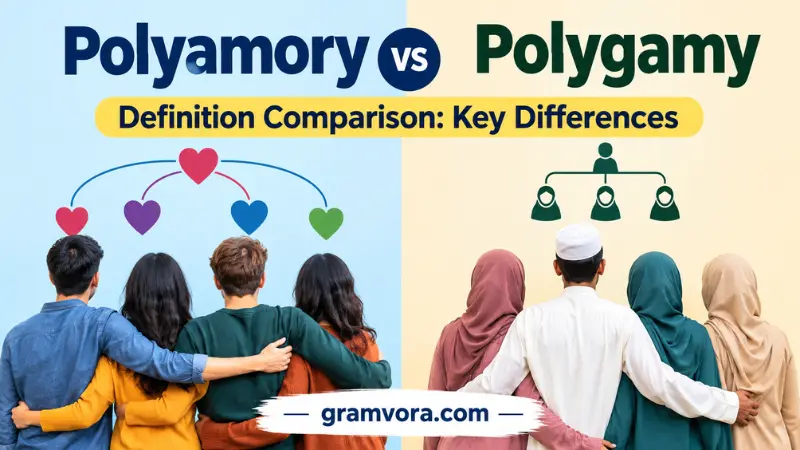
Polyamory and polygamy look and sound similar, but they do not mean the same thing.
Both words describe relationship arrangements involving more than two people. The key difference is what the word focuses on.
Polygamy specifically refers to having more than one spouse at the same time. Polyamory refers to having multiple romantic or sexual relationships at the same time, with the knowledge and consent of the people involved.
That means marriage is central to the meaning of polygamy, while marriage is not required for polyamory.
Quick Answer
Use polygamy when you are talking about having multiple spouses at the same time.
Use polyamory when you are talking about multiple romantic or sexual relationships in which the people involved know about and consent to the relationships.
For example:
- Polygamy: A person has more than one spouse.
- Polyamory: A person has multiple romantic relationships with everyone’s knowledge and consent.
Neither word is a general synonym for the other. Choosing between them depends on what kind of relationship you are describing.
Why People Confuse Them
The confusion is understandable because both words begin with poly-, a word element associated with “many.”
Both terms also relate to relationships involving more than two people. However, their second parts point toward different ideas.
Polygamy is centered on marriage or spouses.
Polyamory is centered on love, romance, or intimate relationships.
Another reason for confusion is that a person can be married and also practice polyamory. Being married does not automatically make a relationship polygamous.
For instance, someone may be married to one person while also having another romantic relationship with that person’s knowledge and consent. That situation can be described as polyamory, but it is not automatically polygamy because the person does not have multiple spouses.
Key Differences At A Glance
| Feature | Polyamory | Polygamy |
|---|---|---|
| Basic meaning | Multiple romantic or sexual relationships | Marriage to more than one spouse |
| Marriage required? | No | Yes, by definition |
| Consent | Knowledge and consent are central to the usual meaning | The word itself does not define every aspect of consent |
| Main focus | Multiple romantic or intimate relationships | Multiple spouses |
| Grammatical form | Noun | Noun |
| Common context | Modern relationship discussions | Marriage, cultural, religious, and legal discussions |
Compact comparison
- Polyamory = multiple romantic or sexual relationships.
- Polygamy = multiple spouses.
- Polyamory does not require multiple marriages.
- Polygamy specifically involves more than one spouse.
Meaning and Usage Difference
The clearest distinction is relationship versus marriage.
Polyamory
Polyamory is a noun referring to the practice of having sexual or romantic relationships with more than one person at the same time. In common modern usage, knowledge and consent among the people involved are an important part of the concept.
Example:
Maya practices polyamory and has two committed romantic relationships.
The sentence does not say that Maya has two spouses. She could be dating both people, or her relationships could have other arrangements.
Polygamy
Polygamy is a noun referring to the practice or condition of being married to more than one person at the same time.
Example:
The documentary examines the history of polygamy in different societies.
Here, the focus is on marriage involving multiple spouses.
Why the distinction matters
Calling every multi-partner relationship polygamy can create the wrong impression because the word specifically brings multiple spouses into the meaning.
Likewise, calling every form of plural marriage polyamory can remove the marriage-specific meaning that polygamy provides.
The safest approach is to identify what you are actually describing: multiple romantic relationships or multiple spouses.
Tone, Context, and Formality
Both polyamory and polygamy are standard nouns in English.
Neither is simply a slang word. Both can appear in serious writing, educational material, journalism, and everyday conversation.
Their contexts, however, often differ.
Polyamory is common in discussions about dating, relationships, communication, consensual non-monogamy, and contemporary relationship structures.
Polygamy is more directly connected with marriage and may appear in discussions about family structures, law, religion, history, anthropology, or cultural practices.
The surrounding context can therefore make one word more appropriate than the other.
For example:
- “She is interested in polyamory.”
- “The book discusses the history of polygamy.”
- “Their relationship is polyamorous.”
- “The law addresses polygamous marriages.”
The adjective forms polyamorous and polygamous are useful when the sentence describes a person, relationship, household, or arrangement.
Which One Should You Use?
Choose polyamory when your main point is multiple romantic or sexual relationships and the people involved know about and consent to those relationships.
Choose polygamy when your main point is having more than one spouse at the same time.
A simple test is to ask:
Are multiple spouses involved?
If yes, polygamy is the marriage-focused word.
Are multiple romantic or sexual relationships involved without the requirement of multiple spouses?
If yes, polyamory is usually the more precise word.
For example:
Jordan has a wife and another romantic partner, and everyone knows about the arrangement.
If Jordan has only one spouse, calling the arrangement polyamory may be appropriate. Calling it polygamy would suggest multiple spouses.
When One Choice Sounds Wrong
Some sentences sound inaccurate because they use the wrong term for the relationship being described.
Example 1
Less precise:
Alex has three girlfriends, so Alex is practicing polygamy.
Better:
Alex has three girlfriends, so Alex may be practicing polyamory.
The first sentence uses polygamy even though no multiple spouses are mentioned.
Example 2
Less precise:
The family practices polyamory because one person has several spouses.
Better:
The family practices polygamy because one person has several spouses.
Here, multiple spouses are the defining feature.
Example 3
Less precise:
Polyamory always means being married to several people.
Better:
Polyamory does not require marriage to several people.
Marriage is not the defining requirement of polyamory.
Example 4
Less precise:
Polygamy and polyamory are just different spellings for the same thing.
Better:
Polygamy and polyamory describe different relationship structures.
The words overlap in subject matter, but they are not interchangeable.
Common Mistakes (and Quick Fixes)
Mistake 1: Treating the words as synonyms
Wrong idea: Polyamory and polygamy mean exactly the same thing.
Quick fix: Remember multiple relationships for polyamory and multiple spouses for polygamy.
Mistake 2: Assuming polyamory requires marriage
Polyamory can involve dating or committed romantic relationships without multiple marriages.
Quick fix: Do not use marriage as a requirement for polyamory.
Mistake 3: Calling every multi-partner relationship polygamy
Having several romantic partners does not automatically mean someone has several spouses.
Quick fix: Check whether marriage to multiple spouses is actually part of the situation.
Mistake 4: Assuming polygamy automatically describes every detail of the relationship
The word polygamy tells you that multiple spouses are involved. It does not, by itself, provide every detail about how the relationships operate.
Quick fix: Use additional wording when details such as consent, relationship boundaries, or family structure matter.
Mistake 5: Confusing the adjective forms
The nouns are polyamory and polygamy.
The corresponding adjectives are commonly polyamorous and polygamous.
For example:
They practice polyamory.
They have a polyamorous relationship.
The book examines polygamy.
The documentary discusses a polygamous family structure.
Everyday Examples
Here are natural examples showing how the words work in US English.
Polyamory:
Taylor explained that polyamory allows them to maintain more than one romantic relationship with everyone’s knowledge.
Polyamory:
Their discussion about polyamory focused on communication and clear relationship boundaries.
Polyamorous:
She described her relationship as polyamorous.
Polygamy:
The history class discussed polygamy as a form of plural marriage.
Polygamy:
The article explains how polygamy has appeared in different cultural settings.
Polygamous:
The documentary follows a polygamous household.
Notice the difference in focus. The polyamory examples center on multiple romantic relationships. The polygamy examples center on multiple spouses or plural marriage.
Dictionary-Style Word Details
Verb
- Polyamory: Not commonly used as a verb in standard US English. You would normally say that someone practices polyamory or is polyamorous.
- Polygamy: Not commonly used as a verb in standard US English. Natural phrasing includes practice polygamy, have multiple spouses, or be polygamous.
Noun
- Polyamory: An uncountable noun describing the practice or relationship structure involving multiple romantic or sexual relationships.
- Polygamy: An uncountable noun describing the practice or condition of being married to more than one person at the same time.
Both are normally used as nouns rather than as names for individual people.
For example:
Polyamory can take different forms.
Polygamy is discussed in the documentary.
The related adjectives are polyamorous and polygamous.
Synonyms
- Polyamory: There is no single perfect synonym in every context. Consensual non-monogamy can be a close broader term in appropriate contexts, but it is not always an exact replacement.
- Polygamy: Plural marriage is a close plain alternative when the context specifically concerns marriage to multiple spouses.
The two terms should not be listed as exact synonyms for one another.
Example Sentences
- Polyamory: “They talked openly about practicing polyamory.”
- Polyamory: “Her polyamorous relationship includes more than one committed romantic connection.”
- Polygamy: “The book examines polygamy in several societies.”
- Polygamy: “Polygamy refers specifically to having more than one spouse at the same time.”
- Polyamory: “Marriage is not required for polyamory.”
- Polygamy: “Multiple spouses are central to the meaning of polygamy.”
Word History
Both words contain the element poly-, associated with the idea of “many,” which helps explain why they look similar.
The second parts point in different directions. Polygamy is connected with the idea of marriage, while polyamory is built around the idea of love or romantic relationships.
Because detailed accounts of the modern history of polyamory differ, it is safer not to attach a single specific coinage date to the word without additional historical evidence.
For a modern English reader, the most useful distinction is the meaning of the words today: polyamory focuses on multiple romantic or sexual relationships, while polygamy focuses on multiple spouses.
Phrases Containing
Common phrases with polyamory include:
- polyamorous relationship
- polyamorous partner
- practice polyamory
- polyamory community
- polyamory and communication
Common phrases with polygamy include:
- practice polygamy
- polygamous marriage
- polygamous relationship
- polygamous family
- history of polygamy
The adjective forms are especially useful when you need to describe a person, relationship, marriage, or family structure.
FAQs
What is the difference between polyamory and polygamy?
Polyamory means having multiple romantic or sexual relationships with the knowledge and consent of the people involved. Polygamy specifically refers to being married to more than one person at the same time.
Is polyamory the same as polygamy?
No. The terms are related but not interchangeable. Polyamory focuses on multiple romantic or intimate relationships, while polygamy focuses on having multiple spouses.
Does polyamory involve marriage?
Not necessarily. A polyamorous relationship does not require marriage. People can practice polyamory while dating or having committed romantic relationships without having multiple spouses.
Does polygamy mean having multiple partners?
Polygamy specifically involves multiple spouses. Simply having more than one dating or romantic partner does not automatically mean a person is practicing polygamy.
Can someone be polyamorous without being polygamous?
Yes. A person can have multiple consensual romantic relationships without being married to more than one person. In that situation, polyamory is the more precise term.
Can someone be both polyamorous and polygamous?
Yes, the concepts can overlap. A person in a polygamous marriage could also describe their relationships as polyamorous if multiple romantic relationships and consensual involvement are part of the arrangement.
Is polygamy a type of polyamory?
Not necessarily. The terms describe different concepts. Polygamy is defined around multiple spouses, while polyamory is defined around multiple romantic or sexual relationships with the knowledge and consent of those involved.
What is the correct word for multiple romantic relationships?
Polyamory is generally the appropriate term when multiple romantic or sexual relationships are openly maintained with the knowledge and consent of the people involved.
What is the correct word for marriage to multiple people?
Polygamy is the marriage-focused term. It describes having more than one spouse at the same time.
Is polyamory or polygamy more common in everyday US English?
The words are used in different contexts, so frequency alone does not determine which one is correct. Use polyamory for multiple romantic relationships and polygamy when multiple spouses are involved.
Conclusion
The difference between polyamory vs polygamy becomes much easier once you focus on the central idea of each word.
Polyamory describes multiple romantic or sexual relationships, with knowledge and consent among the people involved.
Polygamy describes marriage to more than one spouse at the same time.
A person can therefore be polyamorous without having multiple spouses. Multiple spouses, however, are central to the meaning of polygamy.
When choosing between the two, ask whether the sentence is about multiple romantic relationships or multiple spouses. That simple distinction will usually point you to the more precise word.


