
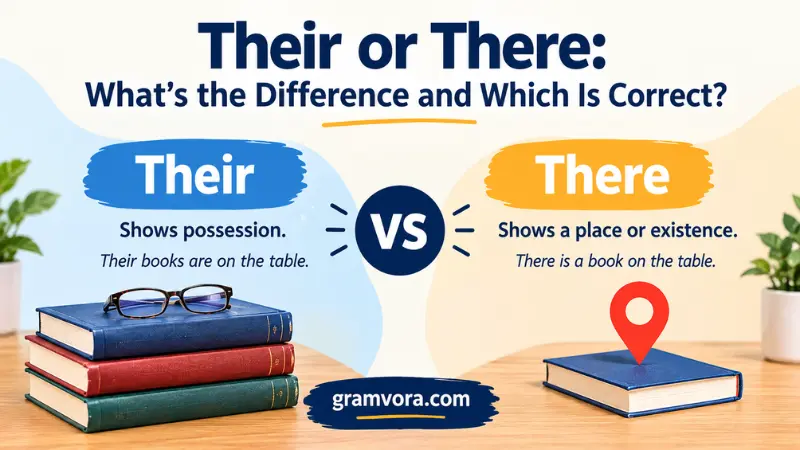
Their and there are both correct English words, but they do different jobs.
Use their when you are showing possession or a connection to people represented by they. For example, “The students brought their books.”
Use there when you are talking about a place or introducing the existence of something. For example, “The books are over there” or “There are five books on the desk.”
The two words are easy to confuse because they sound alike in ordinary speech. Their spelling, meaning, and grammatical function, however, are different.
The key is to focus on what the sentence means rather than how the word sounds.
Quick Answer
The simplest distinction is:
- Their = belonging to them or associated with them.
- There = a place, position, or a way of introducing something that exists.
Compare these sentences:
Their car is parked outside.
The car is over there.
The first sentence tells us who the car belongs to. The second tells us where the car is.
Both words can appear in the same sentence:
Their bags are over there.
Here, their shows possession, while there identifies a location.
A useful question can help:
Does the word show possession? Choose their.
Does the word point to a place or introduce something that exists? Choose there.
Why People Confuse Them
The main reason for the confusion is pronunciation. Their and there are pronounced the same in standard US English, even though they have different spellings and meanings.
When people hear a sentence, the sound does not tell them which spelling to write. The writer has to determine the grammatical role from the sentence.
For example:
The children left their jackets there.
When spoken aloud, both target words sound alike. In writing, however, the first word needs to show possession, while the second identifies a location.
Another source of confusion is the word they’re, which sounds the same as both words. They’re means they are.
For example:
They’re waiting over there with their friends.
Although this article focuses on their and there, remembering this third form can prevent many mistakes.
Key Differences At A Glance
| Feature | Their | There |
|---|---|---|
| Main function | Shows possession or association | Indicates place or introduces existence |
| Common position | Before a noun | Often after a verb or in expressions such as “there is” |
| Example | Their apartment is downtown. | Their apartment is over there. |
| Basic question | Whose? | Where? / What exists? |
| Apostrophe | No | No |
The difference becomes especially clear when you compare the questions whose? and where?
Whose phone is ringing?
Their phone is ringing.
Where is the phone?
It is over there.
This simple contrast works well for many everyday sentences.
Meaning and Usage Difference
What Does “Their” Mean?
Their is a possessive determiner. It shows that something belongs to, is connected with, or is associated with the people or entities referred to by they.
For example:
The employees finished their reports.
The reports are associated with the employees.
The dogs chased their toys.
The toys are associated with the dogs.
The neighbors parked their cars outside.
The cars belong to or are associated with the neighbors.
Their normally appears before a noun:
their house
their idea
their children
their office
their decision
It can also refer to one person when the person’s gender is unknown, unspecified, or when singular they is appropriate.
Someone left their phone on the table.
Here, their refers to one unspecified person.
What Does “There” Mean?
There commonly refers to a place or location.
Put the boxes there.
We went there after lunch.
Your keys are right there.
In these sentences, there answers a location question.
However, there also has another important function. It can introduce a statement about the existence or presence of something.
There is a problem with the printer.
There are two seats available.
There was a long line outside.
In these examples, there is not simply pointing to a physical place. It helps introduce the information that something exists or is present.
That distinction matters because reducing there to “place” alone does not cover all of its standard uses.
Tone, Context, and Formality
There is no major difference in formality between their and there. Both are ordinary standard English words used in conversation, schoolwork, business writing, journalism, and formal writing.
The important issue is correctness within the sentence.
For example:
The company updated their policy.
Here, their expresses association with the company.
The company office is over there.
Here, there identifies a location.
In modern US English, their can also be used with a singular person when appropriate:
If anyone calls, tell them their package has arrived.
This construction is widely accepted in contemporary English. The exact choice of pronoun should still match the context and the person being referred to.
Which One Should You Use?
Choose their when you can reasonably ask “whose?”
The students opened their books.
Whose books? The students’ books.
The team celebrated their victory.
Whose victory? The team’s victory.
Choose there when you mean a place, position, or existence.
Leave the package there.
Where should you leave it? There.
There is a package at the door.
What exists or is present? A package.
A useful pair of substitutions can also help.
For their, try replacing it mentally with our or your.
Their house is large.
Our house is large.
If that relationship makes sense, their may be the correct choice.
For there, try here when you are talking about location.
Put the bag there.
Put the bag here.
If the location idea works, there is likely correct.
When One Choice Sounds Wrong
Some mistakes become obvious when you examine the meaning.
Incorrect: “There car is outside.”
If you mean a car belonging to them, there is wrong.
Correct:
Their car is outside.
Incorrect: “Put the chairs over their.”
If you mean a location, use there.
Correct:
Put the chairs over there.
Incorrect: “I left my keys their.”
The sentence needs a location.
Correct:
I left my keys there.
Incorrect: “Their are three students waiting.”
The sentence introduces the existence or presence of three students.
Correct:
There are three students waiting.
The spelling mistake may look small, but it changes the grammatical function of the sentence.
Common Mistakes (and Quick Fixes)
Mistake 1: Using “there” for possession
Wrong: The students forgot there homework.
Correct: The students forgot their homework.
Ask whose homework? The answer is the students’ homework, so use their.
Mistake 2: Using “their” for a location
Wrong: Your shoes are over their.
Correct: Your shoes are over there.
Ask where? The answer is “over there,” so use there.
Mistake 3: Confusing “their” with “they’re”
Wrong: Their going to the store.
Correct: They’re going to the store.
Here, the meaning is they are going, so they’re is required.
Mistake 4: Writing “there” in “there is” incorrectly
Wrong: Their is a problem with the computer.
Correct: There is a problem with the computer.
The phrase introduces the existence of a problem, so the correct form is there.
Mistake 5: Assuming “their” must always refer to multiple people
Modern English also uses singular their in appropriate contexts.
Someone left their wallet.
Here, their refers to one person whose identity is unspecified.
Everyday Examples
Here are some natural US-English examples:
Their house is near the school.
The house is over there.
The students brought their laptops to class.
There are several laptops on the table.
Their team won the game.
The coach is standing over there.
The customers left their bags at the counter.
There is a bag near the entrance.
The neighbors said their driveway was blocked.
We can park over there.
One sentence can use both words naturally:
Their children are playing over there.
Their tells us whose children they are. There tells us where the children are.
Another example:
I think their office is over there.
Again, their identifies the office’s association, while there identifies its location.
Dictionary-Style Word Details
Verb
- Their: Not commonly used as a verb in standard US English.
- There: Not normally used as a verb. It can perform several grammatical functions, including functioning as an adverb of place and introducing an existential construction.
Neither word should be treated as a regular action verb.
Noun
- Their: Not normally used as a noun. It is a possessive determiner associated with they.
- There: It is primarily used as an adverb and can have other grammatical functions depending on context. It is not normally used as a noun in ordinary modern US English.
For example:
Their plan worked.
Here, their modifies plan.
The restaurant is there.
Here, there identifies the location.
Synonyms
- Their: There is no single exact synonym in every sentence. Depending on context, closest plain alternatives may include possessive forms such as our, your, or his/her, but these cannot always replace their without changing the meaning or reference.
- There: Depending on context, possible plain alternatives include in that place, at that location, or where indicated. These are context-dependent rather than exact replacements.
Neither word has a single synonym that can replace it in every grammatical situation.
Example Sentences
Their:
The students submitted their assignments.
The players thanked their coach.
Someone forgot their umbrella.
There:
Your package is waiting there.
We stayed there for an hour.
There is a new restaurant downtown.
There are several options available.
The examples show why the words cannot normally be substituted for each other.
Word History
The two words have different historical backgrounds, but their modern distinction is more useful to most readers than detailed historical information.
There developed as a location-related word in English.
Their developed as the possessive form associated with they.
Their similar pronunciation is one reason modern readers and writers can confuse them, but the words have different meanings and grammatical functions.
Phrases Containing
Their:
- their house
- their car
- their family
- their idea
- their own
- their responsibility
- their choice
These expressions use their to show possession or association.
There:
- over there
- right there
- go there
- stay there
- there is
- there are
- there was
- there were
These expressions commonly involve location or the introduction of something that exists or is present.
FAQs
What is the difference between their and there?
Their shows possession or association with people or things referred to by “they.” There usually refers to a place or location, or it introduces something that exists. For example, “Their car is outside” shows possession, while “The car is over there” shows location.
Is it “their” or “there” house?
The correct choice is their when you mean a house belonging to or associated with them.
Example: Their house is near the park.
Is it “over their” or “over there”?
The correct phrase is “over there.” Here, there refers to a particular place or location.
Example: Your jacket is over there.
Is “there” used for possession?
No. There does not normally show possession. Use their when you want to show that something belongs to or is associated with them.
Example: Their dog is in the yard.
Can “their” refer to one person?
Yes. Their can refer to one person when singular “they” is used, such as when the person’s gender is unknown or unspecified.
Example: Someone left their phone on the table.
How do you remember the difference between their and there?
A simple memory trick is to connect their with ownership and there with location. Ask yourself, “Whose?” for their and “Where?” for there.
Example: Their keys are there.
Here, their answers “whose?” and there answers “where?”
Is it “their are” or “there are”?
The correct phrase is “there are.” It introduces the existence or presence of multiple things or people.
Example: There are three students in the classroom.
Is it “their is” or “there is”?
The correct phrase is “there is.”
Example: There is a problem with the computer.
Use their when showing possession, as in “Their computer is new.”
Are their and there pronounced the same?
Yes. In standard US English, their and there are generally pronounced the same. Because they sound alike, writers must use the meaning and grammatical role of the sentence to choose the correct spelling.
Which is correct: “their” or “there”?
Both are correct words, but the right choice depends on the sentence. Use their for possession or association and there for location or to introduce something that exists.
Examples:
- Their bags are on the table.
- The bags are over there.
- There are two bags on the table.
Conclusion
Their and there are both correct, but they cannot normally replace each other.
Use their for possession or association:
The students brought their books.
Use there for a place, position, or an expression of existence:
The books are over there.
There are five books on the desk.
The quickest way to choose is to ask what the sentence means. If you are identifying whose something is, choose their. If you are identifying where something is or introducing something that exists, choose there.
Once you focus on the grammatical job rather than the sound, the distinction becomes much easier to recognize.


