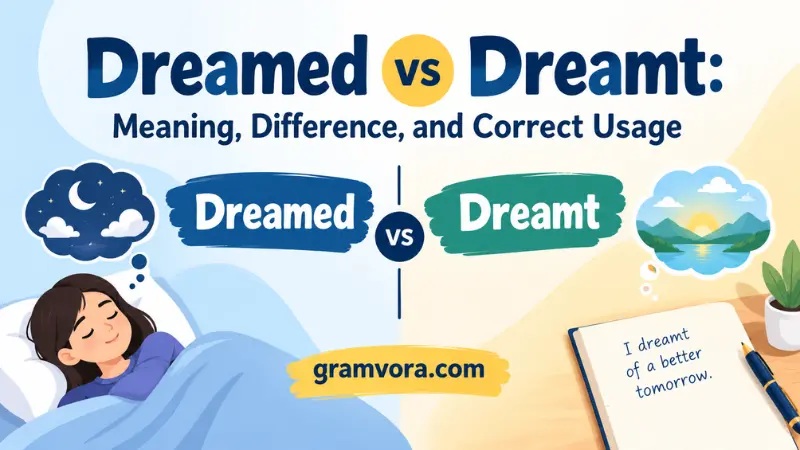
If you are unsure whether to write dreamed or dreamt, you are dealing with two accepted past forms of the verb dream.
Both forms can describe something you experienced while sleeping or something you strongly hoped for. The main difference is usage preference, not meaning.
For American English, dreamed is the safest and most natural choice. Dreamt is also a real English form, but it is less common in US usage and is more strongly associated with British English.
Quick Answer
Both dreamed and dreamt are correct.
Use dreamed when writing for a general American audience. It is the regular past form and the usual choice in US English.
Use dreamt if that form fits your established style or the variety of English you are using. It has the same basic grammatical function as dreamed.
For example:
- I dreamed about my old school last night.
- I dreamt about my old school last night.
Both sentences are grammatically correct. The first sounds more natural as a default choice for American English.
Why People Confuse Them
The confusion comes from the fact that dream has two past forms.
Many English verbs use one regular past form ending in -ed. For example, a writer adds -ed to a verb to form its past tense.
Dreamed follows that regular pattern.
Dreamt uses a shorter irregular form. Because readers may see both forms in books, websites, movies, or conversations, it can be difficult to know whether one is wrong.
The answer is no. Neither form is automatically wrong.
Another source of confusion is regional English. British English commonly uses dreamt, while American English generally favors dreamed. However, the forms are not completely restricted to one country.
Key Differences At A Glance
| Context | Best Choice | Why |
|---|---|---|
| General American English | Dreamed | It is the usual US choice. |
| British English | Dreamed or dreamt | Both are accepted. |
| Casual American writing | Dreamed | It sounds natural and familiar. |
| Formal American writing | Dreamed | It is the clearest default for US readers. |
| Writing that follows British usage | Dreamt or dreamed | Either form can work. |
| Past tense | Dreamed or dreamt | Both are past forms of dream. |
| Past participle | Dreamed or dreamt | Both can follow forms of have. |
Quick comparison
- Dreamed: regular -ed form; preferred in American English.
- Dreamt: irregular -t form; accepted in English and especially familiar in British usage.
Meaning and Usage Difference
There is no major difference in meaning between dreamed and dreamt.
Both can describe mental experiences during sleep:
I dreamed about flying over the ocean.
I dreamt about flying over the ocean.
Both can also describe hopes, wishes, or ambitions:
She dreamed of opening her own bakery.
She dreamt of opening her own bakery.
The important difference is the form of the verb. Dreamed and dreamt are two past forms of the same verb.
They can also be used with perfect constructions:
I have dreamed of visiting Alaska for years.
I have dreamt of visiting Alaska for years.
The meaning remains essentially the same.
Tone, Context, and Formality
The choice between the two forms usually does not create a major difference in tone.
Dreamed is the better default for American readers because it follows the regular -ed pattern and is widely familiar in US English.
Dreamt can sound less common to an American reader. Depending on the sentence and the reader, it may feel more associated with British English or a literary style. That does not make it incorrect.
Do not assume that dreamt has a special meaning for hopes while dreamed refers only to sleep. Both forms can be used for both meanings.
For example:
I dreamed that I was back in high school.
and:
I dreamed of becoming a doctor.
The first describes sleep, while the second describes an ambition. The difference comes from the meaning of the verb in context, not from the spelling of its past form.
Which One Should You Use?
If your audience is primarily American, choose dreamed.
It is especially useful when you want a simple, familiar form in school assignments, workplace writing, websites, emails, and everyday communication.
For example:
I dreamed about the trip last night.
She dreamed of starting a business.
We never dreamed that the project would succeed so quickly.
If you are writing in British English, dreamt is a perfectly reasonable choice.
The key point is consistency. If you normally follow American English, dreamed is the easiest default.
When One Choice Sounds Wrong
Neither form is grammatically wrong simply because you chose it instead of the other.
However, dreamt may sound unusual to some American readers because dreamed is more familiar in US English.
Consider this sentence:
I dreamt about the new apartment last night.
There is nothing grammatically wrong with it. An American reader can understand it easily. Still, I dreamed about the new apartment last night is the more natural default for a broad US audience.
The same principle applies to perfect forms:
I have dreamt about this moment for years.
This is valid. For standard American usage, many writers would naturally choose:
I have dreamed about this moment for years.
The issue is preference and audience, not a difference in meaning.
Common Mistakes (and Quick Fixes)
Mistake 1: Treating “dreamt” as completely wrong
Incorrect idea: “Dreamt” is never correct.
Fix: Both dreamed and dreamt are established past forms of dream.
Mistake 2: Assuming they have different meanings
Some writers think one form refers to sleep and the other refers to hopes.
Fix: Both forms can be used for either meaning.
Mistake 3: Using “dream” for a completed past event
Yesterday, I dream about my childhood.
Better:
Yesterday, I dreamed about my childhood.
You could also write:
Yesterday, I dreamt about my childhood.
Mistake 4: Thinking American English requires “dreamed” in every situation
American English strongly favors dreamed, but that does not make every occurrence of dreamt grammatically invalid.
Mistake 5: Switching forms without a reason
I dreamed about college, and later I dreamt about my old job.
This is not automatically grammatically wrong, but unnecessary switching can make your writing less consistent.
For a simple American English style, you can write:
I dreamed about college, and later I dreamed about my old job.
Everyday Examples
Here are natural examples showing how both forms work:
Talking about sleep
I dreamed about my childhood home last night.
She dreamt that she was walking through a forest.
Talking about hopes
He dreamed of becoming a professional musician.
She dreamt of opening a small restaurant.
Using a perfect construction
I have dreamed about this opportunity for years.
They had dreamt of moving closer to the coast.
With “that”
I dreamed that I won the competition.
He dreamt that he was late for work.
With “about”
We dreamed about our vacation all week.
She dreamt about the trip again.
With “of”
I dreamed of owning a house.
He dreamt of playing in the major leagues.
In each pair, changing dreamed to dreamt does not create a new meaning.
Dictionary-Style Word Details
Verb
- Dreamed: the regular past tense and past participle of dream. It is the preferred form in American English.
- Dreamt: an irregular past tense and past participle of dream. It is accepted in English and is especially familiar in British English.
Both forms can describe dreaming during sleep or strongly imagining or hoping for something.
Noun
Neither dreamed nor dreamt is a noun.
The noun is dream.
A dream can mean an experience during sleep:
I had a strange dream last night.
It can also mean a strong hope or ambition:
Her dream is to become a teacher.
Synonyms
Because dreamed and dreamt are forms of the same verb, they do not have separate synonym sets.
For the sleep-related sense, closest plain alternatives can include:
- imagined
- experienced in sleep
- saw in a dream
For the hope-related sense, closest plain alternatives can include:
- hoped
- wished
- imagined
- aspired to
These alternatives do not always fit every sentence, so they should not automatically replace dreamed or dreamt.
Example Sentences
Dreamed
I dreamed about my old neighborhood last night.
She dreamed of becoming a doctor.
We never dreamed that the plan would work.
Dreamt
I dreamt about my old neighborhood last night.
She dreamt of becoming a doctor.
We never dreamt that the plan would work.
The meaning remains the same in these pairs.
Word History
Dreamed and dreamt developed as different past forms of the verb dream. Modern dictionaries recognize both forms.
The important point for modern writers is not choosing one based on a different meaning. Instead, the choice mainly reflects grammatical form and regional usage.
American English generally favors dreamed, while British English allows both dreamed and dreamt.
Phrases Containing
Both forms can occur in common structures involving dream.
- dreamed/dreamt about something — experienced something in a dream or thought about something wished for
- dreamed/dreamt of something — strongly hoped for or imagined something
- dreamed/dreamt that… — described something experienced or imagined
- have dreamed/have dreamt of… — used with the perfect construction
- had dreamed/had dreamt of… — used with the past perfect
- dreamed/dreamt up something — invented or imagined an idea
For American English, dreamed is generally the easiest form to use throughout these structures.
FAQs
Is “dreamed” or “dreamt” correct?
Both dreamed and dreamt are correct past forms of the verb dream. However, dreamed is generally the better default choice for American English.
Is “dreamt” grammatically correct?
Yes. Dreamt is a grammatically correct past tense and past participle of dream. It is especially common in British English, although it can also be used in American English.
Do “dreamed” and “dreamt” mean the same thing?
Yes. They generally have the same meaning. Both can describe an experience during sleep or a strong hope or ambition.
Which is more common in American English, “dreamed” or “dreamt”?
Dreamed is generally more common in American English. If you are writing for a broad US audience, dreamed is the safest and most natural choice.
Can I use “dreamt” in American English?
Yes. Dreamt is not incorrect in American English. It may simply sound less familiar or more British to some US readers.
What is the past tense of “dream”?
Both dreamed and dreamt can be used as the past tense of dream. For example, “I dreamed about my vacation” and “I dreamt about my vacation” are both correct.
What is the past participle of “dream”?
Both dreamed and dreamt can function as the past participle. For example, “I have dreamed about this opportunity” and “I have dreamt about this opportunity” are both grammatically acceptable.
Is “I dreamed about you” correct?
Yes. “I dreamed about you” is grammatically correct and natural American English. You could also say “I dreamt about you,” but “dreamed” is the more common US choice.
Is “dreamed” better than “dreamt” for formal writing?
For American English, dreamed is usually the safer choice for formal writing because it is the familiar standard form for US readers. However, dreamt is not grammatically wrong.
Should I use “dreamed” or “dreamt” in American English?
Use dreamed as your default choice in American English. Choose dreamt when you intentionally follow a style or variety of English where that form is preferred.
Conclusion
Dreamed vs dreamt is not a case of one word being correct and the other being wrong. Both are accepted past forms of dream, and both can be used for sleeping experiences, hopes, and imagined possibilities.
For American English, dreamed is the best default. It is familiar, natural, and widely used in everyday and formal writing.
Dreamt is also valid, but it is less common in US usage and is more strongly associated with British English.
So, if you are writing for a general American audience and you are unsure which form to choose, use dreamed.