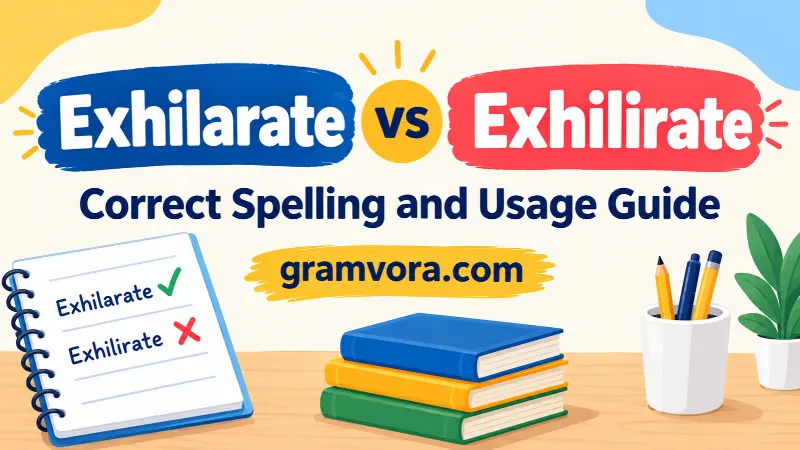
English spelling can be confusing, especially when a word contains several vowels and a letter that does not sound the way learners expect. One example is the confusion between exhilarate and exhilirate. Both forms may look believable at first glance, but they do not have the same status in standard American English.
The correct spelling is exhilarate. It is a verb that means to make someone feel very happy, excited, energized, or full of enthusiasm. An exciting concert, a successful achievement, or a thrilling outdoor adventure can exhilarate someone.
By contrast, exhilirate is not the standard spelling used in modern American English. The extra “i” in the middle is a common type of spelling error. Writers who use this form in school assignments, professional emails, articles, or other formal writing should correct it to exhilarate.
Understanding the difference does not require memorizing a long list of grammar rules. You need to remember the correct sequence of letters, understand how the word works in a sentence, and practice using its related forms.
This guide explains the correct spelling, pronunciation, meaning, word history, common mistakes, and practical examples. It also provides simple techniques to help you remember the correct form whenever you write.
Quick Answer
Exhilarate is the correct spelling in standard American English. Exhilirate is a misspelling and should generally be avoided in formal and edited writing.
Use exhilarate when describing something that makes a person feel extremely happy, excited, or energized.
Examples:
- The final minutes of the game exhilarated the crowd.
- Winning her first scholarship helped exhilarate her.
- The breathtaking mountain views were exhilarating.
- He felt exhilarated after completing his first marathon.
The key spelling detail is the letter “a” after “l” in exhilarate. Do not replace that “a” with an “i.”
Remember this sequence:
E-X-H-I-L-A-R-A-T-E
The word contains an “a” after the “l” and another “a” before the final “t” sound and “e” ending. Paying attention to these vowels can help prevent the most common spelling mistake.
Why People Confuse Them
Several features make exhilarate difficult to spell correctly.
First, the word contains multiple vowels in a relatively short space. When writers remember a word mainly by how it sounds, they may struggle to recall its exact letter sequence. The unstressed vowel in the middle can be especially easy to overlook.
Second, the pronunciation does not clearly announce every letter. In American English, exhilarate is commonly pronounced approximately as “ig-ZIL-uh-rayt.” The middle vowel sounds like a relaxed “uh,” which may not immediately remind a learner to write the letter “a.”
Third, English spelling does not always follow a simple sound-to-letter pattern. A person may understand a word perfectly when hearing it but still make a mistake when writing it. This happens with many words, particularly those that have several syllables or unfamiliar historical roots.
Another reason for the confusion is visual memory. After seeing a misspelled form several times, a writer may begin to recognize it as familiar. Familiarity, however, does not establish that a spelling is correct.
For example, someone might type exhilirating while writing a social media post. Because the sentence still communicates excitement, the error may go unnoticed. However, the correct spelling is exhilarating.
The most useful solution is to connect the word’s spelling with its meaning and related forms. Remember that exhilarate, exhilarated, exhilarating, and exhilaration share the same central spelling pattern.
Key Differences At A Glance
The main distinction is spelling accuracy, not meaning. The two forms should not be treated as equally acceptable alternatives in contemporary standard American English.
| Context | Best Choice | Why |
|---|---|---|
| School assignments | Exhilarate | It is the standard spelling. |
| Professional emails | Exhilarate | It presents a polished, accurate text. |
| Articles and essays | Exhilarate | It follows standard written English. |
| Describing an exciting experience | Exhilarate | It expresses the intended meaning. |
| Proofreading a sentence containing “exhilirate” | Exhilarate | The nonstandard form should be corrected. |
Here is a quick comparison of their spelling and usage.
| Feature | Exhilarate | Exhilirate |
|---|---|---|
| Standard American spelling | Yes | No |
| Standard dictionary headword | Yes | Not as the standard modern spelling |
| Meaning in intended usage | To make someone happy and excited | Intended meaning is usually understood from context |
| Recommended in formal writing | Yes | No |
The practical rule is straightforward: write exhilarate whenever you want to use this verb in standard English.
Are They the Same Word?
The two forms are intended to represent the same word in most everyday writing situations, but only exhilarate is the standard modern spelling recommended for general use.
The verb exhilarate means to cause someone to experience strong happiness, excitement, or renewed energy. It can describe a physical activity, a memorable event, an achievement, or even encouraging news.
For instance:
“The announcement of her promotion exhilarated her.”
This sentence means the news made her feel very happy and excited.
Now consider:
“The announcement of her promotion exhilirated her.”
The intended message remains understandable, but the spelling is incorrect in standard contemporary American English. The reader can usually infer the intended word without difficulty.
It is important not to confuse spelling accuracy with meaning. The nonstandard form does not establish a separate, accepted meaning. Instead, it usually represents an attempt to write exhilarate.
Pronunciation
The standard pronunciation is approximately “ig-ZIL-uh-rayt,” with the strongest emphasis on the second syllable. The International Phonetic Alphabet represents the common American pronunciation as /ɪɡˈzɪləˌreɪt/.
The spelling confusion is understandable because the middle vowel is not strongly emphasized. However, pronunciation does not change the standard written form.
Learning to recognize the word when spoken can help you understand it, while remembering its written form helps you spell it accurately.
Related Forms
Several related words use the same spelling pattern:
- Exhilarated: Feeling very happy, excited, or energized.
- Exhilarating: Causing strong excitement or happiness.
- Exhilaration: The feeling of excitement or happiness.
- Exhilaratingly: In a way that produces excitement or pleasure, although this adverb is less common.
Examples:
- We were exhilarated by the unexpected victory.
- The roller coaster ride was exhilarating.
- She could barely hide her exhilaration.
- The team celebrated its exhilarating comeback.
Notice that the “a” after “l” remains in each of these related forms. Learning the family together reinforces the correct spelling.
US vs UK Preference
There is no established American-versus-British spelling split between exhilarate and exhilirate.
Standard English dictionaries use exhilarate in both American and British English. The word’s core meaning and central spelling remain the same across these varieties.
For American readers, exhilarate is the appropriate choice in schoolwork, business writing, published articles, and everyday communication. British writers can use the same spelling.
This differs from genuine regional spelling variations, where two forms may both be accepted but one is preferred in a particular country. In this case, the difference is not a recognized regional convention.
Writers should also avoid assuming that a frequently repeated spelling online is automatically correct. Informal posts, comments, and unedited pages can contain errors. A standard dictionary is a better guide when you need to confirm a word’s accepted spelling.
For consistency, use exhilarate and its correctly spelled related forms throughout your writing, regardless of whether your audience is in the United States or the United Kingdom.
Which Spelling Should You Use?
Choose exhilarate every time you need the standard verb.
The word is particularly useful when you want to describe a strong feeling of happiness or excitement. It can make a sentence more precise than a general word such as please or interest when the situation involves a more powerful emotional response.
Consider these examples:
- “The unexpected concert announcement exhilarated the fans.”
- “A weekend in the mountains always exhilarates my family.”
- “Her first successful performance exhilarated her.”
- “The possibility of traveling abroad exhilarated the students.”
In each sentence, the verb describes something that creates excitement or lifts someone’s spirits.
Use exhilarate in formal writing as well as ordinary conversation. Although the word may sound more formal than excite or thrill, it is a natural choice when you want to emphasize a strong, positive emotional response.
You can also choose a related form when the sentence requires a different grammatical structure.
For example, use exhilarated to describe a person’s feeling: “I was exhilarated after the race.”
Use exhilarating to describe the experience that causes the feeling: “The race was exhilarating.”
Use exhilaration when the feeling itself is the subject: “Her exhilaration was obvious.”
These forms are related, but they are not interchangeable in every sentence. Choose the form that fits the grammar of your sentence, and maintain the correct spelling throughout.
When One Spelling Looks Wrong
The spelling exhilirate may look reasonable because its letters are close to those of the correct word. Nevertheless, it is not the standard form you should use in edited English.
One helpful test is to look at the letters immediately after “l.” In exhilarate, the sequence is “lar,” not “lir.” That small difference is the central issue.
Another useful check is to compare the verb with its related forms. If you write exhilirated, exhilirating, or exhiliration, the same spelling error appears in each word. Correcting the base form helps you avoid repeating the mistake across the entire word family.
A spell-checking feature may flag the incorrect form, but writers should still review the sentence and select the intended word. Automatic correction can be helpful, yet careful proofreading remains important.
For example:
Incorrect: “The breathtaking view exhilirated us.”
Correct: “The breathtaking view exhilarated us.”
Incorrect: “It was an exhilirating experience.”
Correct: “It was an exhilarating experience.”
Incorrect: “She felt a rush of exhiliration.”
Correct: “She felt a rush of exhilaration.”
These corrections preserve the original meaning while restoring the standard spelling.
Common Mistakes (and Quick Fixes)
Spelling errors often become easier to correct once you know exactly where they occur. Here are some practical ways to improve accuracy.
1. Replacing “a” with “i”
The most direct error is writing exhilirate instead of exhilarate.
Quick fix: Memorize the sequence “ex-hil-a-rate.” Pay particular attention to the “a” after “l.”
2. Misspelling related forms
Writers sometimes learn the base word but make the same error when adding endings.
Incorrect: “The students were exhilirated.”
Correct: “The students were exhilarated.”
Quick fix: Practice the complete word family together rather than memorizing only the base verb.
3. Confusing the verb and adjective
The word exhilarate describes the action of causing excitement. The adjective exhilarating describes something that causes that excitement, while exhilarated describes the person experiencing it.
Incorrect: “The concert was exhilarated.”
Correct: “The concert was exhilarating.”
Quick fix: Ask whether the sentence describes the experience or the person’s feelings.
4. Relying only on sound
Hearing the word correctly does not guarantee that you will remember its written form.
Quick fix: Read the word, spell it aloud, and write it from memory. Repeat the exercise with exhilarated and exhilarating.
5. Ignoring proofreading
A small spelling error can remain unnoticed when you focus only on the overall meaning of a sentence.
Quick fix: Review unfamiliar or long words separately before submitting an assignment or publishing an article.
These simple habits can reduce repeated errors without requiring extensive grammar study.
Everyday Examples
The following examples show how to use exhilarate and its related forms naturally in American English.
School and Education
- The students were exhilarated when their science project won first place.
- Learning that she had been accepted into her preferred college exhilarated Maya.
- The exciting classroom experiment exhilarated the young learners.
Sports and Fitness
- Scoring the winning goal exhilarated the entire team.
- The runners felt exhilarated after finishing their first half-marathon.
- Reaching the summit exhilarated the hikers.
Travel and Outdoor Activities
- Driving along the scenic coastal highway exhilarated us.
- The opportunity to explore a national park exhilarated the children.
- Snowboarding down the mountain was an exhilarating experience.
Work and Personal Achievements
- Receiving a promotion exhilarated Daniel.
- The successful product launch exhilarated the company team.
- Completing her first major project left her feeling exhilarated.
Entertainment and Social Life
- The surprise birthday party exhilarated the guest of honor.
- The live band’s performance exhilarated the audience.
- Hearing her favorite singer perform in person was exhilarating.
Everyday Conversation
- “That roller coaster ride exhilarated me!”
- “I felt exhilarated when I saw my exam results.”
- “The trip was exhausting, but the experience was exhilarating.”
These examples demonstrate how the word can describe positive emotional responses in many different situations.
Dictionary-Style Word Details
Verb
Exhilarate: A transitive verb meaning to make someone feel very happy, excited, lively, or energized.
Examples:
- The good news exhilarated her.
- The mountain air exhilarated the hikers.
- The unexpected win exhilarated the fans.
Exhilirate: A nonstandard spelling of the intended verb. Use exhilarate in standard American English.
The verb’s common forms include exhilarates, exhilarated, and exhilarating. Its spelling should remain consistent when these endings are added.
Noun
Exhilarate: This word functions primarily as a verb, not as a noun. The related noun exhilaration describes the feeling of intense happiness, excitement, or renewed energy.
Example: “The exhilaration of winning the championship stayed with her for days.”
Exhilirate: This is not the standard spelling of a noun. Writers who intend to refer to the feeling should use exhilaration.
Another related noun is exhilarator, which can refer to something or someone that exhilarates, although it is less common in everyday writing.
Synonyms
Exhilarate: Suitable synonyms depend on the context. Useful alternatives include thrill, excite, elated, energize, invigorate, and delight, although their grammatical forms and exact meanings differ.
For example:
- “The news exhilarated her.”
- “The news thrilled her.”
- “The news delighted her.”
These sentences are similar, but the words do not always carry identical shades of meaning. Invigorate often emphasizes renewed energy, while delight emphasizes pleasure.
Exhilirate: Since this is a nonstandard spelling of the same intended verb, it does not have a separate set of synonyms.
There is no need to create a different synonym list for a misspelled form. Select an alternative based on the meaning and tone you want to express.
Example Sentences
Exhilarate:
- The final scene of the movie exhilarated the audience.
- A successful job interview exhilarated her.
- The fresh mountain air exhilarated the hikers.
- Winning the championship exhilarated the players.
- The chance to study overseas exhilarated him.
- Their unexpected reunion exhilarated the entire family.
Exhilirate:
This form should be corrected in standard writing.
Incorrect: “The concert exhilirated everyone in the room.”
Correct: “The concert exhilarated everyone in the room.”
Incorrect: “The trip was exhilirating.”
Correct: “The trip was exhilarating.”
Incorrect: “He felt exhilirated after the announcement.”
Correct: “He felt exhilarated after the announcement.”
Practicing these examples helps you recognize the correct form in different sentence structures.
Word History
The history of exhilarate helps explain its unusual spelling. The word entered English in the 16th century and comes from Latin exhilarare, meaning to cheer or gladden. Its history is also connected to the Latin adjective hilaris, meaning cheerful.
This connection helps explain why the correct spelling contains the letters “hil” followed by “a.” The word’s development is also related to familiar English words such as hilarious and hilarity.
The historical background supports the spelling exhilarate. It does not establish exhilirate as an accepted modern American spelling.
A useful memory technique is to associate exhilarate with hilarity and hilarious. These words share a historical connection involving cheerfulness and happiness. Remembering that connection can make the spelling easier to recall.
Phrases Containing
The standard word appears in several useful sentence patterns.
Exhilarate someone: Describes causing someone to feel excitement or happiness.
Example: “The unexpected victory exhilarated the fans.”
Feel exhilarated: Describes a person’s emotional state.
Example: “She felt exhilarated after completing the race.”
An exhilarating experience: Describes an activity or event that creates excitement.
Example: “The helicopter tour was an exhilarating experience.”
An exhilarating ride: Describes a ride that produces strong excitement.
Example: “The roller coaster offered an exhilarating ride.”
A sense of exhilaration: Refers to the feeling of intense excitement or happiness.
Example: “He experienced a sense of exhilaration after reaching the finish line.”
Exhilarating news: Describes news that produces a strong positive emotional response.
Example: “The announcement brought exhilarating news to the whole family.”
The spelling exhilirate should not be used in these expressions. Choose exhilarate, exhilarated, exhilarating, or exhilaration according to the sentence’s meaning and grammatical structure.
FAQs
Is it exhilarate or exhilirate?
Exhilarate is the correct spelling in standard American English. Exhilirate is a misspelling and should be corrected in formal and informal writing.
What does exhilarate mean?
Exhilarate is a verb that means to make someone feel very happy, excited, or energized. For example, winning a championship can exhilarate a sports team.
Why do people misspell exhilarate as exhilirate?
People often confuse these spellings because the word contains several vowels, and its unstressed middle syllable can make the correct letter sequence difficult to remember.
Is exhilarate the correct spelling in American English?
Yes. Exhilarate is the standard spelling in American English and is also used in British English.
Do exhilarate and exhilirate have different meanings?
No separate meaning is established for exhilirate in standard modern English. Writers generally use it mistakenly when they intend to write exhilarate.
How do you pronounce exhilarate?
Exhilarate is commonly pronounced approximately as “ig-ZIL-uh-rayt,” with the main stress on the second syllable.
What is the past tense of exhilarate?
The past tense is exhilarated. For example: “The exciting announcement exhilarated the entire team.”
What is the difference between exhilarated and exhilarating?
Exhilarated describes a person who feels excited or happy. Exhilarating describes something that causes that feeling. For example, “I felt exhilarated after the race” and “The race was exhilarating.”
What are some synonyms for exhilarate?
Depending on the context, synonyms include thrill, excite, delight, and energize. These words have slightly different meanings, so choose the one that best fits your sentence.
How can I remember the correct spelling of exhilarate?
Remember the letter sequence E-X-H-I-L-A-R-A-T-E. Pay special attention to the “a” after “l” and practice related words such as exhilarated, exhilarating, and exhilaration.
Conclusion
The spelling choice is clear: exhilarate is correct, while exhilirate is a nonstandard misspelling that should be avoided in modern American English.
Use exhilarate when describing something that makes a person feel extremely happy, excited, or energized. The same spelling pattern appears in exhilarated, exhilarating, and exhilaration.
Although the middle vowel can be difficult to remember, a little practice makes the word easier to write accurately. Remember the sequence “ex-hil-a-rate,” connect it with hilarity, and proofread the related forms before publishing or submitting your work.
Whether you are writing a school assignment, a professional email, a personal story, or an article, choosing exhilarate ensures that your spelling follows standard English usage.