
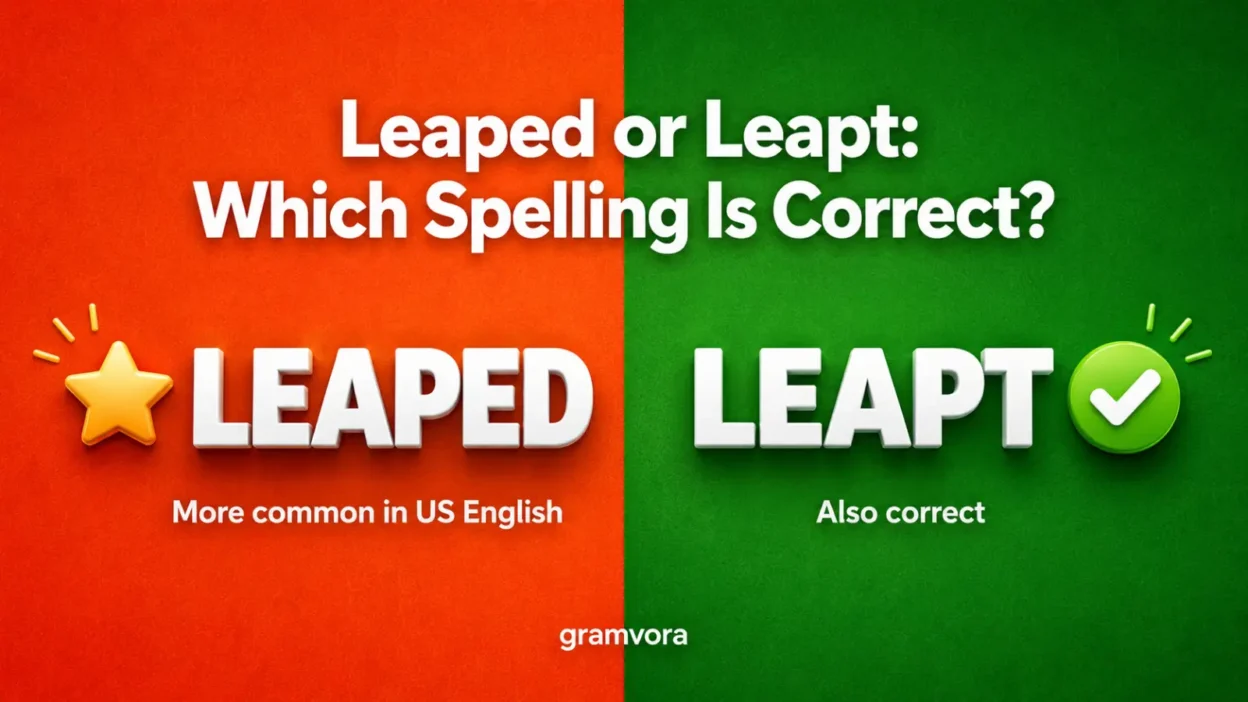
Leaped and leapt are both correct past forms of the verb leap. They describe someone or something jumping, moving suddenly, or changing quickly. The choice is usually about style, region, and the kind of English you want to use.
For most US writing, leaped is the safer everyday choice. Leapt is also standard, but it can sound a little more British, literary, or dramatic to many American readers.
Quick Answer
Both leaped and leapt are correct. They mean the same thing and can work as the past tense and past participle of leap. In American English, leaped is usually the more natural choice. In British English, leapt is often preferred. Use one spelling consistently unless quoted text or house style requires otherwise.
Why People Confuse Them
People confuse leaped and leapt because English has two common ways to form some past-tense verbs. One form uses -ed, as in leaped. The other uses -t, as in leapt.
This pattern also appears in pairs such as dreamed and dreamt or learned and learnt. In American English, the -ed form often feels more regular. The -t form can feel older, shorter, or more British.
Pronunciation also adds confusion. Leapt is commonly pronounced like “lept.” Leaped keeps the long ee sound from leap and is often heard close to “leept.” The sound difference does not change the meaning.
Key Differences At A Glance
| Context | Best Choice | Why |
|---|---|---|
| Everyday US writing | leaped | It is the more common American preference. |
| British-style writing | leapt | It often sounds more natural in UK English. |
| School or business writing in the US | leaped | It feels clear, standard, and direct. |
| Fiction or dramatic narration | either | Leapt can sound sharper or more literary, but both are correct. |
| Past participle after has or had | either | Both forms work: has leaped, has leapt, had leaped, had leapt. |
| Consistent document style | choose one | Switching back and forth can look careless. |
Are They the Same Word?
Yes. Leaped and leapt are two accepted past forms of the same verb, leap. They do not have separate meanings.
You can write:
The cat leaped onto the counter.
You can also write:
The cat leapt onto the counter.
Both sentences mean the same thing. The cat jumped from one place to another. The spelling choice does not change the action.
They also work in figurative uses:
Sales leaped after the new product launch.
Sales leapt after the new product launch.
Again, the meaning is the same. Sales rose quickly.
US vs UK Preference
In US English, leaped is usually the better default. It looks regular, familiar, and simple. It also fits well in school essays, workplace writing, news-style writing, and clear web copy.
Leapt is not wrong in American English. However, it may sound more literary, dramatic, or British to some US readers.
In UK English, leapt is often preferred. British readers are more likely to accept it as the natural past form, especially in polished writing.
Here is the simplest way to decide:
| Feature | leaped | leapt |
|---|---|---|
| Correct? | Yes | Yes |
| Main region preference | More common in US English | More common in UK English |
| Meaning | Past form of leap | Past form of leap |
| Tone | Plain and regular | Slightly sharper or more literary |
| Past participle? | Yes | Yes |
Which Spelling Should You Use?
Use leaped for most American writing. It is clear, standard, and unlikely to distract readers.
Choose leapt when you want a slightly more literary sound or when you are writing for a UK audience. It can fit well in fiction, storytelling, or expressive sentences.
For a US grammar article, school assignment, business note, or simple explanation, leaped is usually the cleanest choice.
Good US style:
The player leaped over the defender.
The dog leaped into the truck.
The company’s revenue leaped in the second quarter.
Natural British-style or literary style:
The player leapt over the defender.
The dog leapt into the truck.
Her heart leapt when she saw the message.
When One Spelling Looks Wrong
Neither spelling is wrong by itself. Still, one can look odd if it does not match the rest of the writing.
Leapt may look unusual in a plain US business sentence:
The quarterly numbers leapt after the campaign.
That sentence is correct, but many US writers would choose leaped because it sounds more neutral.
Leaped can look less natural in a very British-style sentence:
He leaped to his feet at once.
That sentence is also correct, but leapt to his feet may sound smoother to many readers.
The real issue is not grammar. It is consistency, audience, and tone.
Common Mistakes (and Quick Fixes)
Mistake: Thinking leapt is always wrong in US English.
Quick fix: Leapt is standard, but leaped is usually the safer US default.
Mistake: Thinking leaped and leapt have different meanings.
Quick fix: They mean the same thing.
Mistake: Mixing both forms in one short paragraph.
Quick fix: Pick one spelling and keep it consistent.
Mistake: Using the base verb after has or had.
Quick fix: Write has leaped, has leapt, had leaped, or had leapt.
Mistake: Dropping the a from leapt.
Quick fix: The standard spelling is leapt.
Mistake: Using leap as the past tense.
Quick fix: Write “Yesterday, she leaped” or “Yesterday, she leapt.”
Everyday Examples
Leaped:
The toddler leaped into the pile of pillows.
The player leaped over the line before the whistle.
My dog leaped onto the couch as soon as I sat down.
The price leaped after the announcement.
She leaped at the chance to join the team.
Leapt:
The deer leapt across the trail.
He leapt out of bed when the alarm rang.
Her heart leapt when she heard the good news.
The dancer leapt across the stage.
The idea leapt from one conversation to the next.
Past participle examples:
The cat has leaped onto that shelf before.
The cat has leapt onto that shelf before.
The runner had leaped over every hurdle cleanly.
The runner had leapt over every hurdle cleanly.
Dictionary-Style Word Details
Verb
Leaped: A past tense and past participle form of the verb leap. It means jumped, moved suddenly, or changed quickly. It is usually the safer choice in American English.
Leapt: Also a past tense and past participle form of the verb leap. It has the same meaning as leaped. It is often preferred in British English and can sound more literary in US writing.
Noun
Leaped: Not commonly used as a noun in standard English. It is a verb form.
Leapt: Not commonly used as a noun in standard English. It is also a verb form.
The noun is leap. Example: “That was a huge leap forward.”
Synonyms
Leaped: Closest plain alternatives include jumped, sprang, bounded, vaulted, and hopped. In figurative use, rose or surged may fit.
Leapt: The same alternatives apply because the meaning is the same.
Antonyms depend on context. For physical movement, landed may be the opposite action after a jump, but it is not a direct opposite in every sentence. For figurative increase, dropped, fell, or declined may work.
Example Sentences
Leaped: The goalie leaped to block the shot.
Leapt: The goalie leapt to block the shot.
Leaped: The kids leaped over the puddles after the rain.
Leapt: The kids leapt over the puddles after the rain.
Leaped: The team’s energy leaped after the first goal.
Leapt: The team’s energy leapt after the first goal.
Word History
Leaped follows the regular English pattern of adding -ed to make a past form.
Leapt uses a shorter -t ending. English has several verbs with this kind of past-form variation. Both spellings have been used for a long time, and the modern choice is mostly about regional and style preference.
The history does not create a meaning difference. It only helps explain why two accepted forms exist.
Phrases Containing
Leaped:
• leaped over
• leaped into action
• leaped at the chance
• leaped out of bed
• leaped to someone’s defense
Leapt:
• leapt over
• leapt into action
• leapt at the chance
• leapt out of bed
• leapt to someone’s defense
Both forms can appear in common phrases. In US writing, leaped often feels more neutral. In British-style writing, leapt may feel more natural.
FAQs
Is leaped or leapt correct?
Both leaped and leapt are correct. They are accepted past tense and past participle forms of the verb leap. The meaning is the same, so the choice depends mostly on audience, region, and style.
Which is better in American English, leaped or leapt?
In American English, leaped is usually the better default. It sounds clear, standard, and natural in everyday US writing. Leapt is still correct, but it may sound more British or literary to some American readers.
Is leapt British English?
Leapt is often preferred in British English, but it is not limited to British writing. American writers can also use it, especially in fiction or expressive writing. Still, for simple US writing, leaped is usually safer.
Do leaped and leapt mean the same thing?
Yes. Leaped and leapt mean the same thing. Both can mean jumped, moved suddenly, or changed quickly. For example, “The cat leaped onto the chair” and “The cat leapt onto the chair” have the same meaning.
Can I use leaped and leapt after has or had?
Yes. Both forms can work after has or had. You can write “She has leaped over that fence before” or “She has leapt over that fence before.” Both are grammatically correct.
Should I use both spellings in one article?
It is better to choose one spelling and stay consistent. For a US article, use leaped throughout unless you have a special reason to use leapt. Mixing both spellings can make the writing look uneven.
Conclusion
Leaped and leapt are both correct spellings for the past tense and past participle of leap. They share the same meaning, so the choice is not about grammar or definition.
For American English, choose leaped in most clear, everyday writing. Use leapt when writing for a British audience or when you want a sharper, more literary sound. Above all, stay consistent in the same article, story, or document.