
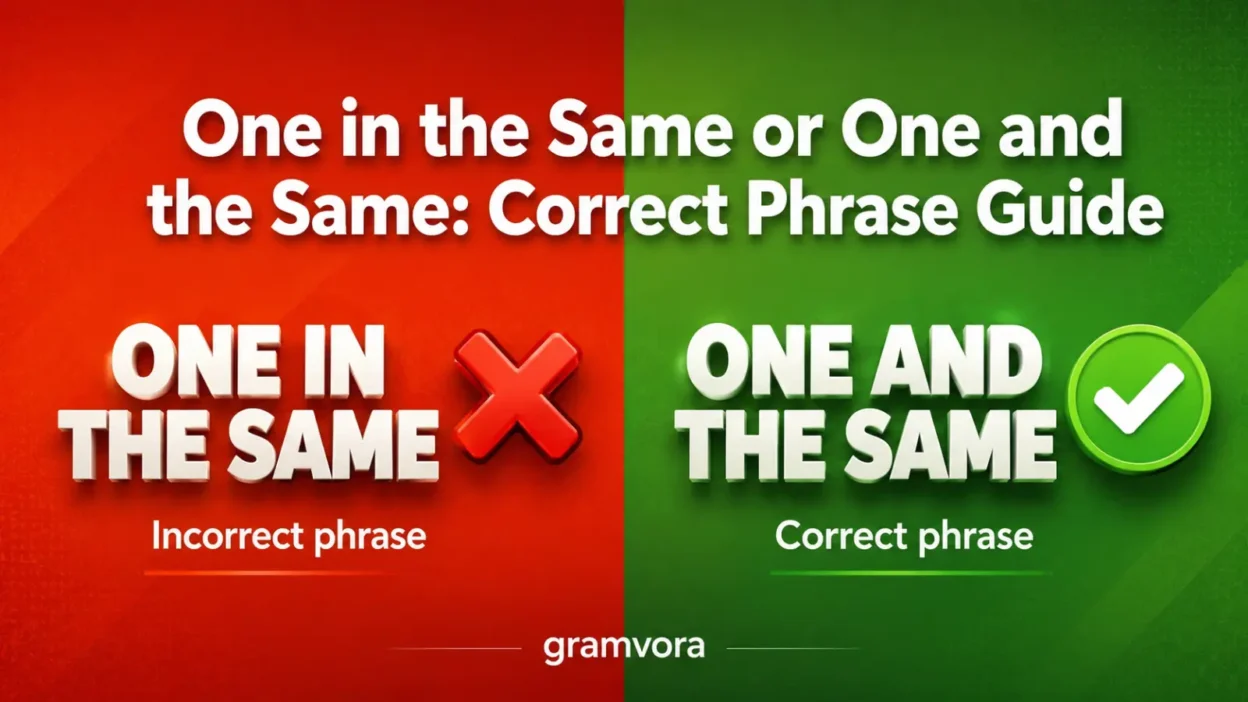
The correct phrase is one and the same. Use it when two names, people, roles, ideas, or things may seem separate but are actually identical.
One in the same is a common mistake. It usually happens because people hear “and” quickly in speech and write it as “in.” In standard US English, that wording does not carry the intended meaning. If you are choosing between one in the same or one and the same, choose one and the same.
Quick Answer
One and the same is correct. It means “the exact same person or thing.” One in the same is usually incorrect in standard writing because “in” changes the structure and makes the phrase unclear. Write, “The owner and the manager are one and the same,” not “one in the same.”
Why People Confuse Them
People confuse these phrases because and often sounds weak in fast speech. When someone says “one and the same,” it may sound like “one ’n the same.” That soft middle sound can be misheard as in.
The mistake also feels natural because in the same is a real word pattern in other sentences. For example, you can say, “They are in the same class.” However, that does not work in the set phrase one and the same.
The correct phrase uses and to join two ideas: one and same. That pairing adds emphasis. It does not mean something is inside something else.
Key Differences At A Glance
| Context | Best Choice | Why |
|---|---|---|
| Standard writing | one and the same | This is the accepted phrase. |
| School essays | one and the same | It is clear and correct. |
| Business emails | one and the same | It sounds polished and precise. |
| Legal or formal contexts | one and the same | It can clarify identity. |
| Casual speech | one and the same | It is still the correct form. |
| Describing something inside something else | not this phrase | Use a different sentence structure. |
| Writing “one in the same” | avoid it | It is usually a mistaken form. |
Meaning and Usage Difference
One and the same means that two things are not really two separate things. They are identical, or they refer to the same person, role, item, idea, or result.
The founder and CEO are one and the same.
Her public goal and private goal were one and the same.
The two account numbers turned out to be one and the same.
One in the same does not mean that in standard usage. The word in suggests location or inclusion, as if one thing were inside another. That is not the meaning people usually want.
Compact comparison:
• one and the same: correct phrase meaning “identical” or “the same person or thing”
• one in the same: common mistaken version of the phrase
• best simple substitute: “the same” or “identical”
• main reason for confusion: “and” can sound like “in” in quick speech
Tone, Context, and Formality
One and the same sounds more emphatic than the same. It is useful when you want to stress that two things are actually identical.
In everyday speech, you can often use the same instead:
Simple: The two passwords are the same.
More emphatic: The two passwords are one and the same.
In formal writing, one and the same can sound clear and precise, especially when identity matters. For example, it fits contracts, reports, school writing, and professional emails.
Still, do not overuse it. If the sentence does not need emphasis, the same may sound more natural.
Which One Should You Use?
Use one and the same when you mean “not separate” or “actually identical.”
Use it when comparing:
two names for one person
two roles held by one person
two labels for one thing
two ideas that lead to the same point
two records that refer to the same item
Examples:
The landlord and property owner are one and the same.
The billing address and shipping address are one and the same.
In this case, the problem and the solution are one and the same.
Do not use one in the same for this meaning. In edited US English, it will usually look like a mistake.
When One Choice Sounds Wrong
One in the same sounds wrong when the sentence is about identity.
Wrong: The artist and the designer are one in the same.
Correct: The artist and the designer are one and the same.
Wrong: Our goals are one in the same.
Correct: Our goals are one and the same.
Wrong: The two files are one in the same.
Correct: The two files are one and the same.
The only time one in the same might make literal sense is in a very unusual sentence about one thing being inside the same thing. That is not how people normally use this expression. For the common meaning, choose one and the same.
Common Mistakes (and Quick Fixes)
Mistake: Writing the phrase the way it sounds.
Wrong: Their mission and ours are one in the same.
Correct: Their mission and ours are one and the same.
Quick fix: If you mean “identical,” write and, not in.
Mistake: Using the phrase when a simpler word is better.
Wordy: The two dates are one and the same.
Better: The two dates are the same.
Quick fix: Use one and the same only when you need emphasis.
Mistake: Treating the phrase as casual filler.
Weak: My opinion and my point are basically one and the same, kind of.
Better: My opinion and my point are one and the same.
Quick fix: Remove extra softeners when you want a clear statement.
Everyday Examples
The teacher and the club sponsor are one and the same person.
For this event, registration and check-in are one and the same.
The two email addresses are one and the same account.
In her mind, honesty and loyalty were one and the same.
The repair shop and the dealership are not one and the same.
At that company, the owner and the lead engineer are one and the same.
The movie suggests that the hero and the narrator may be one and the same.
Our short-term goal and long-term goal are not one and the same.
The apartment number and unit number are one and the same.
For tax purposes, those two forms are not one and the same.
Dictionary-Style Word Details
Verb
• one in the same: Not commonly used as a verb in standard US English. It is not a verb phrase.
• one and the same: Not commonly used as a verb in standard US English. It is an idiomatic phrase, often used after a form of be, as in “are one and the same.”
Noun
• one in the same: Not a standard noun. It is usually a mistaken version of the accepted phrase.
• one and the same: Not a noun by itself. It is an idiomatic phrase that identifies one person or thing as identical with another. It can appear before a noun in phrases like “one and the same person” or “one and the same thing.”
Synonyms
• one in the same: No exact standard synonyms because the phrase is not the accepted form for the intended meaning. Use the intended alternatives for one and the same instead.
• one and the same: Closest plain alternatives include the same, identical, the very same, not separate, and one single person or thing.
Clear opposites include different, separate, distinct, and not the same.
Example Sentences
• one in the same: Avoid in standard writing.
Wrong: The buyer and the seller are one in the same.
Correct: The buyer and the seller are one and the same.
• one and the same: The buyer and the seller are one and the same only in rare cases.
• one in the same: Avoid when you mean “identical.”
Wrong: The two passwords are one in the same.
Correct: The two passwords are one and the same.
• one and the same: The username and account ID are one and the same in our system.
Word History
• one in the same: This form does not have a separate accepted history as the standard phrase. It is best understood as a misheard or miswritten version of one and the same.
• one and the same: This is an established emphatic phrase. Its structure repeats the idea of sameness for stress, much like other emphatic pairings in English. The important point for modern writers is simple: the standard wording uses and.
Phrases Containing
• one in the same: No standard phrase pattern is needed for this form. Avoid it when you mean “the same.”
• one and the same: Common patterns include one and the same person, one and the same thing, one and the same issue, one and the same account, and at one and the same time.
FAQs
Is it “one in the same” or “one and the same”?
The correct phrase is one and the same. It means two names, people, things, or ideas are actually identical. One in the same is a common mistake, usually caused by hearing the phrase quickly in speech.
What does “one and the same” mean?
One and the same means “the exact same person or thing.” For example, “The owner and the manager are one and the same” means the owner and manager are not two different people.
Is “one in the same” ever correct?
In standard US English, one in the same is not the correct form of this phrase. It may appear in casual writing, but it is usually treated as an error. Use one and the same in school, business, and formal writing.
Why do people say “one in the same”?
People say or write one in the same because and can sound like in when spoken quickly. The phrase may sound like “one ’n the same,” so writers sometimes choose the wrong word.
Can I just say “the same” instead?
Yes. The same is often simpler and more natural. Use one and the same when you want extra emphasis or when you need to make identity very clear.
How do you use “one and the same” in a sentence?
You can use it after a form of be. For example: “The billing address and shipping address are one and the same.” Another example is, “For this project, the client and the decision-maker are one and the same.”
Conclusion
Use one and the same when you mean that two people, things, names, ideas, or roles are actually identical. It is the standard phrase in US English.
Avoid one in the same in polished writing. Although people may understand what you mean, the wording is usually treated as a mistake. When in doubt, replace the phrase with the same or identical. If that meaning fits, one and the same is the phrase you want.
[…] Correct only outside the degree phrase […]