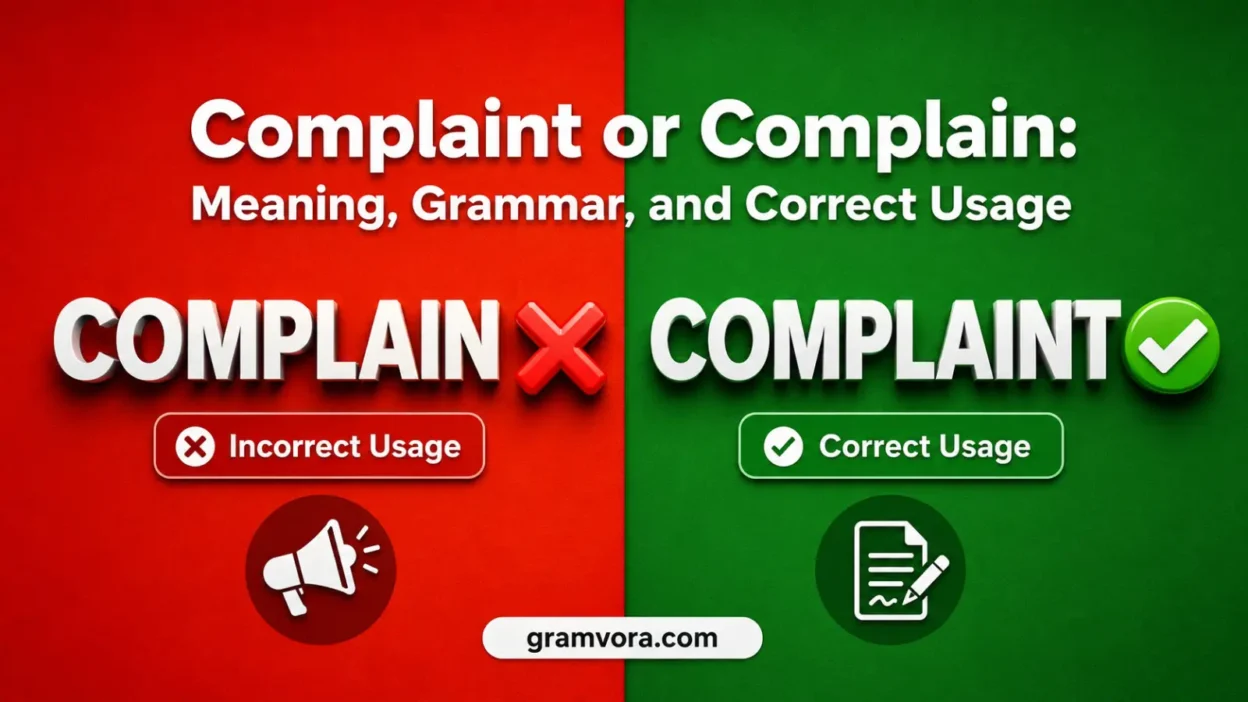
Complaint and complain are both correct English words, but they do different jobs. Complaint names a problem, grievance, or statement of dissatisfaction. Complain describes the action of expressing that dissatisfaction.
The choice is grammatical. A sentence needs complaint when the word functions as a noun and complain when it functions as a verb.
Quick Answer
Use complaint as a noun: “I filed a complaint about the charge.”
Use complain as a verb: “I need to complain about the charge.”
Words such as a, the, my, written, and formal usually point to complaint. Subjects and verb markers such as I, they, will, did, and to usually point to complain.
Why People Confuse Them
The words share the same main idea and differ by only one final letter. They also sound almost alike. Complaint ends with a t sound, while complain does not.
Confusion often occurs when a writer understands the meaning but misses the word’s job in the sentence. This causes errors such as “I have a complain” or “I want to complaint.”
The forms complains and complaints create another problem. Complains is a verb used with he, she, or it. Complaints is the plural noun: “She complains often,” but “She submitted two complaints.”
Key Differences At A Glance
| Context | Best Choice | Why |
|---|---|---|
| Naming a grievance or reported problem | complaint | A noun is required |
| Describing the act of expressing dissatisfaction | complain | A verb is required |
| After a, an, the, my, or your | complaint | These words commonly introduce nouns |
| After to, will, can, did, or should | complain | These forms commonly introduce or support verbs |
| Referring to a formal written report | complaint | The report itself is a noun |
| Saying what a person does about a problem | complain | The sentence describes an action |
Meaning and Usage Difference
The basic distinction is direct:
- Complaint: a noun that names dissatisfaction, a grievance, a reported problem, or a formal statement.
- Complain: a verb that means to express dissatisfaction, annoyance, pain, or concern.
“Her complaint was reasonable” names the issue. “She complained to the manager” describes what she did.
Complaint also has specialized noun meanings. In law, it can name a document that begins a case or states allegations. In medicine, a patient’s complaint can be a reported symptom or problem.
Complain often appears in patterns such as complain about something, complain to someone, complain that something happened, or complain of pain.
Pronunciation can help. Complaint sounds like “kuhm-PLAYNT,” with a final t. Complain sounds like “kuhm-PLAYN,” without that final sound. Both stress the second syllable.
Tone, Context, and Formality
Both words are standard in casual and formal American English. Their tone depends on the sentence.
Complain may sound negative when it suggests repeated criticism: “He complains about everything.” It can also describe a reasonable action: “Residents complained about unsafe wiring.”
Complaint often sounds official in phrases such as formal complaint, written complaint, customer complaint, and legal complaint. However, it can be casual: “My only complaint is that the movie was too long.”
“I would like to file a complaint” focuses on a report or process. “I would like to complain about the service” focuses on the action. Both are correct and can be polite.
Which One Should You Use?
Choose complaint when the sentence needs the name of a thing, issue, statement, or report. If grievance, concern, or problem could fit in the same position, complaint is usually right.
Choose complain when the sentence needs an action. If protest, object, or express dissatisfaction could replace it, complain is usually correct.
Articles provide another clue. “A complaint,” “the complaint,” and “my complaint” are natural noun phrases. “To complain,” “will complain,” and “did complain” are verb patterns.
The same idea can use either word in a different structure: “We made a complaint about the delay” and “We complained about the delay.”
When One Choice Sounds Wrong
Complaint sounds wrong when the sentence requires an action. “She complaint about the bill” is incorrect. Write “She complained about the bill.”
Complain sounds wrong after an article or possessive word. “I sent a complain” is incorrect. Write “I sent a complaint.”
Forms such as complainted and complainting are not standard. The correct verb forms are complained and complaining.
After make, file, submit, receive, or handle, use complaint when referring to a report: make a complaint, file a complaint, and handle a complaint.
Common Mistakes (and Quick Fixes)
Incorrect: I have a complain about my order.
Correct: I have a complaint about my order.
Incorrect: I want to complaint to the manager.
Correct: I want to complain to the manager.
Incorrect: The guest complaint about the noise last night.
Correct: The guest complained about the noise last night.
Incorrect: We filed a complain with the company.
Correct: We filed a complaint with the company.
Incorrect: She complaints whenever the schedule changes.
Correct: She complains whenever the schedule changes.
People generally complain to a person or organization about an issue. A complaint is commonly about an issue or against a person, company, or decision.
Everyday Examples
At a restaurant, you might say, “I need to complain about the cold food.” Later, you could say, “The manager handled my complaint politely.”
At work, an employee may complain about an unfair schedule and later submit a written complaint to human resources.
Tenants can complain to a landlord about broken heating. If the problem continues, they may file a formal complaint.
During a medical visit, a patient may complain of back pain. The doctor may record back pain as the patient’s chief complaint.
“I can’t complain” is a casual expression meaning that life is going reasonably well. It uses the verb complain.
Dictionary-Style Word Details
Verb
Complaint: Not commonly used as a verb in standard American English. Use complain for the action.
Complain: A standard verb meaning to express dissatisfaction, annoyance, pain, or concern. Its common forms are complain, complains, complained, and complaining.
Noun
Complaint: A noun naming a grievance, expression of dissatisfaction, reported problem, formal allegation, or patient-reported condition. It can be singular or plural.
Complain: Not used as a noun in standard American English. Use complaint when naming the grievance or report.
Synonyms
Complaint: Meaning-matched alternatives include grievance, objection, protest, and gripe. Gripe is informal.
Complain: Meaning-matched alternatives include protest, object, grumble, and gripe. Grumble and gripe often suggest informal or repeated dissatisfaction.
No single antonym fits every use. Depending on context, praise, approve, accept, or express satisfaction may provide an opposite idea.
Example Sentences
Complaint: “Your complaint has been sent to billing.” “The school received a complaint about the bus schedule.” “Her main complaint was the long wait.”
Complain: “Customers may complain if the fee is unclear.” “He complained to the front desk about the noise.” “The patient complained of dizziness.”
Word History
Complaint and complain share a historical path through French forms connected with lamenting or expressing grief. English kept complain as the verb and complaint as the related noun.
Phrases Containing
Complaint: make a complaint, file a complaint, submit a complaint, formal complaint, customer complaint, complaint about, complaint against, chief complaint, and without complaint.
Complain: complain about, complain to, complain that, complain of, complain bitterly, and can’t complain.
FAQs
Is complaint or complain correct?
Both words are correct, but they have different grammatical roles. Complaint is a noun that names a grievance or problem. Complain is a verb that describes the action of expressing dissatisfaction.
Is it “I have a complaint” or “I have a complain”?
The correct sentence is “I have a complaint.” The article a must be followed by a noun, so complaint is required. Complain is a verb and cannot normally follow a in this structure.
Is it “I want to complain” or “I want to complaint”?
Use “I want to complain.” After want to, English requires the base form of a verb. Complain is the verb, while complaint is a noun.
What is the difference between complains and complaints?
Complains is a present-tense verb used with he, she, it, or a singular subject: “She complains about the noise.” Complaints is the plural form of the noun complaint: “The office received several complaints.”
Should I say “complain about” or “complain to”?
Use complain about before the problem: “They complained about the delay.” Use complain to before the person or organization receiving the criticism: “They complained to the manager.” Both can appear together: “They complained to the manager about the delay.”
Is it “file a complaint” or “file a complain”?
The correct phrase is “file a complaint.” In this expression, complaint names a formal written or reported grievance. Other correct phrases include make a complaint, submit a complaint, and receive a complaint.
Conclusion
Use complaint when naming a grievance, problem, or report. Use complain when describing the act of expressing dissatisfaction.
Remember the two useful patterns: “I have a complaint” and “I want to complain.” Once you identify whether the sentence needs a noun or a verb, the choice becomes clear.