
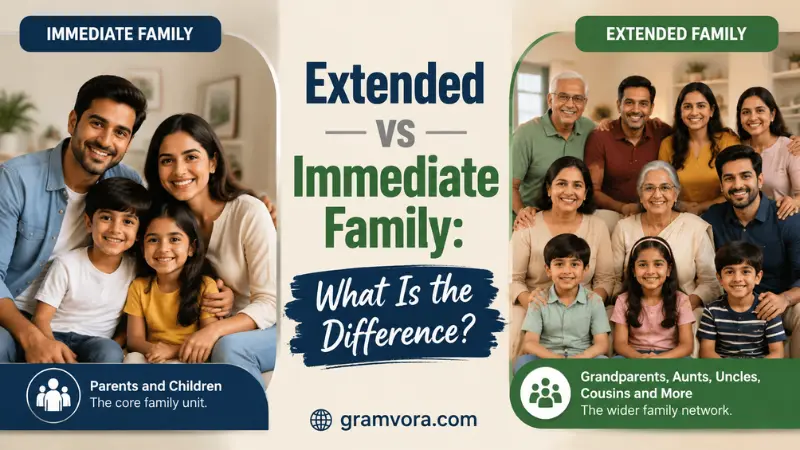
Family relationships can be described in many ways, but two common terms often create confusion: extended family and immediate family. Both describe groups of relatives, but they refer to different circles of connection.
Immediate family usually means the closest relatives in a person’s household or direct family line, such as parents, children, and spouses. Extended family includes relatives beyond that closest group, such as grandparents, aunts, uncles, cousins, and other relatives.
The difference matters because these terms are used in everyday conversations, legal situations, workplace policies, school forms, and social discussions. For example, a company may offer leave for an employee’s immediate family member, while a person may talk about spending holidays with their extended family.
Although the two terms are related, they are not interchangeable. Understanding the difference helps you choose the correct phrase when describing family relationships.
Quick Answer
Immediate family refers to a person’s closest family members, usually including parents, children, spouses, and sometimes siblings.
Extended family refers to relatives outside that closest group, including grandparents, aunts, uncles, cousins, nieces, nephews, and other relatives.
The easiest way to remember the difference:
- Immediate family = closest family circle
- Extended family = family beyond the closest circle
Why People Confuse Them
People often confuse extended family and immediate family because both terms describe relatives connected through blood, marriage, or adoption.
The confusion usually happens because the exact boundary of immediate family can change depending on the situation. For example, some people consider siblings part of their immediate family, while others focus only on parents, children, and spouses.
The meaning of extended family is usually easier to identify because it includes relatives who are one or more steps away from the closest family unit.
Another reason for confusion is that families are organized differently across cultures and households. In some families, grandparents or adult siblings may live together and feel like part of the immediate household. In other situations, they may be considered extended family.
However, in general American English usage, the terms follow a common pattern:
- Immediate family describes the closest relationships.
- Extended family describes the wider network of relatives.
Key Differences At A Glance
| Context | Best Choice | Why |
|---|---|---|
| Talking about parents, spouse, or children | Immediate family | These are usually the closest family members |
| Discussing cousins, grandparents, or aunts | Extended family | These relatives are outside the closest group |
| Workplace family leave policies | Immediate family | Policies often define close relatives specifically |
| Large family gatherings | Extended family | These events often include many relatives |
| Family history discussions | Extended family | The term covers a wider range of relatives |
Feature Comparison
| Feature | Immediate Family | Extended Family |
|---|---|---|
| Meaning | Closest relatives | Relatives beyond the closest group |
| Common examples | Parents, spouse, children | Grandparents, cousins, aunts, uncles |
| Size | Usually smaller | Usually larger |
| Everyday use | Personal and legal contexts | Social and family discussions |
Meaning and Usage Difference
Immediate Family
Immediate family refers to the people closest to you within your family structure.
Common examples include:
- A husband or wife
- Children
- Parents
- Sometimes siblings
The phrase is often used when discussing important personal matters.
Examples:
- “Only immediate family members attended the ceremony.”
- “She spent the weekend with her immediate family.”
- “The company provides support when an employee loses an immediate family member.”
The exact definition can depend on the context. A workplace policy, insurance document, or legal rule may define immediate family differently than everyday conversation.
Extended Family
Extended family refers to relatives outside the closest family group.
Examples include:
- Grandparents
- Aunts and uncles
- Cousins
- Nieces and nephews
- Other relatives connected through family relationships
Examples:
- “Our extended family gathers every summer.”
- “He grew up surrounded by his extended family.”
- “Many extended family members attended the reunion.”
Extended family often describes a larger group of relatives connected through generations or wider family relationships.
Tone, Context, and Formality
Both terms are neutral and commonly used in American English. Neither word is more formal or informal than the other.
However, they appear in different situations.
Immediate Family Context
The phrase immediate family often appears in:
- Legal documents
- Workplace policies
- Medical situations
- Emergency situations
- Personal announcements
Example:
“Employees may request leave after the death of an immediate family member.”
In this context, the phrase helps identify the closest relatives who may have a special connection or responsibility.
Extended Family Context
The phrase extended family is more common in:
- Family conversations
- Holiday discussions
- Personal stories
- Cultural discussions
Example:
“My extended family comes together every Thanksgiving.”
The phrase creates the idea of a larger family circle.
Which One Should You Use?
Choose immediate family when you mean the closest relatives in a person’s life.
Use it for situations involving:
- Parents
- Children
- Spouses
- Closest household relationships
Examples:
- “My immediate family lives nearby.”
- “She invited only her immediate family to the small ceremony.”
Choose extended family when you mean relatives beyond that closest group.
Use it for situations involving:
- Cousins
- Grandparents
- Aunts and uncles
- Larger family gatherings
Examples:
- “My extended family visits during the holidays.”
- “He stays connected with his extended family.”
A simple test:
Ask yourself: Is this person part of my closest family circle, or are they a relative outside it?
Closest circle → immediate family
Wider relatives → extended family
When One Choice Sounds Wrong
Using these terms incorrectly can make your meaning unclear.
Incorrect:
“My cousins are my immediate family.”
Better:
“My cousins are part of my extended family.”
Cousins are relatives, but they are usually not considered immediate family in everyday American English.
Incorrect:
“My parents are part of my extended family.”
Better:
“My parents are part of my immediate family.”
Parents are normally included in the immediate family category.
However, remember that family definitions can vary. Someone may personally describe a grandparent, sibling, or another relative as immediate family because of their close relationship. Context always matters.
Common Mistakes (and Quick Fixes)
Mistake 1: Thinking extended means distant emotionally
Extended family does not mean relatives you are not close to.
A person can have a very close relationship with their extended family.
Example:
“My extended family is very supportive.”
This means many relatives are involved, not that they are emotionally distant.
Mistake 2: Assuming immediate always means people who live together
Immediate family members do not always live in the same home.
Example:
“A college student may still consider their parents immediate family even while living away.”
Mistake 3: Treating the terms as exact legal categories everywhere
Different organizations may define immediate family differently.
For example, a workplace policy may include certain relatives while excluding others.
Always check the specific definition when the phrase appears in official documents.
Everyday Examples
At Home
- “My immediate family lives in California.”
- “My extended family visits us every summer.”
During Holidays
- “We had dinner with our immediate family on Christmas morning.”
- “Our extended family joined us later in the day.”
At Weddings
- “The couple invited their immediate family to the private ceremony.”
- “The reception included friends and extended family members.”
In Conversations
- “I talk to my immediate family every day.”
- “I only see my extended family a few times a year.”
At Work
- “She took time off because an immediate family member was hospitalized.”
The phrase extended family would usually not fit in this type of workplace policy sentence unless the policy specifically includes those relatives.
Dictionary-Style Word Details
Verb
Immediate family:
Not commonly used as a verb in standard US English. “Immediate” functions mainly as an adjective describing closeness or direct connection.
Example:
- “She contacted her immediate family.”
Extended family:
Not commonly used as a verb phrase. “Extended” can function as a verb in other contexts, meaning “to make longer” or “to offer,” but extended family itself is a noun phrase.
Example:
- “His extended family attended the event.”
Noun
Immediate family:
A noun phrase referring to a person’s closest relatives.
Examples:
- “Her immediate family supported her decision.”
- “Only immediate family members were invited.”
Extended family:
A noun phrase referring to relatives outside the closest family group.
Examples:
- “His extended family lives across several states.”
- “The extended family gathered for a reunion.”
Synonyms
Immediate Family
Closest plain alternatives:
- Close family
- Closest relatives
- Direct family members
These alternatives may not always have the same legal or official meaning.
Extended Family
Closest plain alternatives:
- Wider family
- Larger family circle
- Relatives beyond the household
There is no perfect synonym because the exact group included can change depending on context.
Example Sentences
Immediate Family
- “Her immediate family supported her during the difficult time.”
- “He invited only his immediate family to the private celebration.”
- “The hospital contacted his immediate family.”
Extended Family
- “Their extended family meets every year for a reunion.”
- “She grew up spending time with her extended family.”
- “Many members of his extended family attended the event.”
Word History
The terms immediate family and extended family developed from the general idea of describing different levels of family relationships.
The word immediate means something that is close, direct, or without separation. In the phrase “immediate family,” it describes the closest family connections.
The word extended means something made larger or expanded. In “extended family,” it describes a family group expanded beyond the closest relatives.
The phrases are widely used in modern English, especially in discussions about relationships, communities, and official situations.
Phrases Containing
Common phrases with Immediate Family
- Immediate family members
- Immediate family only
- Immediate family support
- Immediate family emergency
- Immediate family relationship
Examples:
- “The invitation was limited to immediate family only.”
- “He notified his immediate family first.”
Common phrases with Extended Family
- Extended family members
- Extended family gathering
- Extended family reunion
- Extended family support
- Extended family network
Examples:
- “The extended family reunion happens every summer.”
- “She maintains strong connections with her extended family.”
FAQs
What is the difference between immediate family and extended family?
Immediate family refers to a person’s closest relatives, usually including parents, children, and a spouse. Extended family includes relatives outside that closest group, such as grandparents, aunts, uncles, cousins, nieces, and nephews.
The main difference is the size of the family circle. Immediate family describes the closest relationships, while extended family describes the wider network of relatives.
Are siblings considered immediate family or extended family?
Siblings are often considered immediate family, especially in everyday American English. However, the exact definition can depend on the situation.
For example, a person may include brothers and sisters as immediate family in personal conversations, while a workplace or legal document may use a narrower definition.
Are grandparents part of immediate family or extended family?
Grandparents are usually considered part of a person’s extended family because they are one generation beyond parents.
However, some people consider grandparents part of their immediate family because of a close relationship, living arrangements, or personal family structure.
Is a cousin considered immediate family?
No, a cousin is generally considered part of the extended family.
Cousins are relatives connected through aunts, uncles, or grandparents, so they usually fall outside the closest family group.
Example:
- “My immediate family lives nearby, but my extended family includes many cousins.”
Can extended family members be closer than immediate family members?
Yes. The terms describe family relationships, not emotional closeness.
A person may have a very close relationship with an aunt, cousin, or grandparent while having a more distant relationship with someone in their immediate family.
For example:
- “My cousin is part of my extended family, but we talk every day.”
Why do companies define immediate family differently?
Companies often create their own definitions of immediate family for policies such as bereavement leave, medical leave, or benefits.
One company may include siblings, while another may only include spouses, children, and parents. The meaning depends on the specific policy.
Is extended family one word or two words?
Extended family is written as two words.
“Extended” is an adjective describing the type of family, and “family” is the noun.
Correct:
- “We visited our extended family.”
Incorrect:
- “We visited our extendedfamily.”
Which term should I use when talking about a family reunion?
Use extended family when talking about a reunion because these events usually include many relatives beyond parents, children, and spouses.
Example:
- “Our extended family reunion happens every summer.”
If the gathering only includes parents, children, and spouses, immediate family may be more accurate.
Is a spouse considered immediate family?
Yes. A spouse is generally considered part of a person’s immediate family.
Examples:
- husband
- wife
- legal spouse
The phrase is commonly used for close family relationships in personal and official contexts.
Is extended family the same as relatives?
Not exactly.
All extended family members are relatives, but not all relatives are considered extended family. The term extended family usually refers to relatives outside the closest family group.
For example:
- Parent → usually immediate family
- Cousin → usually extended family
- Spouse → usually immediate family
Conclusion
The difference between extended vs immediate family is mainly about how close the relatives are within a family structure.
Immediate family refers to the closest relatives, such as parents, children, and spouses. Extended family includes the wider group of relatives, such as grandparents, aunts, uncles, and cousins.
Neither term is better than the other. The correct choice depends on the relationship you want to describe.
When you mean the closest family circle, use immediate family. When you mean the larger network of relatives beyond that circle, use extended family.
Understanding this difference helps you communicate more clearly in everyday conversations, workplace situations, and formal discussions.


