Second cousin and third cousin are both standard family-relationship terms, but they describe different positions on a family tree.
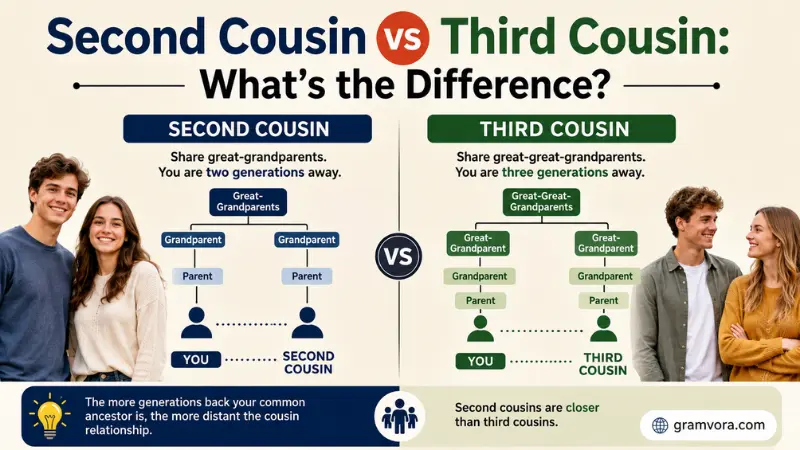
The easiest distinction is the shared ancestor. Second cousins typically share great-grandparents, while third cousins typically share great-great-grandparents.
The terms can be confusing because “second” and “third” do not simply mean that the people are two or three generations apart.
Quick Answer
A second cousin is someone who shares your great-grandparents with you.
A third cousin is someone who shares your great-great-grandparents with you.
Both people are normally in the same generation relative to the shared ancestors. The third cousin is one degree farther out in the family tree.
For example, if you and another person have the same great-grandparents, you are second cousins. If your closest shared ancestors are your great-great-grandparents, you are third cousins.
Why People Confuse Them
The numbers make these terms sound like they describe the number of generations between two people. They do not.
The number identifies the cousin degree. As the common ancestor moves farther back, the cousin number increases.
A useful way to think about it is:
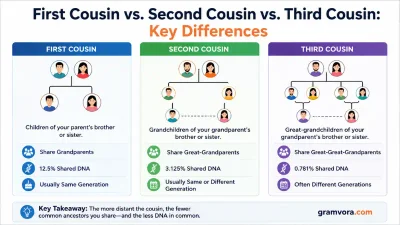
- First cousins share grandparents.
- Second cousins share great-grandparents.
- Third cousins share great-great-grandparents.
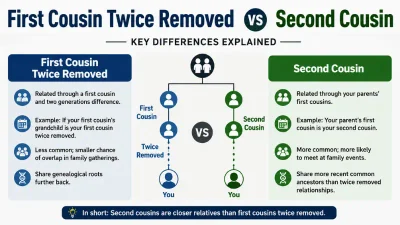
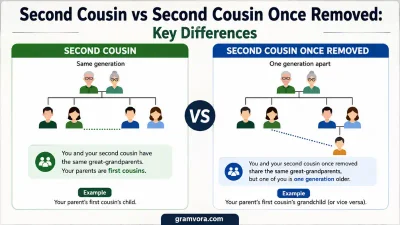
The word removed is different. It describes a generation difference between two relatives. So a second cousin once removed is not simply another name for a third cousin.
Key Differences At A Glance
| Context | Best Choice | Why |
|---|---|---|
| You share great-grandparents | Second cousin | You are at the second-cousin level |
| You share great-great-grandparents | Third cousin | You are at the third-cousin level |
| You are one generation apart from a second cousin | Second cousin once removed | “Removed” describes the generation difference |
| You are both descendants at the third-cousin level | Third cousin | You share great-great-grandparents |
A second cousin is therefore closer in the family tree than a third cousin.
Meaning and Usage Difference
The main difference is genealogical rather than grammatical.
Second cousin
A second cousin is generally the child of one of your parent’s first cousins. In a family tree, you and your second cousin share great-grandparents.
For example, suppose your grandmother and another person’s grandmother were sisters. Their children would be first cousins. Their grandchildren would be second cousins.
Third cousin
A third cousin is one step farther out. Third cousins generally share great-great-grandparents.
If two people descend from the same great-great-grandparents and are at the same generational level, they are third cousins.
The distinction can be summarized simply:
Second cousin → great-grandparents
Third cousin → great-great-grandparents
The terms are nouns and are normally used to identify a person’s relationship to another relative.
Tone, Context, and Formality
Both second cousin and third cousin are neutral and standard expressions in American English.
You can use either term in casual conversation:
“She’s my second cousin.”
“He’s my third cousin.”
They also work in more formal contexts, such as family-history records, genealogical discussions, and descriptions of family relationships.
There is no important difference in tone or formality between the two. The choice depends on the actual family relationship.
Which One Should You Use?
Choose the term based on the closest shared ancestor.
If the shared ancestor is a great-grandparent, use second cousin.
If the shared ancestor is a great-great-grandparent, use third cousin.
A quick family-tree check can help:
- Find the closest common ancestor.
- Count the generations from that ancestor to each person.
- If both people are at the same level, identify the cousin degree from that shared ancestor.
- Use “removed” when the two people are at different generational levels.
Do not choose between the terms based simply on someone’s age. A younger person can be a third cousin, while an older person can be a second cousin.
When One Choice Sounds Wrong
Calling a second cousin a third cousin changes the relationship.
For example:
Incorrect: “My second cousin and I share great-great-grandparents.”
Better: “My third cousin and I share great-great-grandparents.”
Likewise:
Incorrect: “My third cousin and I share great-grandparents.”
Better: “My second cousin and I share great-grandparents.”
Another common mistake is assuming that a second cousin’s child automatically becomes your third cousin. That is not correct. The child is your second cousin once removed because the child is one generation below your second cousin.
Common Mistakes (and Quick Fixes)
Mistake 1: Thinking “third cousin” means three generations apart
Fix: The number identifies the cousin degree, not simply the number of generations separating the two people.
Mistake 2: Calling a second cousin’s child a third cousin
Fix: Your second cousin’s child is your second cousin once removed.
Mistake 3: Assuming third cousins share grandparents
Fix: First cousins share grandparents. Third cousins are farther out and generally share great-great-grandparents.
Mistake 4: Treating “removed” as meaning less related
Fix: “Removed” describes a difference in generation, not simply emotional distance or how distant the family connection feels.
Mistake 5: Using “second cousin” and “third cousin” interchangeably
Fix: They describe different cousin degrees, so use the term that matches the family-tree relationship.
Everyday Examples
Imagine that your great-grandparents had two children. One child became your grandparent, while the other became the grandparent of another person. You and that person are second cousins.
Now move one generation farther back.
Suppose you and another person descend from the same great-great-grandparents, with both of you at the corresponding generational level. You are third cousins.
Here are simple examples:
- “My second cousin lives in Texas.”
- “I met my third cousin at a family reunion.”
- “We discovered that we are second cousins through our great-grandparents.”
- “Our family records show that we are third cousins through our great-great-grandparents.”
The important point is that the cousin number follows the degree of the relationship. It does not tell you how many years apart two people are.
Dictionary-Style Word Details
Verb
- Second cousin: Not commonly used as a verb in standard US English.
- Third cousin: Not commonly used as a verb in standard US English.
Both terms function primarily as noun phrases when they identify family relationships.
Noun
- Second cousin: A noun referring to a person who is a second cousin.
- Third cousin: A noun referring to a person who is a third cousin.
Both can be singular or plural:
- “She is my second cousin.”
- “They are my second cousins.”
- “He is my third cousin.”
- “They are my third cousins.”
Synonyms
Neither term has an exact everyday synonym that preserves the same precise family relationship.
- Second cousin: Closest plain alternative: “a relative who shares great-grandparents with you,” when that level of detail is needed.
- Third cousin: Closest plain alternative: “a relative who shares great-great-grandparents with you.”
Words such as relative or family member are broader and should not be treated as exact replacements.
Example Sentences
- Second cousin: “My second cousin and I discovered that we have the same great-grandparents.”
- Second cousin: “She is my second cousin on my mother’s side.”
- Third cousin: “He is my third cousin through our great-great-grandparents.”
- Third cousin: “We found out that we were third cousins after comparing our family trees.”
Word History
Second cousin is an established English family-relationship term. Merriam-Webster records its first known use as 1660.
The broader word cousin is much older. The precise historical development of every ordinal cousin label is more complicated than the basic modern definitions, so it is best to focus on how the terms are used today.
Third cousin follows the same established system in which the ordinal identifies the degree of cousin relationship.
Phrases Containing
- second cousin
- second cousins
- third cousin
- third cousins
- second cousin once removed
- third cousin once removed
The word removed changes the relationship description because it indicates a generational difference.
FAQs
What is the difference between a second cousin and a third cousin?
A second cousin typically shares great-grandparents with you, while a third cousin typically shares great-great-grandparents with you. A third cousin is therefore one degree farther removed in the family tree.
Are second cousins closer than third cousins?
Yes. Second cousins are closer relatives than third cousins because their closest shared ancestors are one generation more recent.
Do second cousins share great-grandparents?
Yes. Second cousins generally have the same great-grandparents as their closest shared ancestors.
Do third cousins share great-great-grandparents?
Yes. Third cousins generally share great-great-grandparents as their closest shared ancestors.
Is a third cousin more distant than a second cousin?
Yes. A third cousin is more distant in the family tree than a second cousin because the shared ancestor is farther back.
Is my second cousin’s child my third cousin?
No. Your second cousin’s child is generally your second cousin once removed, not your third cousin. “Once removed” describes a one-generation difference.
Is my third cousin the same as my second cousin once removed?
No. These terms describe different relationships. A third cousin is typically in the same generation as you, while a second cousin once removed is one generation above or below you.
How can I tell if someone is my second or third cousin?
Find your closest shared ancestor. If you share great-grandparents, you are generally second cousins. If you share great-great-grandparents, you are generally third cousins.
Can two people be third cousins if they have different grandparents?
Yes. Cousin relationships are based on shared ancestors farther back in the family tree. Third cousins generally share great-great-grandparents, even though their grandparents and parents are different.
Which is closer: second cousin or third cousin?
A second cousin is closer. Second cousins generally share great-grandparents, whereas third cousins generally share great-great-grandparents.
Does age affect whether someone is a second or third cousin?
No. Age does not determine the cousin degree. The relationship depends on the family-tree connection and the closest shared ancestor.
Conclusion
The difference between second cousin and third cousin is straightforward once you focus on the shared ancestor.
A second cousin generally shares your great-grandparents. A third cousin generally shares your great-great-grandparents.
So, if the common ancestor is one generation farther back, the cousin number moves from second to third.
The simplest memory aid is:
Great-grandparents = second cousins.
Great-great-grandparents = third cousins.