
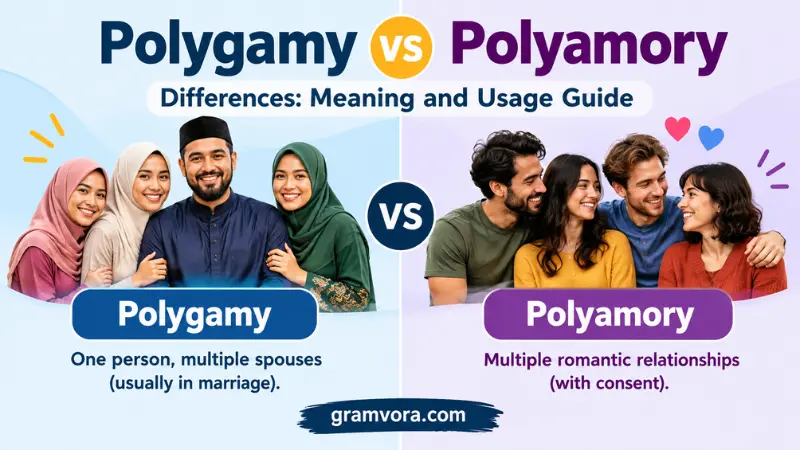
Polygamy and polyamory are easy to confuse because both words describe relationships involving more than two people. They also begin with the same poly- element, which means “many.”
However, the words are not interchangeable.
The clearest difference is marriage versus romantic relationships. Polygamy refers to having more than one spouse at the same time. Polyamory refers to having multiple romantic or intimate relationships, generally with the knowledge and consent of everyone involved.
That distinction matters in everyday English. Calling a relationship “polygamous” can suggest that multiple marriages or spouses are involved. Calling it “polyamorous” points instead to a relationship structure involving multiple romantic or intimate connections.
Quick Answer
Use polygamy when you are talking about having more than one spouse at the same time.
Use polyamory when you are talking about having multiple romantic or intimate relationships with the knowledge and consent of the people involved.
For example:
- “The documentary examines polygamy in a community where one person has multiple spouses.”
- “They describe their relationship as polyamory because they have multiple romantic partners and everyone knows about the arrangement.”
So, which is correct?
Both are correct words, but they describe different relationship structures.
The easiest memory aid is:
Polygamy = multiple spouses.
Polyamory = multiple romantic relationships.
Why People Confuse Them
The confusion starts with the words themselves.
Both contain poly-, a combining form associated with “many.” Their endings point in different directions. -gamy relates to marriage, while amory relates to love.
The two terms also overlap because both can describe forms of non-monogamy. That shared idea can make it tempting to use one as a general replacement for the other.
But the relationship being described determines the better word.
If the central fact is that someone has multiple spouses, polygamy is the precise choice.
If the central fact is that someone has multiple romantic or intimate relationships, polyamory is usually the better choice, even when one or more people in the relationship are married.
Another source of confusion is the common image of polygamy as one man with several wives. That arrangement is more specifically called polygyny. Polygamy is the broader term for having multiple spouses.
Key Differences At A Glance
| Context | Best Choice | Why |
|---|---|---|
| Multiple spouses | Polygamy | Marriage to more than one spouse is the defining idea. |
| Multiple romantic relationships | Polyamory | The focus is on multiple romantic or intimate relationships. |
| Marriage is not required | Polyamory | A polyamorous relationship can exist without multiple marriages. |
| One person has several spouses | Polygamy | The term describes multiple-spouse marriage. |
| Everyone knowingly agrees to multiple romantic relationships | Polyamory | Knowledge and consent are central to contemporary usage. |
| One man with multiple wives | Polygamy | More specifically, this is polygyny. |
The key point is that marriage is central to polygamy but not required for polyamory.
Meaning and Usage Difference
Polygamy is a noun. It refers to the practice or condition of having more than one spouse at the same time.
For example:
“The book discusses the history of polygamy.”
The sentence focuses on a marriage structure.
Polyamory is also a noun. It refers to a relationship practice involving multiple romantic or sexual relationships at the same time. Contemporary explanations of polyamory generally emphasize that the people involved know about and agree to the arrangement.
For example:
“They chose polyamory because they wanted to maintain multiple romantic relationships openly.”
The most important difference is therefore not simply the number of people involved. It is what kind of relationships are being described.
A person can be married and also be polyamorous. For instance, someone may have a spouse and another romantic partner, with everyone aware of the arrangement. That does not automatically make the person polygamous because there is not necessarily more than one marriage.
Likewise, saying that someone practices polygamy tells readers that multiple spouses are involved. It does not by itself describe every emotional or romantic connection those people may have outside the marriages.
A useful comparison is:
- Polygamy: multiple marriage relationships.
- Polyamory: multiple romantic or intimate relationships.
These categories can overlap in real life, but the words emphasize different features.
Tone, Context, and Formality
Both polygamy and polyamory are standard nouns in modern English. Neither is inherently informal.
The context, however, can affect how readers understand them.
Polygamy is commonly used in discussions of marriage, family structures, history, culture, religion, and law. In American English, the word may also bring to mind plural marriage or communities associated with religious traditions. Those associations are common, but they are not the complete meaning of the word.
Polyamory is common in discussions of dating, relationships, relationship identity, and consensual non-monogamy. The word is especially useful when the writer needs to distinguish multiple romantic relationships from multiple marriages.
Neither word should be treated as a judgment about whether a relationship is good or bad.
For example, describing a relationship as polyamorous does not automatically mean it is healthy, unhealthy, casual, serious, sexual, or nonsexual. The word identifies a relationship structure.
Likewise, polygamy identifies a multiple-spouse arrangement. It does not by itself provide every detail about the people involved.
Which One Should You Use?
Choose polygamy when the sentence is specifically about multiple spouses.
“The article examines polygamy and its effect on family structure.”
Choose polyamory when the sentence is about multiple romantic relationships that are openly understood by the people involved.
“She identifies as polyamorous and has two romantic partners.”
If marriage is not the defining feature, polyamory will usually communicate the intended meaning more accurately.
If multiple spouses are the defining feature, polygamy is the stronger choice.
Here is a simple test:
Ask yourself: “Am I talking about multiple spouses or multiple romantic relationships?”
- Multiple spouses → polygamy
- Multiple romantic relationships → polyamory
That test works for most everyday uses.
When One Choice Sounds Wrong
Using polygamy for every relationship involving several romantic partners can create the wrong impression.
For example:
“They practice polygamy, and each person is free to date other people.”
This sentence may be confusing because polygamy specifically points readers toward multiple spouses. If the important fact is multiple consensual romantic relationships rather than multiple marriages, polyamory is more precise.
The reverse problem also occurs.
“The family practices polyamory because one person has three spouses.”
If the people are actually spouses in multiple marriages, polygamy is the more direct term.
Another common mistake is assuming that polygamy always means one man with several wives. That specific arrangement is polygyny. Polygamy is the broader category.
The safest approach is to describe exactly what the relationship structure contains instead of relying on assumptions.
Common Mistakes (and Quick Fixes)
Mistake 1: Treating the words as exact synonyms
Incorrect idea: Polygamy and polyamory both simply mean “having many partners.”
Quick fix: Use polygamy for multiple spouses and polyamory for multiple romantic or intimate relationships.
Mistake 2: Assuming polyamory requires marriage
It does not.
A person can have multiple romantic relationships without being married to those partners.
Mistake 3: Assuming polygamy always means one husband and several wives
That is a common form of polygamy, but the broader noun is gender-neutral.
When the specific structure is one man with multiple wives, polygyny is the more precise term.
Mistake 4: Assuming polyamory means cheating
Polyamory is generally based on openness and agreement among the people involved. Cheating involves violating the expectations or boundaries of a relationship.
The two concepts should not be treated as synonyms.
Mistake 5: Using “polygamous” when you mean “polyamorous”
The adjective polygamous relates to polygamy.
The adjective polyamorous relates to polyamory.
So:
“They have a polyamorous relationship.”
is appropriate when discussing multiple consensual romantic relationships.
Everyday Examples
Here are natural examples showing how the two words work in American English.
Polygamy:
“The documentary explores the history of polygamy.”
The subject is the practice of having multiple spouses.
Polygamy:
“The novel includes a family living in a polygamous marriage.”
The word describes the marriage structure.
Polyamory:
“She explained that she is polyamorous and has two long-term partners.”
The focus is on multiple romantic relationships.
Polyamory:
“Their polyamory depends on clear communication and agreement among everyone involved.”
The sentence focuses on how the relationships are structured.
Polyamory without multiple marriages:
“He is married to one partner but is also in a polyamorous relationship with another partner.”
Here, marriage exists, but the broader relationship structure is polyamorous rather than necessarily polygamous.
Polygamy versus polyamory:
“The class discussed the difference between polygamy and polyamory.”
This is a natural use when comparing marriage-based and relationship-based forms of non-monogamy.
Compact comparison
- Polygamy: “multiple spouses”
- Polyamory: “multiple romantic or intimate relationships”
- Polygamous: relating to polygamy
- Polyamorous: relating to polyamory
Dictionary-Style Word Details
Verb
- Polygamy: Not commonly used as a verb in standard US English. The noun names the practice or condition.
- Polyamory: Not commonly used as a verb in standard US English. The noun names the relationship practice.
Related adjectives exist, but they are different forms rather than verbs: polygamous and polyamorous.
Noun
- Polygamy: A noun referring to the practice or condition of having more than one spouse at the same time.
- Polyamory: A noun referring to the practice of having multiple romantic or intimate relationships at the same time, generally with the knowledge and consent of everyone involved.
Both nouns are generally treated as uncountable when naming the general practice.
Synonyms
Exact synonyms are limited because each word carries a specific meaning.
- Polygamy: “plural marriage” is a close plain alternative when the context specifically concerns multiple spouses.
- Polyamory: “consensual nonmonogamy” is a close related term, but it is broader and should not automatically be treated as an exact synonym.
Monogamy is a useful contrast for both terms because it describes a relationship structure centered on one spouse or partner at a time.
Example Sentences
- Polygamy: “The museum exhibit discusses polygamy in different historical societies.”
- Polygamy: “The report distinguishes polygamy from other forms of non-monogamy.”
- Polyamory: “Their polyamory involves several committed romantic relationships.”
- Polyamory: “She explained that everyone involved knows about the other relationships.”
- Polygamy vs. polyamory: “The terms sound similar, but polygamy centers on multiple spouses while polyamory does not require multiple marriages.”
Word History
Polygamy comes from Greek-derived elements associated with having many marriages or spouses. Dictionary sources trace the English word to the late 16th century.
Polyamory is a much more recent English formation. Dictionary sources record it from the 1990s and connect it with poly- (“many”) and language related to love.
The history helps explain why the words look similar while emphasizing different ideas: polygamy is built around marriage, while polyamory is built around multiple loving or romantic relationships.
Phrases Containing
Common phrases include:
- polygamous marriage — a marriage structure involving multiple spouses
- polygamous relationship — a relationship involving multiple spouses
- polygamy debate — discussion concerning polygamy
- polyamorous relationship — a relationship involving multiple romantic or intimate connections
- polyamorous partner — a partner involved in or open to polyamory
- polyamory community — a community centered around people who practice or discuss polyamory
These phrases should not be swapped automatically. Polygamous points back to polygamy, while polyamorous points back to polyamory.
FAQs
Is polygamy the same as polyamory?
No. Polygamy refers specifically to having more than one spouse at the same time. Polyamory refers to having multiple romantic or intimate relationships, generally with the knowledge and consent of everyone involved. A polyamorous relationship does not require multiple marriages.
What is the main difference between polygamy and polyamory?
The main difference is marriage. Polygamy centers on having multiple spouses, while polyamory centers on having multiple romantic or intimate relationships. Polyamory can exist without multiple marriages.
Can a married person be polyamorous?
Yes. A person can be married and also have other consensual romantic relationships. In that situation, the broader relationship structure may be described as polyamorous. Being married does not automatically make someone polygamous.
Does polyamory mean having multiple spouses?
Not necessarily. Polyamory does not require a person to have multiple spouses. The term focuses on multiple romantic or intimate relationships and the openness and agreement surrounding those relationships.
Does polygamy always mean one man has several wives?
No. That is a specific form of polygamy called polygyny. Polygamy is the broader term for having multiple spouses at the same time.
Is polyamory a form of cheating?
No. Polyamory generally involves openness and agreement among the people involved. Cheating usually involves violating the agreed boundaries of a relationship or hiding a relationship from a partner. Therefore, the terms describe different situations.
Can someone practice both polygamy and polyamory?
Yes, the concepts can overlap. Someone who has multiple spouses may also have additional consensual romantic relationships. However, polygamy describes the multiple-marriage aspect, while polyamory describes the multiple-romantic-relationship aspect.
Which word should I use for multiple romantic partners?
Use polyamory when you mean multiple romantic or intimate relationships that are openly understood by the people involved. If those relationships specifically involve multiple spouses, polygamy may be the more precise term.
Is polygamy only about marriage?
Yes, marriage is central to the meaning of polygamy. The word refers to having more than one spouse at the same time. If there are multiple romantic relationships but no multiple-spouse arrangement, polyamory is generally the more appropriate term.
Which is more accurate: “polygamous relationship” or “polyamorous relationship”?
It depends on the relationship structure. Polygamous relationship is appropriate when multiple spouses are involved. Polyamorous relationship is appropriate when the focus is on multiple romantic or intimate relationships, particularly when those relationships are consensual and openly acknowledged.
Conclusion
The difference between polygamy and polyamory is clearer once you focus on what the words actually describe.
Polygamy is about having more than one spouse at the same time. Polyamory is about having multiple romantic or intimate relationships, generally with everyone’s knowledge and consent.
Marriage is therefore the key dividing point.
If your sentence is about multiple spouses, choose polygamy. If it is about multiple romantic relationships and marriage is not the defining feature, choose polyamory.
The two words can overlap in real-life situations, but they should not be treated as interchangeable. Using the more precise term helps readers understand exactly what kind of relationship structure you mean.


