
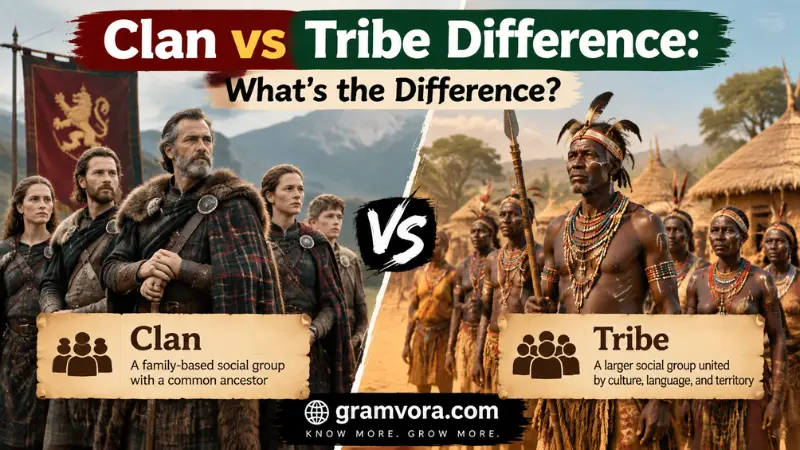
The words clan and tribe both describe groups of people, so it is easy to treat them as interchangeable. They overlap, but they usually emphasize different things.
A clan is most closely associated with family, kinship, ancestry, or a claimed common ancestor. A tribe can describe a broader community connected by culture, language, history, ancestry, territory, or social organization.
The distinction is not always absolute. In some societies, clans can exist as smaller units within a broader community described as a tribe. However, that structure is not a universal rule.
For everyday US English, the best choice depends on what you are actually trying to describe.
Quick Answer
Use clan when the main idea is a group connected by family, ancestry, or a shared lineage.
Use tribe when the main idea is a broader cultural or social community and tribe is the established term for that community.
For example:
- The entire clan gathered for the wedding.
Here, clan emphasizes a large family or related group. - The tribe has preserved its language and traditions.
Here, tribe emphasizes a wider cultural community.
There is also an important caution: do not assume that every tribe contains clans or that every clan belongs to a tribe. Those relationships vary across cultures.
Why People Confuse Them
The confusion comes from the fact that both words can describe people who share ancestry, traditions, identity, or social ties.
Dictionary definitions also overlap. Cambridge describes a clan as a group of families connected by a common family origin and also gives it an informal meaning for a large family or group sharing an interest. Tribe can refer to groups of related families that share language, culture, and history.
That overlap makes simple definitions misleading.
Another reason is that older descriptions sometimes presented social groups as if they followed one fixed hierarchy. Modern anthropology is more cautious. The category tribe has been used in many different ways, and some anthropologists avoid treating it as a universal type of society.
So the safest distinction is not simply “clan = small” and “tribe = large.” The more useful distinction is what kind of relationship or community the word emphasizes.
Key Differences At A Glance
| Feature | Clan | Tribe |
|---|---|---|
| Main idea | Kinship, family, or ancestry | Broader cultural or social community |
| Typical connection | Shared or believed common descent | Culture, history, language, ancestry, or social identity |
| Size | Often describes a more specific group | Can describe a broader community |
| Grammar | Usually a noun | Usually a noun |
| Everyday use | Can also mean a large family | Can also mean an informal group of people |
| Formal context | Depends on the community and subject | Depends strongly on the community and subject |
The key point is that size is not a reliable stand-alone test. A clan may be smaller than a wider community, but the words are defined by more than population.
Meaning and Usage Difference
Clan
A clan generally highlights a family connection or shared ancestry.
The connection may be historical, traditional, or understood within the group’s social system. Cambridge’s American Dictionary describes clan as a family, especially a large group of related people.
For example:
The whole clan came together for Thanksgiving.
In this sentence, clan is informal and means a large family.
The word can also be used for groups whose members are not literally close relatives:
The gaming clan meets online every Friday.
Here, clan refers to a group organized around a shared interest rather than biological family.
Tribe
A tribe generally points to a broader community with shared cultural, historical, linguistic, ancestral, or social ties.
Cambridge defines tribe as a group of people, often from related families, who share language, culture, and history.
For example:
The tribe has maintained its language across generations.
The sentence focuses on a community and its cultural continuity rather than simply on a family.
In the United States, tribe can also occur in formal names and discussions involving Indigenous nations and governments. In such cases, the community’s established terminology matters more than a generic dictionary distinction.
Modern anthropology also warns against assuming that tribe represents one fixed social structure. Different communities can have very different forms of organization.
Tone, Context, and Formality
Clan can sound neutral in historical, cultural, or anthropological contexts. It also has a familiar informal use for a large family.
For example:
The whole Smith clan showed up for the reunion.
That sentence sounds casual and natural in American English.
Tribe can be neutral when it is the established name or accepted term for a particular community. It can also be used informally:
Our little tribe loves camping together.
In that sentence, tribe is figurative. It means a close-knit group rather than a literal cultural community.
Care is especially important when discussing Indigenous peoples. A writer should use the community’s established name when one is known rather than automatically replacing it with tribe.
This is partly because the academic treatment of tribe has changed. Some anthropologists consider the term too broad or historically loaded to function as a universal category.
Which One Should You Use?
Choose clan when:
- family or ancestry is the central idea;
- you are describing a large family informally;
- the group is specifically known as a clan;
- the context involves a lineage or related families.
Choose tribe when:
- you are referring to a recognized community for which tribe is the established term;
- shared culture, language, history, or broader social identity is central;
- the context specifically uses tribe as part of the community’s name or description.
Do not choose based only on the supposed rule that a tribe is always larger than a clan.
A better question is: What kind of group am I describing, and what term does that community or context actually use?
When One Choice Sounds Wrong
Consider this sentence:
My clan speaks a distinct language and has its own cultural traditions.
It is not automatically wrong, but if the established community being discussed is officially or commonly called a tribe, replacing that term with clan could change the meaning.
Now consider:
Everyone in the tribe is my cousin.
That sentence could be misleading if tribe refers to a much broader community. If the speaker means an extended family, clan may be more appropriate in a context where that word is actually used.
Likewise, saying:
Every tribe is made up of several clans.
is too absolute. Some anthropological descriptions do discuss clans as divisions within larger tribal societies, but social organization varies considerably.
The safest wording is to describe the specific community rather than impose a universal structure.
Common Mistakes (and Quick Fixes)
Mistake 1: Treating the words as exact synonyms
A clan often emphasizes kinship or ancestry, while tribe can emphasize a broader cultural or social community.
Quick fix: Identify whether family connection or wider community identity is the main point.
Mistake 2: Assuming tribe always means a larger group
Size can matter in particular descriptions, but it does not provide a universal definition.
Quick fix: Focus on the group’s actual social structure and established terminology.
Mistake 3: Using clan for every family
Clan can mean a large family informally, but not every family is a clan.
Quick fix: Use family when you simply mean relatives.
Mistake 4: Treating tribe as one universal social category
Anthropological usage is more complicated than that.
Quick fix: Consider the culture, historical context, and the group’s preferred terminology.
Mistake 5: Ignoring figurative use
Both words can have informal extended meanings.
Quick fix: Read the surrounding sentence. “My gaming clan” and “our little tribe” may describe social groups rather than traditional communities.
Everyday Examples
Here are practical examples showing how the words work in context:
- The entire clan attended the family reunion.
Clan emphasizes a large family group. - The clan traces its ancestry through several generations.
Clan emphasizes ancestry. - The tribe has its own cultural traditions.
Tribe emphasizes a broader cultural community. - Several families were associated with the clan.
Clan focuses on family connections. - The tribe’s language is an important part of its identity.
Tribe emphasizes community and culture. - Our gaming clan plays together every weekend.
Clan is being used informally for a group with a shared interest. - My extended family jokingly calls itself a clan.
This is an informal family use. - The community uses a specific name for itself, so the writer used that name instead of a generic label.
This is often the most respectful and precise approach.
The examples show why context matters more than a rigid size rule.
Dictionary-Style Word Details
Verb
- Clan: Not commonly used as a verb in standard US English. Its primary use is as a noun.
- Tribe: The ordinary modern use is as a noun. A rare or specialized verbal use exists in historical or dictionary records, but it is not a normal choice for everyday US writing.
Noun
- Clan: A group of related families or people connected through ancestry; informally, a large family or close group.
- Tribe: A group or community associated with shared culture, history, language, ancestry, or social identity; the exact meaning depends on context.
Both are countable nouns:
- one clan / several clans
- one tribe / several tribes
Synonyms
- Clan: Closest plain alternatives include family group, kin group, or lineage when those terms accurately describe the context. They are not exact replacements in every sentence.
- Tribe: Depending on context, closest plain alternatives may include community, cultural group, or people. These are not exact synonyms in every use.
Neither word has one universal synonym that can replace it in every context.
Example Sentences
- Clan: The clan gathered for an annual family celebration.
- Clan: Several generations remained connected through the clan.
- Tribe: The tribe maintains strong cultural traditions.
- Tribe: Researchers studied the tribe’s language and history.
- Clan: The gaming clan competes online every weekend.
- Tribe: In casual speech, she called her closest friends her “tribe.”
Word History
The words have different histories, but their modern meanings have developed through many cultural and social contexts.
Clan entered English through Scottish Gaelic and is strongly associated with a group connected through family or ancestry.
Tribe has a much older history connected to Latin tribus. Its later use as a label for human social groups developed into a broad category used in historical and anthropological writing. Modern scholars have questioned whether that category is sufficiently precise for all societies.
The important point for modern readers is not a particular historical date but how the terms function today.
Phrases Containing
Common expressions include:
- clan member — a person belonging to a clan
- clan leader — a person who leads or represents a clan
- family clan — a family-centered use of clan
- tribal community — a community associated with a tribe
- tribal leader — a leader associated with a tribe
- tribal culture — culture associated with a tribe or tribal community
- tribal government — a formal governmental context involving a tribe
The adjective tribal is the standard adjective formed from tribe. Cambridge defines it as relating to a tribe.
FAQs
What is the main difference between a clan and a tribe?
A clan usually emphasizes family, ancestry, or shared descent. A tribe can refer to a broader community connected by culture, language, history, ancestry, or social identity. The exact distinction depends on the society and context.
Is a clan smaller than a tribe?
Not necessarily. In some social systems, clans may function as smaller groups within a broader community, but this is not a universal rule. Size alone does not reliably distinguish a clan from a tribe.
Are clans based on family relationships?
Usually, the idea of kinship or shared ancestry is important to the meaning of clan. However, the exact way a clan defines membership can vary between cultures and communities.
Is a tribe made up of several clans?
Sometimes, but not always. Some social systems have multiple clans within a larger community, while others do not fit that structure. It is better to describe the specific community than assume that every tribe contains clans.
Can clan and tribe mean the same thing?
They can overlap in some contexts, but they are not exact synonyms. Clan generally places more emphasis on kinship or ancestry, while tribe can emphasize a broader cultural or social community.
Which word should I use for a large family?
Clan can be a natural informal choice when referring to a large or extended family. For example, “The whole clan came to the family reunion” sounds natural in American English.
Can tribe be used for a group of friends?
Yes, in informal and figurative US English. Someone might say, “My friends are my tribe” to describe a close-knit group. In this use, tribe does not refer to a traditional cultural community.
Is it correct to say “clan leader”?
Yes. Clan leader is a natural phrase for someone who leads or represents a clan. The appropriate title and leadership structure can vary among different communities.
Is it correct to say “tribal community”?
Yes. Tribal community is a commonly used phrase when referring to a community associated with a tribe. However, when discussing a particular Indigenous community, using its established name or preferred terminology is often more precise.
What is the easiest way to remember clan vs tribe?
Think of clan as emphasizing kinship or ancestry, while tribe can emphasize a broader cultural or social community. Just remember that this is a practical guide, not an absolute rule.
Conclusion
The clan vs tribe difference is mainly about what the word emphasizes.
Clan most strongly points to family, kinship, ancestry, or a related group. Tribe can describe a broader community connected through culture, language, history, ancestry, or social identity.
The distinction is useful, but it should not become a rigid rule. A tribe is not automatically just a large clan, and a clan is not automatically a smaller tribe. Social organization differs across cultures, and communities may have their own preferred names and structures.
For everyday US English, remember the simplest practical guide:
Use “clan” when kinship or family connection is central. Use “tribe” when referring to a broader community for which that term is appropriate or established.


