
Family relationship terms can become confusing quickly, especially when words such as first cousin, second cousin, and once removed appear together.
At first, the labels may seem to describe how close or distant two relatives are. That is not quite how the system works. Each part of the label tells you something different about the family connection.
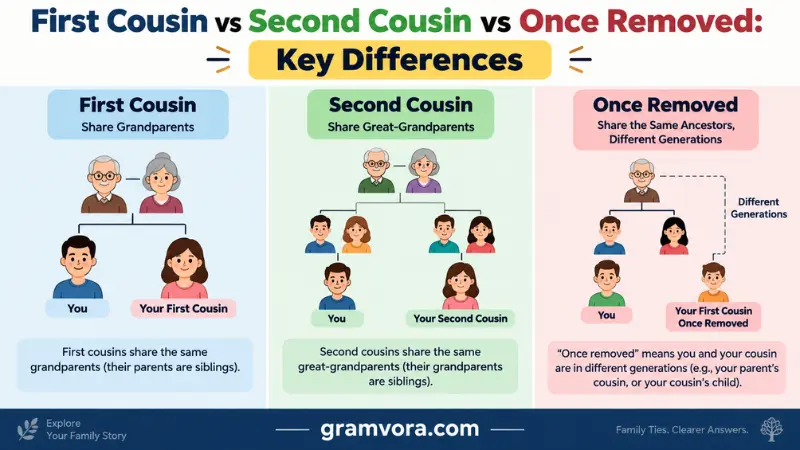
A first cousin and a second cousin are people who share a common ancestor at different levels of the family tree. First cousins share grandparents. Second cousins share great-grandparents.
The phrase once removed works differently. It does not mean that someone is simply a more distant cousin. Instead, it tells you that the two people are one generation apart.
For example, your first cousin’s child is your first cousin once removed. Your parent’s first cousin is also your first cousin once removed.
Understanding that difference makes these labels much easier to use.
Quick Answer
A first cousin is the child of your aunt or uncle. You and your first cousin share grandparents.
A second cousin is someone who shares your great-grandparents as common ancestors. In a typical family tree, your parent’s first cousin’s child is your second cousin.
Once removed means that two cousins are separated by one generation.
So these labels are not three levels of the same thing:
- First cousin = cousin level based on the shared ancestor.
- Second cousin = a more distant cousin level based on the shared ancestor.
- Once removed = a one-generation difference between the two relatives.
For example, if your cousin has a child, that child is your first cousin once removed. You are not second cousins simply because the child belongs to the next generation.
That is the most important distinction to remember.
Why People Confuse Them
The confusion usually comes from treating “first,” “second,” and “once removed” as though they all measure the same thing.
They do not.
The number in first cousin or second cousin relates to the generations between each person and the shared ancestor.
A first cousin relationship normally involves shared grandparents. Both people are two generations away from those grandparents.
A second cousin relationship normally involves shared great-grandparents. Both people are three generations away from those great-grandparents.
The word removed measures something different. It describes a difference in generation between the two people.
Imagine that you and your first cousin are the same age generation in your family tree. You are both grandchildren of the same grandparents.
If your first cousin has a child, that child is one generation below you. The child remains connected to you through the same cousin line, but the generations no longer match.
That is why the relationship becomes first cousin once removed.
The word “removed” does not mean the person has been removed from the family. It is simply a relationship term describing a generation difference.
Key Differences At A Glance
| Context | Best Choice | Why |
|---|---|---|
| Your aunt’s or uncle’s child | First cousin | You normally share grandparents |
| Child of your first cousin | First cousin once removed | The child is one generation below you |
| Your parent’s first cousin | First cousin once removed | That relative is one generation above you |
| Child of your parent’s first cousin | Second cousin | You normally share great-grandparents |
| Person who shares your great-grandparents and is in your generation | Second cousin | You are the same generation from the common ancestors |
| Two cousins separated by one generation | Once removed | “Once removed” identifies the one-generation difference |
A useful way to think about the system is:
Cousin number = how far back the shared ancestor is.
Removed number = how many generations apart the two people are.
For example:
- Same generation + shared grandparents = first cousins.
- Same generation + shared great-grandparents = second cousins.
- One-generation difference + first-cousin relationship = first cousins once removed.
- One-generation difference + second-cousin relationship = second cousins once removed.
A Simple Comparison
| Feature | First Cousin | Second Cousin | Once Removed |
|---|---|---|---|
| Main idea | Cousin level | Cousin level | Generation difference |
| Typical shared ancestor | Grandparents | Great-grandparents | Depends on cousin level |
| Same generation? | Usually yes | Usually yes | No |
| Example | Aunt’s child | Parent’s first cousin’s child | First cousin’s child |
| Meaning of label | Relationship degree | Relationship degree | One-generation separation |
Meaning and Usage Difference
What Is a First Cousin?
Your first cousin is normally the child of your parent’s sibling.
For example, suppose your mother has a sister named Maria. Maria has a son named David.
You and David are first cousins.
You both have the same grandparents, because your mother and Maria are siblings.
A simple family structure looks like this:
Grandparents → two siblings → their children
The children of those two siblings are first cousins.
In everyday American English, people often simply say cousin when they mean first cousin. If someone says, “My cousin is coming over,” the listener will usually understand the general relationship without needing the word “first.”
What Is a Second Cousin?
Second cousins share great-grandparents as their common ancestors.
One common example is the child of your parent’s first cousin.
Suppose your father has a first cousin named James. James has a daughter named Emily.
Emily is your second cousin.
Why?
Your father and James are first cousins. Their children belong to the next generation, making you and Emily second cousins.
Second cousins are therefore one level farther out on the family tree than first cousins.
What Does “Once Removed” Mean?
“Once removed” means the two relatives are one generation apart.
This is the part many people find confusing.
Suppose you and Sarah are first cousins. Sarah has a daughter named Olivia.
You and Olivia are first cousins once removed.
You are still connected through the same first-cousin line, but Olivia is one generation below you.
The relationship works in the other direction too.
If your father has a first cousin named Mark, Mark is your first cousin once removed. Mark is one generation above you.
Therefore, “once removed” can describe a relative who is either:
- one generation older, or
- one generation younger.
The phrase describes the generation gap, not whether the person is older or younger in age.
Tone, Context, and Formality
These relationship terms are neutral and standard in American English.
There is no special informal or formal version of first cousin or second cousin. The same terms can appear in everyday conversation, family-tree research, legal or historical writing, and genealogy discussions.
In casual conversation, people often shorten first cousin to simply cousin.
For example:
“She’s my cousin.”
That is perfectly natural when the exact degree does not matter.
If the exact relationship matters, use the more precise term:
“She’s my first cousin.”
Likewise, when explaining a family connection that spans generations, once removed is useful because it prevents confusion.
For example:
“He’s my first cousin once removed.”
This is more precise than simply saying:
“He’s my cousin.”
The shorter version is not necessarily wrong, but it leaves out useful information.
Which One Should You Use?
Choose first cousin for the child of your aunt or uncle.
A second cousin is someone who normally shares your great-grandparents and belongs to the same generation.
The term once removed applies when two relatives are one generation apart.
The easiest method is to stop looking at the ages of the people and look at their positions on the family tree.
Age does not determine whether someone is your first cousin or second cousin.
For example, you might have a second cousin who is older than you and a first cousin who is younger than you. Age is not the deciding factor.
Instead, identify the common ancestor.
Then ask:
- How many generations separate me from that ancestor?
- How many generations separate the other person from that ancestor?
- Are we in the same generation?
- If not, how many generations apart are we?
If you and the other person are equally far from the common ancestor, there is normally no “removed” label.
If you are one generation apart, the relationship is “once removed.”
When One Choice Sounds Wrong
Calling your first cousin’s child your second cousin is a common mistake.
That child is your first cousin once removed, not your second cousin.
The difference becomes clearer when you compare the family tree.
Your first cousin and you share grandparents.
Your first cousin’s child is one generation below you. The child still belongs to your first-cousin relationship line, but there is now a one-generation difference.
Another common mistake is assuming that “removed” means the relationship is less close.
That is not what the word means.
For example, a first cousin once removed can actually be more closely connected on a family tree than a second cousin. The labels describe different aspects of the relationship.
It is also incorrect to assume that “once removed” always means the younger person.
Your parent’s first cousin is also your first cousin once removed, even though that person is in the generation above you.
Common Mistakes (and Quick Fixes)
Mistake 1: Thinking second cousin means your cousin’s child
Not necessarily.
Fix: Your first cousin’s child is your first cousin once removed.
Mistake 2: Thinking once removed means unrelated
It does not.
Fix: “Removed” describes a difference in generations between two relatives.
Mistake 3: Using age to determine the cousin number
Age is not the basis of the relationship label.
Fix: Identify the shared ancestor and count generations.
Mistake 4: Assuming once removed always means younger
It can refer to someone one generation above or below you.
Fix: Look at both people’s positions in the family tree.
Mistake 5: Calling every extended-family relative a second cousin
Not every distant relative is a second cousin.
Fix: Second cousins normally share great-grandparents.
Mistake 6: Thinking “first” means closer in age
The word “first” refers to the cousin relationship level, not physical or age-based closeness.
Fix: Focus on the shared ancestor.
Everyday Examples
Here are some realistic examples that make the differences easier to understand.
Example 1: Your aunt’s son
Your mother’s sister has a son named Alex.
Alex is your first cousin.
You and Alex share grandparents.
Example 2: Your first cousin’s daughter
Your first cousin Alex has a daughter named Mia.
Mia is your first cousin once removed.
You and Alex are in the same generation. Mia is one generation below you.
Example 3: Your parent’s first cousin
Your father has a first cousin named Robert.
Robert is your first cousin once removed.
Robert belongs to the generation above you.
Example 4: Your parent’s first cousin’s daughter
Robert has a daughter named Emma.
Emma is your second cousin.
You and Emma are in the same generation and normally share great-grandparents.
Example 5: A family reunion
Imagine a family reunion with three generations of relatives.
You meet your mother’s cousin and her granddaughter.
Your mother’s cousin is your first cousin once removed.
Her granddaughter may have a different cousin relationship to you depending on the exact family structure and generation distance.
This is why it is better to map the family tree than to guess from labels alone.
Example 6: Genealogy research
Suppose a family record says that two people are second cousins once removed.
The phrase tells you two things:
- “Second cousin” identifies their cousin level.
- “Once removed” tells you they are one generation apart.
That is much more precise than simply calling them distant cousins.
Dictionary-Style Word Details
Verb
First cousin: Not commonly used as a verb in standard US English. It functions primarily as a noun phrase describing a family relationship.
Second cousin: Also functions primarily as a noun phrase. It is not normally used as a verb.
Once removed: “Removed” is the key word describing the generational difference in expressions such as first cousin once removed. In this family-relationship use, it does not mean physically separated or excluded from a family.
Noun
First cousin: A noun phrase identifying a person who is normally the child of your aunt or uncle and shares your grandparents.
Second cousin: A noun phrase identifying a person who normally shares your great-grandparents with you.
First cousin once removed / second cousin once removed: These are noun phrases identifying cousin relationships in which the two people are separated by one generation.
The number identifies the cousin level. The word “removed” identifies the generational difference.
Synonyms
Exact synonyms are limited because these are precise family-relationship terms.
First cousin: In ordinary conversation, cousin is a common shorter alternative when the exact relationship is obvious or unimportant.
Second cousin: There is no equally precise everyday synonym that should replace the term.
Once removed: There is no exact plain-English replacement that preserves the full genealogical meaning. A person can explain it as “one generation apart,” but that is an explanation rather than a true synonym.
Example Sentences
First cousin:
- My first cousin lives in Texas.
- I grew up with several of my first cousins.
- Her first cousin is also attending the family reunion.
Second cousin:
- I met my second cousin for the first time at a family gathering.
- We discovered that we are second cousins through our great-grandparents.
- My second cousin lives on the other side of the country.
Once removed:
- Her daughter is my first cousin once removed.
- He is my father’s first cousin, so he is my first cousin once removed.
- We discovered that they are second cousins once removed.
Word History
The family-relationship system uses cousin to describe relatives who share an ancestor outside the immediate parent-child and sibling relationships.
The specific labels first cousin, second cousin, and once removed developed as ways of making those relationships more precise.
The exact meaning of “removed” in this context is straightforward: it identifies a difference in generations between two relatives.
There is no need to attach a special historical meaning to the term when using it today. In modern US English, these labels are primarily practical ways to describe positions on a family tree.
Phrases Containing
Common expressions include:
- first cousin
- second cousin
- first cousin once removed
- second cousin once removed
- first cousin twice removed
- second cousin twice removed
The same basic pattern continues as the family relationship extends across generations.
For example, twice removed indicates a two-generation difference, while once removed indicates a one-generation difference.
The important point is that the cousin number and the removal number provide separate information.
FAQs
What is the difference between a first cousin and a second cousin?
A first cousin is typically the child of your aunt or uncle, and you share grandparents. A second cousin is usually someone with whom you share great-grandparents. Second cousins are therefore one level farther out on the family tree.
Is my first cousin’s child my second cousin?
No. Your first cousin’s child is your first cousin once removed. The child is one generation below you, so “once removed” describes the generation difference.
Is my parent’s first cousin my first cousin once removed?
Yes. Your parent’s first cousin is normally your first cousin once removed because that person is one generation above you.
What does “once removed” mean in a family relationship?
“Once removed” means that two relatives are one generation apart. It can describe someone one generation older or one generation younger than you.
Are second cousins closer than first cousins once removed?
The terms describe different aspects of a family relationship, so they should not be treated as a simple closeness ranking. “Second cousin” describes the cousin level, while “once removed” describes a one-generation difference.
Do first cousins and second cousins share the same grandparents?
Usually, no. First cousins normally share grandparents. Second cousins normally share great-grandparents.
Can a person be both a second cousin and once removed?
Yes. For example, someone can be your second cousin once removed. “Second cousin” identifies the cousin level, while “once removed” indicates that you and the person are one generation apart.
Does “once removed” mean the relative is younger?
No. A cousin once removed can be either older or younger than you. Your parent’s first cousin can be your first cousin once removed, and your first cousin’s child can also be your first cousin once removed.
Is my cousin’s grandchild my first cousin twice removed?
Typically, yes. Your first cousin’s child is your first cousin once removed, and that child’s child is your first cousin twice removed. “Twice removed” indicates a two-generation difference.
Conclusion
The difference between a first cousin, second cousin, and a cousin once removed becomes much easier when you separate two ideas: cousin level and generation difference.
A first cousin normally shares your grandparents.
A second cousin normally shares your great-grandparents.
Once removed means that you and the other cousin are one generation apart.
That means your first cousin’s child is your first cousin once removed, not automatically your second cousin. Likewise, your parent’s first cousin is your first cousin once removed because that person is one generation above you.
The simplest way to identify any of these relationships is to find the most recent common ancestor and compare how many generations separate each person from that ancestor.
Remember the basic formula:
First or second = cousin level.
Once removed = one-generation difference.
Once you understand that distinction, family-tree labels become much easier to read, explain, and use correctly.


