
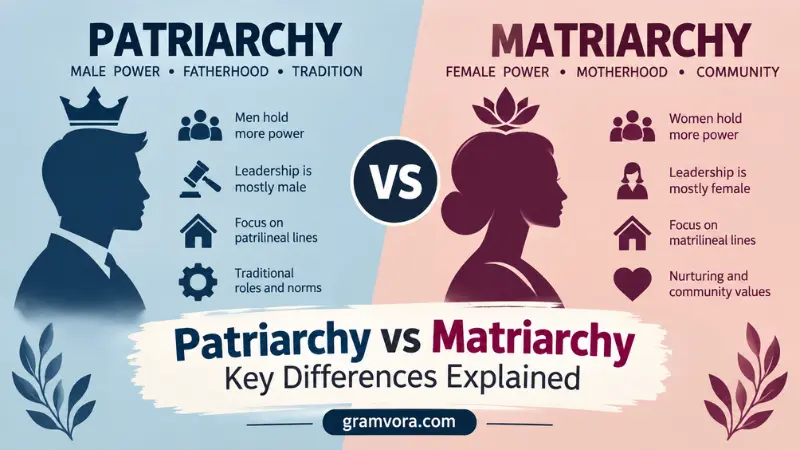
The phrase patriarchy vs matriarchy diagram usually refers to a visual way of understanding two different ideas about gender and social power.
Patriarchy describes a social arrangement in which men hold major authority or power. Matriarchy refers to a system in which women are understood as holding that kind of central authority.
These terms are often confused with words such as patrilineal, matrilineal, and matrilocal. Those words describe family descent or residence rather than necessarily describing who controls society.
Understanding the difference matters because a family can follow the mother’s lineage without being a matriarchy. Likewise, a society can have women in important leadership positions without every part of society being matriarchal.
This guide explains the two terms, gives you a simple diagram, and clears up the most common terminology problems.
Quick Answer
A patriarchy is a social system in which men hold primary authority or power. A matriarchy refers to a social system in which women hold primary authority or power.
The two terms describe gender and power, while patrilineal and matrilineal describe descent.
TL;DR
• At its core, patriarchy centers social authority on men.
• By contrast, matriarchy refers to female-centered authority.
• Neither word simply describes having a father or mother as family head.
• A matrilineal system follows the maternal line for descent or inheritance.
• Being patrilineal does not mean every man has equal social power.
• In practice, social systems can contain several forms of authority at once.
Patriarchy Definition
Patriarchy is a social system or pattern in which men are positioned as major holders of authority and power.
The concept can apply to family life, institutions, economic systems, politics, religion, and other parts of society. Anthropological sources describe patriarchy as a gender system that places men in dominant positions in private and public life.
In a simple family example, a household might traditionally recognize the oldest man as the main decision-maker. In a broader social example, men may occupy many positions of institutional authority.
The term does not mean that every man has power over every woman. It describes a broader social pattern.
Patriarchy in Simple Words
Think of patriarchy as:
Men → greater institutional or family authority → women
This is a simplified model. Real societies contain different laws, customs, families, and levels of individual authority.
Patriarchy can also operate through traditions and expectations. For example, a culture may expect men to provide financially while expecting women to handle most domestic responsibilities.
Matriarchy Definition
Matriarchy refers to a social system or ideology in which women hold primary authority or power.
The basic concept is therefore different from patriarchy. Instead of men occupying the dominant position, women would occupy that central position.
OpenStax describes matriarchy as a gender ideology that positions women as rulers of private and public life. It also notes that anthropologists have not identified a contemporary society that clearly fits a simple model of women dominating men across all social institutions.
This point is important because people often use matriarchy to describe any family where a mother is highly influential.
That is usually too broad.
A mother who makes many household decisions does not automatically make the entire family or society matriarchal.
Patriarchy vs Matriarchy Diagram
Here is a simple way to visualize the basic distinction:
| Context | Patriarchy | Matriarchy |
|---|---|---|
| Main authority | Men | Women |
| Power structure | Male-centered | Female-centered |
| Leadership | Primarily associated with men | Primarily associated with women |
| Family authority | Senior men may hold major authority | Senior women may hold major authority |
| Social institutions | Men hold greater structural power | Women would hold greater structural power |
| Basic idea | Male-centered authority | Female-centered authority |
The diagram should be read as a conceptual model, not as a claim that every society fits perfectly into one category.
Social systems can contain several forms of authority at the same time.
For example, a family may have a male head while inheritance follows the mother’s family line. That arrangement can be patriarchal in one respect and matrilineal in another.
Key Differences Between Patriarchy and Matriarchy
The most important difference is who is understood to hold primary social authority.
Under the basic definition of patriarchy, men occupy the central position of authority. Under the basic definition of matriarchy, women occupy that position.
The difference can appear in several areas.
Leadership
A patriarchal structure gives greater authority to men. A matriarchal structure, in the theoretical sense, gives greater authority to women.
Family Decisions
In a patriarchal family structure, senior men may control important family decisions. In a matriarchal structure, senior women would have that central role.
Resources
Authority can also involve control over property, money, land, or other resources.
Social Institutions
Patriarchy can extend beyond families into political, economic, religious, and educational institutions. A true matriarchal structure would similarly place women in central positions across major institutions.
Patriarchy in Everyday Social Structures
Patriarchy is not limited to family relationships.
Sociologists and anthropologists can examine gendered power within institutions, cultural expectations, and social practices. OpenStax describes patriarchy as connected to political, economic, family, and other social structures.
Consider a traditional family structure.
A father or grandfather may be treated as the final authority. Property may also be controlled through the male side of the family.
Another example involves expectations about work.
A culture might expect men to earn income while women are expected to focus on childcare and household work. That division alone does not prove a society is patriarchal, but it can be examined as part of broader gender expectations.
The key question is not simply, “Who does this job?”
The more useful question is, “Who has authority, resources, and decision-making power?”
Matriarchy and the Evidence
Matriarchy is more complicated than the simple opposite of patriarchy.
The word is often used to describe a society where women have major authority. However, anthropological research warns against assuming that female-centered family systems automatically equal matriarchy.
OpenStax notes that researchers have proposed various theories about ancient matriarchies, but interpretations of archaeological evidence have been disputed.
This means readers should be careful with statements such as:
“This society is matriarchal because women inherit property.”
Inheritance through women does not automatically prove female political or social dominance.
Likewise, a society can give mothers an important role without giving women greater authority in every institution.
A useful distinction is therefore:
Women-centered family practice ≠ automatically matriarchy
Matriarchy vs Matrilineal
This is one of the most important distinctions in the entire topic.
Matrilineal describes descent through the mother’s family line.
For example, a matrilineal system may determine family membership or inheritance through the mother’s relatives.
Matriarchy, however, concerns authority and power.
A matrilineal society can still have important leadership roles held by men. OpenStax specifically explains that matrilineal kinship does not automatically make a society matriarchal.
Simple Example
Imagine a community where:
- Children belong to their mother’s family line.
- Property passes through the mother’s relatives.
- Family membership follows the mother.
- Senior men still make many major decisions.
That community can be matrilineal without being matriarchal.
This distinction prevents one of the most common errors in discussions about family structures.
Related Terms You Should Know
Several similar words describe different ideas.
Patriarchal
Patriarchal is the adjective related to patriarchy.
Example:
The organization had a strongly patriarchal structure.
Matriarchal
Matriarchal is the adjective related to matriarchy.
Example:
The story describes a matriarchal community.
Patrilineal
Patrilineal refers to descent through the father’s or male line.
It is primarily a kinship concept.
Matrilineal
Matrilineal refers to descent through the mother’s or female line.
It does not automatically describe who controls the society.
Patrilocal
Patrilocal refers to a residence pattern in which a married couple lives with or near the husband’s family.
Matrilocal
Matrilocal refers to a residence pattern in which a married couple lives with or near the wife’s family.
OpenStax uses these kinship and residence distinctions when discussing different family systems.
Common Misunderstandings
“Matriarchy means women are mothers.”
Not exactly.
The term concerns authority and power, not simply motherhood.
“Matrilineal means women rule.”
No.
Matrilineal describes descent or inheritance through the maternal line. It does not automatically establish female political authority.
“Patriarchy means every man is powerful.”
No.
Patriarchy describes a broader social structure. Individual men can have little authority or social power.
“A female family leader creates a matriarchy.”
Not necessarily.
One woman can be the head of a household without the wider society being matriarchal.
“Patriarchy and matriarchy describe identical real-world systems.”
The terms are conceptual categories. Real societies can have mixed and complicated patterns of authority.
Examples and Simple Scenarios
Scenario 1: Male family authority
A family traditionally expects the oldest male relative to make major financial and family decisions.
This illustrates a patriarchal family pattern.
Scenario 2: Female family authority
A fictional community gives senior women primary authority over family resources, leadership, and major social decisions.
That represents a matriarchal model.
Scenario 3: Maternal inheritance
A community passes family property through daughters, but senior men still hold many leadership positions.
This can be matrilineal without being matriarchal.
Scenario 4: Shared authority
A family divides financial, household, and parenting decisions between adults without giving one gender automatic authority.
That example does not fit a simple patriarchal or matriarchal model.
These examples show why one family practice should not automatically be treated as proof of an entire social system.
FAQs
What is the difference between patriarchy and matriarchy?
Patriarchy describes a social arrangement in which men hold primary authority or power. Matriarchy describes a system in which women are understood to hold primary authority.
The terms focus on gender and power rather than simply family membership.
Is matriarchy the opposite of patriarchy?
Conceptually, they point in opposite directions. Patriarchy centers authority on men, while matriarchy centers authority on women.
However, real societies may not fit either model perfectly.
What is a patriarchal society?
A patriarchal society is one in which men hold significant or primary authority across important areas of social life.
This can involve family structures, institutions, economic resources, leadership, and cultural expectations.
What is a matriarchal society?
A matriarchal society would be one in which women hold primary authority across major areas of social life.
The concept is clearer as a theoretical category than as a description of a universally accepted contemporary society.
Is a matrilineal society the same as a matriarchal society?
No.
Matrilineal refers to descent through the maternal line. Matriarchal refers to female-centered authority or power.
A society can therefore be matrilineal without being matriarchal.
Does patriarchy only exist in families?
No.
The concept can also be applied to institutions and wider social structures. Researchers may examine gendered authority in economic, political, religious, educational, and family settings.
Are there matriarchal societies today?
The answer depends on how strictly matriarchy is defined.
Anthropological discussions distinguish matriarchy from matrilineal and matrilocal systems. OpenStax notes that researchers have not identified a contemporary society that clearly fits a broad model of women dominating men throughout social institutions.
Mini Quiz
1. What does patriarchy primarily describe?
A. Descent through mothers
B. Male-centered authority
C. Residence near the mother’s family
Answer: B
2. What does matrilineal mean?
A. Women rule society
B. Men rule society
C. Descent follows the maternal line
Answer: C
3. Does matrilineal automatically mean matriarchal?
Answer: No.
4. What does matriarchy describe?
Answer: A social system or ideology centered on female authority.
Conclusion
The simplest patriarchy vs matriarchy diagram places male-centered authority on one side and female-centered authority on the other.
The most important distinction is between power and descent. Patriarchy and matriarchy concern authority, while patrilineal and matrilineal describe family lineage.
When reading about gender and family systems, keeping these terms separate makes the discussion much easier to understand.


