
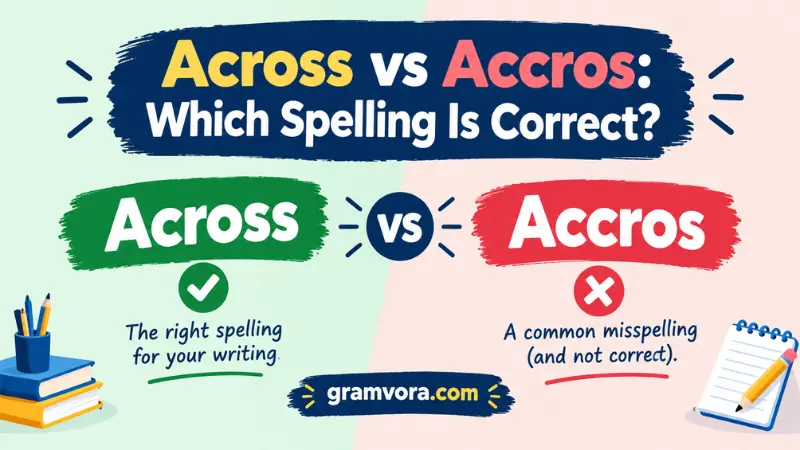
Across vs Accros is a common spelling question for people who are learning English or typing quickly. The two forms look very similar, but they are not equal spellings of the same word.
The correct spelling is across.
Accros is a misspelling. It is not a standard alternative spelling used in American English or British English. Major dictionaries list across as the standard word and give it several related uses as a preposition and adverb.
You may see accros when someone makes a typing mistake, leaves out a letter, or writes the word based on an incorrect memory of its spelling. Because the word contains a double-sounding sequence in speech, some learners may accidentally leave out the second s or rearrange the letters.
The good news is that the correction is simple:
Use “across.” Do not use “accros.”
The word across can describe movement from one side to another, location on the opposite side, something extending from one side to another, or something occurring throughout an area. It is also common in phrases such as across the street, across the country, and across the room.
This guide explains the spelling, pronunciation, grammar, common mistakes, everyday examples, and useful expressions so you can confidently use across in your writing.
Quick Answer
The correct spelling is across.
| Context | Best Choice | Why |
|---|---|---|
| Standard American English | across | This is the standard spelling. |
| Standard British English | across | British English also uses this spelling. |
| Formal writing | across | It is the recognized dictionary form. |
| Informal texting | across | Shortening or misspelling it as accros is unnecessary. |
| Academic writing | across | Use the standard spelling. |
| Professional communication | across | Accros can look like a spelling error. |
The simple rule
Write:
across
Not:
accros
For example:
- We walked across the street.
- She looked across the room.
- The store is across from the bank.
- The news spread across the country.
Do not write:
- We walked accros the street.
- She looked accros the room.
- The store is accros from the bank.
The incorrect form accros does not become acceptable simply because it may appear in online writing. A typo can occur anywhere, including in casual messages, comments, or social posts.
Why People Confuse Them
The main reason people confuse across and accros is that the words look almost identical.
The correct spelling contains the sequence:
a-c-r-o-s-s
The incorrect form contains:
a-c-c-r-o-s
The two forms therefore differ in the placement and number of letters.
When people write quickly, they may accidentally type accros instead of across. This can happen because the letters c, r, and o occur close together and the final ss may be remembered incorrectly.
Pronunciation can also contribute to spelling uncertainty. In American English, across is pronounced approximately uh-KROSS. Cambridge gives the American pronunciation as /əˈkrɔs/, while Oxford gives the American form as /əˈkrɔːs/.
The sound does not clearly tell a learner that the written word ends in ss. English spelling often requires remembering the written form rather than simply writing every letter that seems obvious from pronunciation.
Another source of confusion is visual memory. Someone may have seen accros in an incorrectly typed message and later remember that form as if it were correct.
That does not make accros a legitimate spelling variant.
A useful habit is to remember the word as two parts:
a + cross = across
The word is historically related to the word cross, and the spelling retains the cross sequence at the end. Oxford identifies its origin as Middle English, from French expressions involving croix and later associated with a- plus cross.
This gives you a helpful visual reminder:
a + cross → across
Key Differences At A Glance
The most important point is that there is no legitimate US-versus-UK spelling difference between across and accros.
| Feature | Across | Accros |
|---|---|---|
| Standard spelling | Yes | No |
| American English | Correct | Misspelling |
| British English | Correct | Misspelling |
| Dictionary entry as the standard word | Yes | No |
| Common grammatical uses | Preposition and adverb | None as a standard English word |
| Formal writing | Appropriate | Avoid |
| Meaning | Has several established meanings | No standard meaning |
| Pronunciation | /əˈkrɔs/ in American English | Not established as a standard word |
| Recommended form | Use it | Do not use it |
The difference is therefore a spelling error, not a difference in meaning.
Across is the English word.
Accros is simply an incorrect spelling of that word.
This distinction matters because some spelling comparisons involve two accepted forms. For example, English sometimes has different spellings in American and British usage. That is not what happens here.
There is no standard English variety in which accros replaces across.
Are They the Same Word?
They are intended to represent the same word when someone writes accros, but only across is the accepted spelling.
The standard word across functions primarily as a preposition and adverb. Cambridge lists both grammatical categories and gives meanings involving movement from one side to another and being on the opposite side.
For example:
- We walked across the bridge.
- The children ran across the field.
- My office is across the street.
- She looked across at me.
- The message spread across the country.
The word can also describe something extending from one side to another:
- A line was drawn across the page.
- A bridge stretches across the river.
- She folded her arms across her chest.
Oxford gives similar uses, including movement from one side to another, location on the opposite side, something extending over part of the body, and distribution throughout an area.
By contrast, accros does not have an independent standard meaning. If someone writes:
We walked accros the road.
the intended word is clearly across.
The correction is therefore:
We walked across the road.
It would be misleading to describe accros as a second spelling of across. It is better described as a misspelling.
Is “Accros” ever correct?
In standard English writing, no.
A person might type accros by mistake, but accidental use does not establish it as an accepted spelling.
If you are writing an essay, email, article, school assignment, résumé, report, website page, or professional message, use across.
US vs UK Preference
There is no meaningful US-versus-UK spelling choice between across and accros.
Both American and British English use across.
Cambridge provides American and British pronunciation information for across, while Oxford also provides American English information for the word. The spelling remains across in both varieties.
For American English, use:
across
For British English, use:
across
This is different from genuine regional spelling differences such as some words that use -or in American English and -our in British English. Across does not follow that type of variation.
You should therefore not write accros merely because you are following American English.
It is not an American spelling.
Likewise, accros is not a British spelling.
Pronunciation in American English
The American pronunciation is approximately:
uh-KROSS
Cambridge lists /əˈkrɔs/ for American English.
Oxford’s American dictionary gives /əˈkrɔs/ as well.
The exact vowel sound can vary somewhat among speakers and accents, but this does not change the spelling.
A useful pronunciation-to-spelling reminder is:
uh-KROSS → across
The final sound corresponds to the ss in the written form.
Which Spelling Should You Use?
Use across.
There is no situation in standard American English where you need to choose accros instead.
In school writing
Use:
The students walked across the field.
Avoid:
The students walked accros the field.
In professional writing
Use:
Our company has offices across the United States.
Avoid:
Our company has offices accros the United States.
In emails
Use:
I saw your message across the platform.
or:
The store is across the street.
In articles
Use:
The trend has spread across several major cities.
In everyday conversation
Use:
I’ll meet you across the street.
The word across is completely natural in everyday American English.
A useful memory trick
Think of:
across = a + cross
The spelling contains the word cross:
a + cross → across
This is not a rule that requires you to analyze the word every time you write it. It is simply a helpful memory device.
If you remember cross, you are less likely to accidentally type accros.
When One Spelling Looks Wrong
Accros looks wrong because it is not the standard written form of the word.
Consider this sentence:
She walked accros the parking lot.
Most readers will understand the intended meaning immediately, but the spelling may distract them.
The corrected version is:
She walked across the parking lot.
The issue is not grammar. The sentence structure is fine. The problem is the spelling of one word.
This is important because writers sometimes try to find a meaning difference where none exists.
There is no rule such as:
- across for movement
- accros for location
That distinction is false.
There is also no rule such as:
- across in American English
- accros in British English
That distinction is false too.
There is only one standard spelling:
across
What if you see “accros” online?
Treat it as a typo unless the context clearly shows that someone is discussing the misspelling itself.
For example, a language-learning article might write:
“Accros” is a common misspelling of “across.”
In that sentence, accros appears because the writer is talking about the incorrect form. That does not make the spelling acceptable in ordinary writing.
The same principle applies to dictionaries, spelling guides, and proofreading articles. An incorrect form can be displayed for discussion without becoming a correct word.
Common Mistakes (and Quick Fixes)
Mistake 1: Leaving out the second “s”
Incorrect:
We drove accros the bridge.
Correct:
We drove across the bridge.
Remember the ending:
-ross
not:
-ros
Mistake 2: Moving the “r”
Incorrect:
She walked accros the room.
Correct:
She walked across the room.
The correct letter order is:
a-c-r-o-s-s
Mistake 3: Treating “accros” as an alternative spelling
Incorrect idea:
“Across” is American, while “accros” is another English spelling.
Correct idea:
Across is the standard spelling in both American and British English.
Mistake 4: Using the incorrect form in formal writing
Incorrect:
The company operates accros the country.
Correct:
The company operates across the country.
A spelling error may look especially noticeable in a résumé, cover letter, academic paper, or business document.
Mistake 5: Assuming pronunciation determines spelling
The sound of across does not automatically reveal every letter.
This is common in English. Some words have spellings that learners cannot reliably predict from sound alone.
The safest approach is to learn the written form:
across
Mistake 6: Confusing “across” with “cross”
The words are related in spelling and meaning, but they do not function identically.
Compare:
We walked across the street.
with:
We crossed the street.
In the first sentence, across is a preposition. In the second, crossed is the past-tense form of the verb cross.
Do not replace one with the other automatically.
Mistake 7: Confusing “across” with “through”
These words can both describe movement, but they are not always interchangeable.
Cambridge explains that across is commonly used when moving from one side to another across something with clear sides or limits, while through is used when movement goes within something such as a forest or long grass.
For example:
We walked across the field.
but:
We walked through the forest.
This is a usage distinction, not a spelling distinction, but it can help prevent related mistakes.
Everyday Examples
The best way to remember across is to see it in natural sentences.
Movement from one side to another
We walked across the street.
She ran across the field.
They swam across the lake.
The dog jumped across the stream.
He drove across the bridge.
These examples show the basic idea of moving from one side to another. Cambridge and Oxford both give this central sense in their dictionary entries.
Being on the opposite side
The pharmacy is across the street.
Our hotel is across from the station.
Her apartment is across the hall.
The restaurant is across from the bank.
The phrase across from is especially common in American English. Cambridge specifically notes its use for referring to something or someone on the opposite side.
Extending from one side to another
A crack ran across the window.
She drew a line across the page.
The bridge stretches across the river.
He placed a towel across his shoulders.
Oxford includes uses involving something extending over or across part of a body or surface.
Throughout an area
The storm caused damage across the state.
Stores across the country opened early.
The announcement was shared across the organization.
People across the city attended the event.
This use means something is happening in many parts of a particular area, group, or organization. Cambridge and Oxford both recognize this broader distribution sense.
Looking or reaching toward something
She looked across the room.
He glanced across at his friend.
I reached across the table for the salt.
These examples show that across is useful for describing direction or position as well as physical movement.
Measurement
Across can also appear after a measurement to describe width or distance from one side to another.
For example:
The pool is 30 feet across.
The room is about 20 feet across.
The table is six feet across.
Cambridge notes this measurement use, and Oxford also gives examples in which across follows a measurement.
Dictionary-Style Word Details
Verb
Across is not normally used as a standalone verb in standard American English.
Accros is not a standard verb either.
The important grammatical roles for across are primarily preposition and adverb. Cambridge explicitly identifies those two categories.
Do not invent a verb form such as to across in ordinary English.
Instead, English uses verbs such as:
- cross
- walk
- run
- drive
- swim
- move
- travel
For example:
We walked across the bridge.
Here, walked is the verb and across helps describe the movement.
Likewise:
She ran across the field.
The verb is ran, not across.
Noun
Across is not normally used as a noun in standard American English.
Accros is not a standard noun either.
The word may appear in expressions connected with crossword puzzles, such as 3 across, where across functions as an adverbial term describing the direction of an answer. Oxford includes this crossword use.
For normal writing, however, learners should focus on across as a preposition and adverb.
Synonyms
Because across has several meanings, the best replacement depends on the sentence.
Closest plain alternatives for the sense of movement from one side to another include:
- from one side to the other
- over
- to the other side
For the sense of location, useful alternatives may include:
- opposite
- on the other side
For the sense of distribution, possible alternatives include:
- throughout
- in all parts of
- around
These are not perfect replacements in every sentence.
For example:
She walked across the bridge.
can be expressed as:
She walked from one side of the bridge to the other.
But replacing across with throughout would not work.
Similarly:
Stores across the country closed early.
can be expressed as:
Stores throughout the country closed early.
The correct alternative depends on the intended meaning.
There is no need to create a synonym list for accros, because it is not a standard word. The appropriate correction is simply across.
Example Sentences
Here are practical examples using the correct spelling:
- We walked across the parking lot.
- The children ran across the playground.
- She lives across the street.
- The bank is across from the grocery store.
- He looked across the room.
- A bridge stretches across the river.
- The news spread across the city.
- The company has offices across the country.
- She drew a line across the page.
- The crack extended across the screen.
- We drove across the state.
- The message reached people across the organization.
- The lake is several miles across.
- He reached across the table.
- They traveled across the United States.
Now compare those sentences with the incorrect spelling:
- We walked accros the parking lot.
- She lives accros the street.
- The news spread accros the city.
Each should be corrected to across.
Word History
The spelling across has a long history in English. Oxford traces the word to Middle English and connects it with French expressions involving croix, meaning “cross,” with the modern form later understood in relation to a- and cross.
This history helps explain why across contains the recognizable sequence cross.
That is useful for spelling memory:
a + cross = across
There is no comparable standard word history that establishes accros as a legitimate competing spelling.
For this reason, it is safest to treat accros as an error rather than as a historical or regional form.
The important modern fact is straightforward: current English dictionaries list across as the standard word. Cambridge and Oxford both provide established entries for it, including American English pronunciation and usage information.
Phrases Containing
Across appears in many common phrases and constructions.
Across the street
The coffee shop is across the street.
This means the coffee shop is on the other side of the street.
Across from
The library is across from the school.
This means the library is opposite the school.
Across the country
The announcement was reported across the country.
This means in many or all parts of the country.
Across the world
People across the world followed the event.
This means in many parts of the world.
Across the room
She looked across the room.
This describes looking from one position toward another part of the room.
Across the table
He reached across the table.
This describes movement from one side of the table toward another point.
Across the board
Across the board is an established expression meaning something applies generally or to every part of a situation.
For example:
The company announced salary increases across the board.
Get the message across
This expression means to communicate an idea successfully.
For example:
The teacher used a simple example to get the message across.
Cambridge lists several common expressions and phrasal verbs involving across, including across the board, come across, cut across, get across, and run across.
These expressions all use the standard spelling across.
Never change it to accros.
FAQs
Is “across” or “accros” correct?
Across is correct. Accros is a misspelling and is not a standard English spelling.
How do you spell “across” correctly?
The correct spelling is across: A-C-R-O-S-S. Remember that the word ends with ss.
Is “accros” a real English word?
No. Accros is not a standard English word. It is generally a misspelling of across.
What does “across” mean?
“Across” can describe movement from one side to another, a position on the opposite side, or something spread throughout an area.
Is “across” correct in American English?
Yes. Across is the standard spelling used in American English.
Is “across” correct in British English?
Yes. Across is also the standard spelling in British English. Accros is not a standard British spelling.
Why is “accros” commonly misspelled?
People may accidentally leave out the second s or type the letters in the wrong order when writing quickly. The correct spelling is across.
How do you pronounce “across”?
In American English, across is commonly pronounced approximately uh-KROSS.
What is an easy way to remember “across”?
A helpful memory trick is a + cross = across. The word contains cross, which helps you remember the final two s letters.
Conclusion
When choosing between Across vs Accros, the answer is simple: across is correct, and accros is a misspelling.
There is no standard American English rule that allows accros. There is also no British English spelling preference that makes accros acceptable. The standard spelling is across in both major varieties of English.


