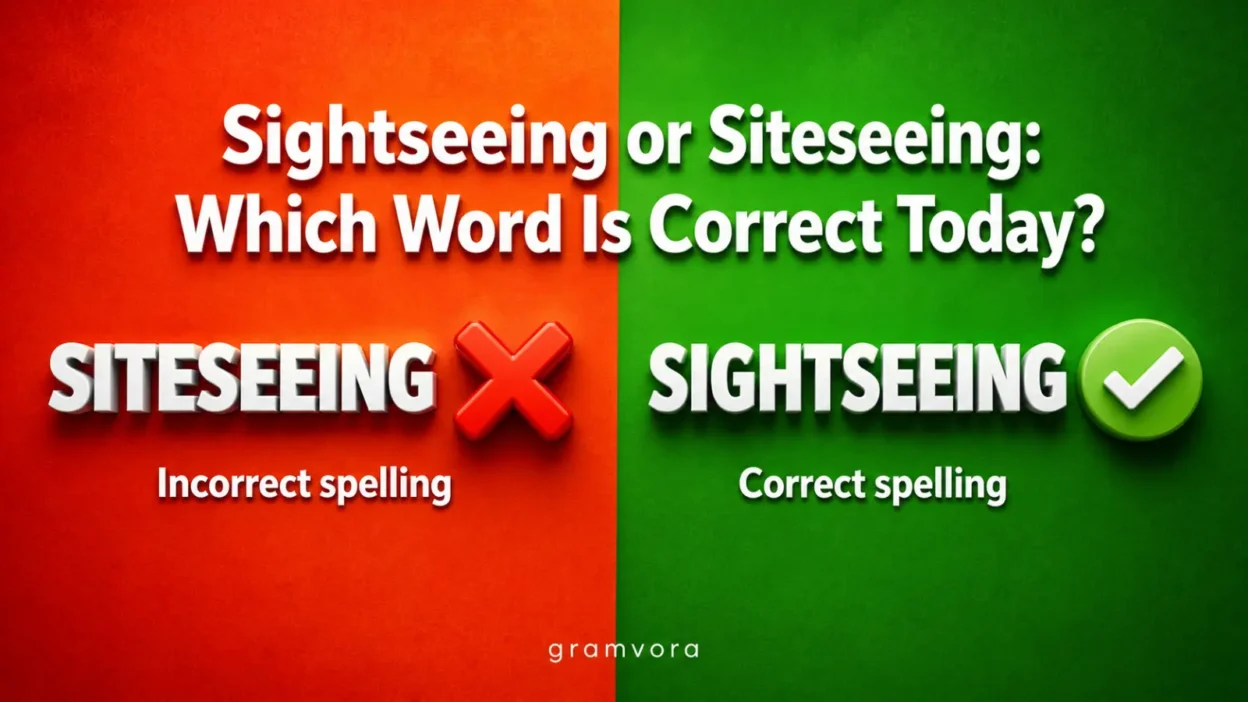
Use sightseeing when you mean visiting famous, interesting, historic, scenic, or tourist-friendly places.
Siteseeing is not the standard spelling in US English. It is usually a mistake caused by confusing sight, meaning something worth seeing, with site, meaning a place or location.
So write:
Correct: We spent Saturday sightseeing in Chicago.
Incorrect: We spent Saturday siteseeing in Chicago.
Quick Answer
Choose sightseeing almost every time.
Sightseeing means visiting places of interest, usually while traveling or exploring a city. It can be a noun, as in “We did some sightseeing,” or it can describe another noun, as in “a sightseeing tour.”
Siteseeing is not a standard word. Do not use it in travel plans, emails, school writing, social posts, business copy, or guidebooks.
Why People Confuse Them
The confusion makes sense. A tourist often visits a site, such as a historic site, a memorial site, or a park site. Because of that, some writers think the activity must be “siteseeing.”
But the standard word is built from sight, not site.
A sight is something worth seeing. In travel, “the sights” means the attractions, landmarks, views, museums, neighborhoods, or other places people want to visit.
That is why the activity is sightseeing: you are seeing the sights.
Key Differences At A Glance
| Context | Best Choice | Why |
|---|---|---|
| Visiting landmarks on vacation | sightseeing | This is the standard word for touring places of interest. |
| Writing a travel itinerary | sightseeing | It sounds natural and correct in US English. |
| Describing a city tour | sightseeing | It can describe tours, buses, routes, and plans. |
| Saying you visited famous places | sightseeing | It clearly means seeing attractions. |
| Using “siteseeing” in travel writing | sightseeing | “Siteseeing” is not the standard spelling. |
| Talking about looking at a physical location for work | site visit or site inspection | These are clearer than “siteseeing.” |
Meaning and Usage Difference
Sightseeing means the activity of visiting interesting places, especially while traveling.
Examples:
We went sightseeing after the conference.
The hotel offers a free sightseeing shuttle.
They planned a full day of sightseeing in Boston.
Siteseeing does not have a standard meaning in everyday US English. Readers will usually see it as a misspelling of sightseeing.
The key idea is this:
- Sightseeing = seeing sights, attractions, landmarks, or places of interest.
- Siteseeing = not the accepted word for that meaning.
Pronunciation is worth a quick note because both forms would sound almost the same in speech. Sightseeing is pronounced like “SITE-see-ing.” That sound is one reason people sometimes spell it with site, but the correct spelling still uses sight.
Tone, Context, and Formality
Sightseeing is neutral and natural. It works in casual, professional, academic, and travel-related writing.
You can use it in a text message:
We’re sightseeing downtown today.
You can also use it in polished writing:
The package includes lodging, transportation, and sightseeing.
Siteseeing does not fit any normal level of formality when you mean travel or tourism. It looks like an error in both casual and formal writing.
For work-related visits, avoid siteseeing too. If someone is touring a job location, construction area, campus, or facility, use a clearer phrase:
site visit
site tour
site walk-through
site inspection
Those phrases use site correctly because they mean a specific location.
Which One Should You Use?
Use sightseeing when you mean exploring places for interest, fun, travel, history, culture, or scenery.
Use it for:
vacation plans
city tours
tour buses
museum visits
landmark trips
travel guides
weekend exploring
visitor activities
Do not use siteseeing. It is not the right choice for the travel meaning.
A helpful memory trick:
Sightseeing means seeing the sights.
That short phrase solves most of the confusion.
When One Choice Sounds Wrong
Siteseeing sounds wrong when the sentence is about travel.
Wrong: We booked a siteseeing tour of New Orleans.
Right: We booked a sightseeing tour of New Orleans.
Wrong: The family went siteseeing near the Golden Gate Bridge.
Right: The family went sightseeing near the Golden Gate Bridge.
Wrong: Our siteseeing plans include the Space Needle.
Right: Our sightseeing plans include the Space Needle.
The word site is not always wrong by itself. It is correct in phrases like “historic site,” “job site,” and “camping site.” The mistake happens when writers turn it into siteseeing.
Common Mistakes (and Quick Fixes)
Mistake: Using siteseeing because tourists visit sites.
Fix: Use sightseeing because tourists see sights.
Mistake: Writing sight seeing as two words.
Fix: Use the one-word form sightseeing.
Mistake: Writing site seeing tour for a tourist activity.
Fix: Write sightseeing tour.
Mistake: Using sightseeing for a work inspection.
Fix: Use site visit or site inspection.
Mistake: Thinking the word must include “site” because the place is a location.
Fix: Remember that the activity is about what visitors see, not the word for the location.
Everyday Examples
We saved Sunday for sightseeing in San Francisco.
The conference schedule includes an optional sightseeing tour for attendees.
After spending three hours exploring the city, we stopped for coffee.
Incorrect: We went siteseeing around downtown Denver.
Corrected: We went sightseeing around downtown Denver.
Incorrect: The resort offers siteseeing trips.
Corrected: The resort offers sightseeing trips.
Incorrect: She packed comfortable shoes for a long day of siteseeing.
Corrected: She packed comfortable shoes for a long day of sightseeing.
Dictionary-Style Word Details
Verb
sightseeing: Not commonly used as a verb in standard US English. The verb is sightsee. Example: We plan to sightsee on Friday.
siteseeing: Not commonly used as a verb in standard US English. Avoid it. If you mean visiting tourist spots, use sightsee or go sightseeing.
Noun
sightseeing: A standard noun. It means the activity of visiting famous or interesting places. Example: We did some sightseeing after lunch.
It can also work before another noun like a modifier: sightseeing tour, sightseeing bus, sightseeing trip.
siteseeing: Not a standard noun for travel or tourism. Readers will usually understand it as a misspelling.
Synonyms
sightseeing: Closest plain alternatives include touring, visiting attractions, seeing the sights, and exploring landmarks. These are not always exact matches, but they often fit travel contexts.
Possible opposite ideas depend on the sentence. Staying in, skipping the sights, or relaxing at the hotel may work in context, but there is no single perfect opposite.
siteseeing: No true synonyms, because it is not the standard word. Use sightseeing instead.
Example Sentences
Sunday was reserved for sightseeing in San Francisco.
Attendees can also join an optional sightseeing tour during the conference.
After three hours of exploring local attractions, we took a coffee break.
siteseeing: Avoid this spelling. Write: After three hours of sightseeing, we stopped for coffee.
Word History
sightseeing: The word is built from sight and seeing. In this use, sight means something notable or interesting to see, especially for visitors.
siteseeing: This form appears to come from confusion with site, meaning a place or location. It is not the standard travel word.
Phrases Containing
sightseeing:
go sightseeing
do some sightseeing
sightseeing tour
sightseeing bus
sightseeing trip
day of sightseeing
local sightseeing
siteseeing:
No standard phrases use siteseeing for travel. Replace it with sightseeing.
FAQs
1. Is it sightseeing or siteseeing?
The correct word is sightseeing. It means visiting and exploring interesting places, such as tourist attractions, landmarks, museums, and natural sites. Siteseeing is a common misspelling and is not considered standard English.
2. What does sightseeing mean?
Sightseeing means traveling to places of interest to see and experience famous locations, historical sites, cultural attractions, or natural scenery. For example, tourists often go sightseeing when they visit a new city.
3. Why do people confuse sightseeing and siteseeing?
People confuse these words because “site” means a place or location, and sightseeing involves visiting places. However, the correct spelling comes from sight + seeing, meaning looking at or observing interesting sights.
4. Can I use siteseeing in a sentence?
It is better not to use siteseeing because it is considered incorrect. Use sightseeing instead. Correct example: “We spent the afternoon sightseeing around New York City.”
5. What is the difference between sightseeing and site seeing?
Sightseeing is a standard English word for visiting attractions and enjoying views. Site seeing would literally mean seeing a site, but this two-word form is not normally used for tourism.
6. Is sightseeing a noun or a verb?
Sightseeing is mainly used as a noun. Example: “Sightseeing was the highlight of our vacation.” It can also appear in phrases like “go sightseeing,” where it describes an activity.
7. What are some examples of sightseeing activities?
Common sightseeing activities include visiting landmarks, exploring historical buildings, touring museums, taking city tours, viewing natural landscapes, and photographing famous attractions.
Conclusion
The choice is simple: use sightseeing, not siteseeing.
Sightseeing is the correct word for visiting landmarks, attractions, scenic areas, historic places, and other points of interest. Siteseeing is a misspelling in this context.