Both disorganized and unorganized are real English words. The question is not whether one is “fake.” The real question is which one sounds natural in the sentence you are writing.
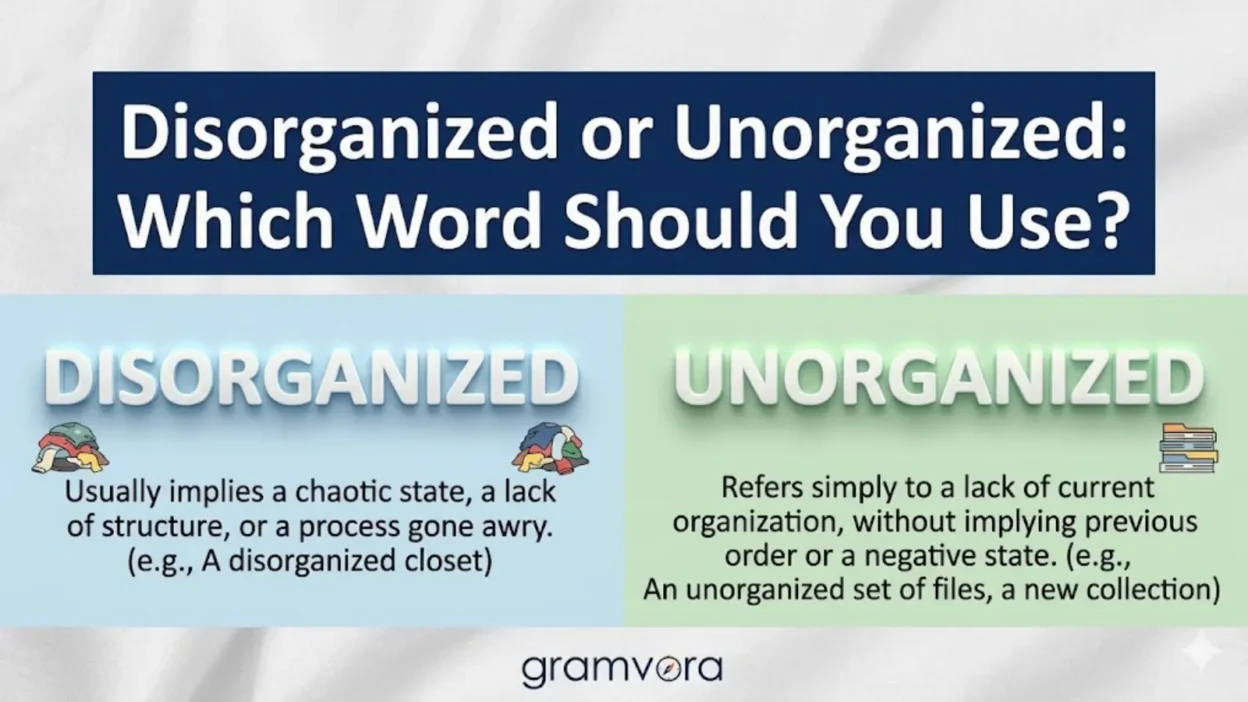
For most everyday US English, disorganized is the safer choice when you mean messy, poorly planned, chaotic, or not able to keep things in order. Use unorganized when you mean something has not been sorted, arranged, structured, or formally organized yet.
The difference is often about tone. Disorganized usually sounds more critical. Unorganized often sounds more neutral and literal.
Quick Answer
Use disorganized for a person, room, meeting, process, response, or plan that lacks order in a noticeable or frustrating way.
Use unorganized for items, data, photos, papers, activities, or groups that have not been arranged into a clear system.
Why People Confuse Them
People confuse these words because both contain organized, and both can mean “not organized.” In casual speech, many people use them in similar ways.
Still, they do not always feel the same.
Disorganized suggests a lack of order that causes confusion. It can describe bad planning, messy habits, or a system that is not working well.
Unorganized suggests a lack of structure or arrangement. It can describe things that have not been sorted yet. It can also describe workers who are not represented by a labor union.
A helpful way to think about it: disorganized often points to disorder; unorganized often points to absence of organization.
Key Differences At A Glance
| Context | Best Choice | Why |
|---|---|---|
| A messy person | Disorganized | It describes habits or behavior. |
| A confusing meeting | Disorganized | It suggests poor planning. |
| A folder of unsorted photos | Unorganized | The items have not been arranged yet. |
| A chaotic emergency response | Disorganized | It suggests confusion and weak coordination. |
| Workers without union representation | Unorganized | This is a standard labor-related use. |
| A new pile of papers not yet sorted | Unorganized | It sounds neutral and literal. |
| A team that cannot coordinate | Disorganized | It sounds more natural for poor teamwork. |
| A set of raw notes | Unorganized | The notes may simply need structure. |
Compact comparison:
• Disorganized = messy, confused, poorly planned, lacking order in a noticeable way.
• Unorganized = not arranged, not sorted, not structured, or not formally organized.
• Disorganized usually sounds more negative.
• Unorganized can sound more neutral, especially for things that simply need sorting.
Meaning and Usage Difference
Disorganized is an adjective. It describes something that lacks order, method, coherence, or good planning.
Use it when the problem is visible:
The schedule was disorganized.
Her notes were so disorganized that she could not find the main point.
Their response felt rushed and disorganized.
Unorganized is also an adjective. It describes something that has not been organized, arranged, or formed into a clear whole.
Use it when the main idea is “not sorted yet”:
The photos are still unorganized.
The closet has several unorganized storage bins.
The report includes useful but unorganized research notes.
A common shortcut says disorganized means “once organized, now messy,” while unorganized means “never organized.” That idea can help sometimes, but it is not a hard rule. Real usage overlaps. The clearer rule is this: choose disorganized for disorder or poor planning, and unorganized for lack of arrangement or structure.
Tone, Context, and Formality
Both words are acceptable in standard US English.
Disorganized is more common and natural when describing people, events, planning, behavior, or performance. It often carries judgment.
When a meeting is disorganized, it often feels badly run.
Teams may view a disorganized response as confused or poorly coordinated.
Unorganized is useful when you do not want to sound as critical. It can describe material that simply has not been put into order.
For example, an unorganized folder may just need sorting.
Even an unorganized list can still contain good ideas.
Likewise, an unorganized collection may be useful but not arranged well.
In formal writing, disorganized usually fits when you are evaluating quality. Unorganized fits when you are describing structure in a more neutral way.
Which One Should You Use?
Choose disorganized when the sentence includes frustration, confusion, poor planning, or messy habits.
Use disorganized for:
meetings, schedules, teams, offices, responses, thoughts, notes, workflows, and people.
Choose unorganized when the sentence means “not yet sorted,” “not arranged,” “not structured,” or “not formally grouped.”
Use unorganized for:
files, receipts, photos, records, data, raw notes, collections, activities, and nonunion workers.
Here is the simplest test:
If you mean messy or poorly planned, write disorganized.
If you mean not arranged into a system, write unorganized.
When One Choice Sounds Wrong
Some sentences strongly prefer one word.
She is unorganized is understandable, but she is disorganized sounds more natural in US English when describing someone’s habits.
The meeting was unorganized is understandable, but the meeting was disorganized sounds better if the meeting was confusing or badly run.
Unorganized labor is the right choice when you mean workers without union representation. Disorganized labor would suggest labor groups are confused or poorly coordinated, which is a different meaning.
Unorganized territory refers to land without the usual local government structure. Disorganized territory would sound like the land itself is chaotic, not like a formal status.
Common Mistakes (and Quick Fixes)
Mistake: Using unorganized for every messy situation.
Better: Use disorganized when the sentence includes confusion, poor planning, or disorder.
Mistake: Treating unorganized as incorrect.
Better: Use it when something has not been sorted, structured, or formally organized.
Mistake: Saying the words are always interchangeable.
Better: Say they overlap, but they often create different impressions.
Mistake: Forcing the “once organized” rule every time.
Better: Use that idea only as a clue, not as a grammar law.
Mistake: Writing disorganized labor when you mean nonunion workers.
Better: Write unorganized labor.
Everyday Examples
The office looked disorganized after everyone rushed to meet the deadline.
My tax documents are unorganized, but I saved every receipt.
The coach called a timeout because the defense looked disorganized.
The folder contains unorganized screenshots from the whole project.
Our group chat became disorganized once three people started changing the plan.
The garage has unorganized boxes from our last move.
The event felt disorganized because no one checked people in at the door.
I keep unorganized ideas in one notebook before turning them into an outline.
The kitchen staff seemed disorganized during the dinner rush.
The archive is valuable, but much of it is still unorganized.
Dictionary-Style Word Details
Verb
Disorganized: Can be the past-tense or past-participle form of disorganize, meaning to disturb or break up order. Example: The sudden change disorganized the schedule.
Unorganized: Not commonly used as a verb in standard US English. Instead of saying “unorganized the files,” say did not organize the files, left the files unorganized, or made the files disorganized.
Noun
Disorganized: Not commonly used as a noun. The related noun is disorganization.
Unorganized: Not commonly used as a noun. Use lack of organization, unorganized material, or a specific noun phrase such as unorganized labor.
Synonyms
Disorganized: closest plain alternatives include messy, chaotic, confused, jumbled, muddled, disorderly, and unsystematic.
Unorganized: closest plain alternatives include unsorted, unarranged, unstructured, uncategorized, loose, and not yet organized.
Useful antonyms for both include organized, orderly, structured, systematic, and well planned.
Example Sentences
Unorganized: The files are unorganized, so I need to sort them by month.
Unorganized: She has a box of unorganized family photos.
Word History
Disorganized: Built from disorganize plus -ed. In modern use, it works as both an adjective and a verb form.
Unorganized: Built from un- plus organized. In modern use, it is an adjective meaning not organized, not structured, or not formally organized.
Current usage matters more than the prefix alone.
Phrases Containing
Disorganized: common combinations include disorganized meeting, disorganized desk, disorganized response, disorganized notes, disorganized team, and disorganized person.
Unorganized: common combinations include unorganized files, unorganized photos, unorganized data, unorganized records, unorganized labor, and unorganized territory.
Conclusion
Both disorganized and unorganized are correct, but they are not always the best fit for the same sentence.
Use disorganized when something is messy, confusing, poorly planned, or badly coordinated. It is the better everyday choice for people, meetings, teams, habits, offices, and responses.
Use unorganized when something has not been sorted, arranged, structured, or formally organized. It works well for files, photos, notes, data, records, collections, and labor-related contexts.
When in doubt, choose disorganized for chaos and unorganized for unsorted structure.