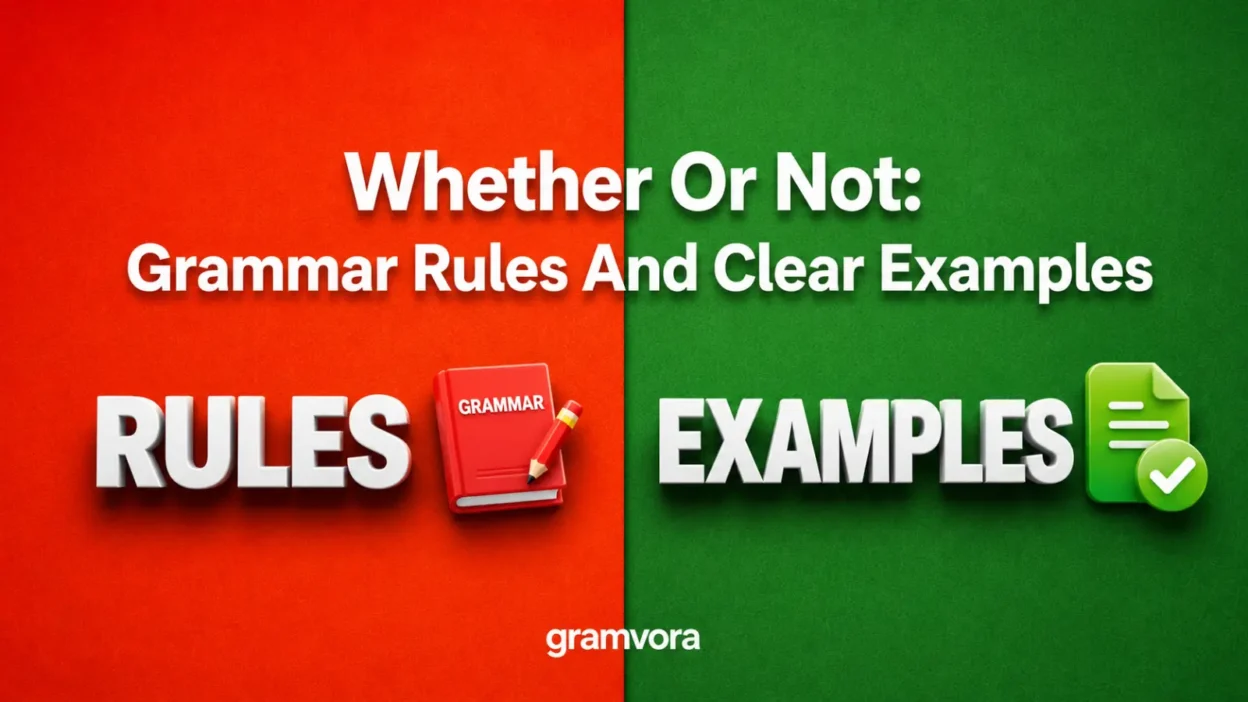
The phrase whether or not is correct, but it is not always the best choice. In many sentences, whether alone already gives the reader both possibilities.
The key is meaning. Add or not when you mean “regardless of the answer.” Leave it out when you are simply reporting a question, doubt, or choice.
Quick Answer
Use whether alone for most indirect questions and choices: “Please confirm whether the store is open.” Use whether or not when the result stays the same either way: “We’re leaving at 8 whether or not everyone is ready.”
What Is Correct?
Both forms can be correct. The shorter form, whether, is often cleaner. The longer form adds emphasis or shows that one outcome will happen in either case.
Correct: “I don’t know whether the meeting was canceled.”
Correct: “The policy applies whether or not you use the service.”
The first sentence asks about uncertainty. The second sentence says the policy applies either way.
The Core Grammar Rule
Whether is a conjunction. It introduces a clause about a choice, doubt, or yes-or-no question.
In “I’m checking whether the package arrived,” the negative possibility is already understood. The package arrived, or it did not. You do not need to spell out both sides.
However, when the sentence means “regardless of the answer,” the full phrase is useful. It tells the reader that the outcome does not depend on the condition.
When Each Form Is Correct
| Form or Pattern | Best Use | Why |
|---|---|---|
| whether | Indirect questions, doubts, choices, and decisions | The opposite possibility is already understood |
| whether + clause | Clean formal and everyday writing | It avoids extra words |
| whether or not | “Regardless of the answer” meaning | It shows that the result will not change |
| whether … or not | Clear contrast between two stated options | It balances both possibilities |
| whether to | Decisions before an infinitive verb | It means deciding if an action should happen |
Use the shorter form when the sentence is about finding out an answer. Use the longer form when the answer does not affect the final action.
When It Is Incorrect Or Less Natural
The full phrase is often less natural when or not adds no real meaning.
Less natural: “I’m checking whether or not the bill was paid.”
Better: “I’m checking whether the bill was paid.”
Less natural: “She asked whether or not I wanted coffee.”
Better: “She asked whether I wanted coffee.”
These longer versions are usually not serious grammar errors. Still, they can make simple sentences sound heavy.
A truly incorrect sentence may leave out the connector.
Incorrect: “I don’t know the office is open.”
Correct: “I don’t know whether the office is open.”
Meaning, Structure, Or Emphasis Differences
Whether alone sounds direct and neutral. It works well in school writing, business emails, reports, and everyday speech.
Example: “Please tell me whether you received the file.”
That sentence asks for information. The reader understands that there are two possible answers.
The longer phrase adds an either-way meaning.
Example: “The deadline stays the same whether or not the office closes early.”
Here, the office closing does not change the deadline. That is why adding or not helps.
You can also place or not at the end for balance.
Example: “I don’t know whether he agrees or not.”
This is acceptable, but “I don’t know whether he agrees” is usually smoother.
Real-World Examples
“I’m checking whether the restaurant takes reservations.”
“Please confirm whether your address has changed.”
“She asked whether I could cover the afternoon shift.”
“We need to decide whether to renew the lease.”
“The fee applies whether or not you attend.”
“The coach will hold practice whether or not it rains.”
“You must follow the rule whether or not you agree with it.”
“I’m not sure whether the form was submitted.”
“Ask the client whether the new date works.”
“The team will move forward whether or not the report is finished.”
Common Mistakes And Quick Fixes
One common mistake is adding or not after every whether. This creates wordy writing.
Wordy: “Let me know whether or not you can join the call.”
Better: “Let me know whether you can join the call.”
Another mistake is using if before to.
Awkward: “I’m deciding if to apply.”
Better: “I’m deciding whether to apply.”
A third mistake is writing rather or not. That is not the correct phrase for this meaning.
Incorrect: “Rather or not you agree, we need a decision.”
Correct: “Whether or not you agree, we need a decision.”
Grammar Rule Details
Rule
Use whether to introduce a choice, doubt, or indirect yes-or-no question. Add or not when the sentence means the result will be the same in both cases.
Correct Usage
Correct: “I don’t know whether the class is full.”
Correct: “We’re going whether or not it snows.”
The first sentence shows uncertainty. The second says the plan will not change.
Incorrect Or Less Natural Usage
Less natural: “Tell me whether or not you need help.”
Better: “Tell me whether you need help.”
Incorrect: “Tell me you need help or not.”
Correct: “Tell me whether you need help or not.”
The first longer version is just wordy. The incorrect version needs whether before the indirect question.
Examples
“I’m wondering whether to bring my laptop.”
“The company has not said whether prices will change.”
“We must submit the report whether or not the data is complete.”
“Whether you agree or not, the deadline is final.”
Common Mistakes
Do not treat or not as required after every whether.
Do not write rather or not when you mean whether.
Do not remove whether from an indirect question that needs a connector.
Exceptions
There is no major exception that makes the full phrase generally wrong. It is standard when it carries the “regardless” meaning.
However, in concise writing, remove or not when it repeats an idea the reader already understands.
Quick Test
Use this fast check:
• If you can replace the wording with “regardless of the answer,” add or not.
• If you can replace it with if, use whether alone.
• If the next word is to plus a verb, use whether to.
Usage Notes
The longer version can sound more emphatic. It is common in speech and acceptable in writing. Even so, clear writing avoids extra words unless they change the meaning or add useful emphasis.
FAQ
Is the full phrase grammatically correct?
Yes. It is grammatically correct. It works best when the meaning is “regardless of the answer.”
Is it redundant?
Sometimes. In “I don’t know whether she called,” the shorter form is enough. Adding or not would usually make the sentence wordier.
When should I use whether alone?
Use whether alone when you are asking about a choice, doubt, or unknown fact. Example: “Please check whether the room is available.”
When should I add or not?
Add it when the result stays the same in both cases. Example: “The rule applies whether or not you signed the form.”
Can I write whether to instead of whether or not to?
Yes. The shorter pattern is usually cleaner: “I’m deciding whether to apply.” Add or not only when you want extra emphasis.
Is rather or not correct?
No. Rather or not is incorrect for this meaning. Use whether, with or without or not depending on the sentence.
Conclusion
Whether alone is usually the cleaner choice for questions, doubts, and decisions. It already suggests two possible answers.
Add or not when the sentence means “regardless of the answer.” That small difference keeps your writing clear, natural, and accurate.