
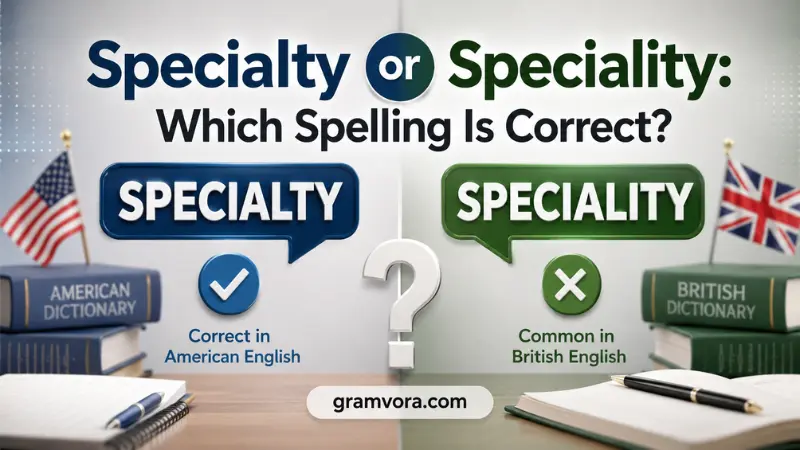
Both specialty and speciality are correct English spellings. They usually refer to a field of expertise, a product for which a place is known, or something a person does especially well.
The main difference is regional preference. Specialty is the normal spelling in American English. Speciality is more common in general British English.
The division is not absolute. British medical writing often uses specialty, and American dictionaries recognize speciality, even though most US readers will find it unusual.
Quick Answer
Use specialty for American readers:
Cardiovascular imaging is her medical specialty.
Use speciality when following general British spelling:
Fresh seafood is the restaurant’s speciality.
They have the same core meanings. The choice usually reflects regional convention, publication style, or an official name—not a difference in grammar or meaning. In British medical contexts, specialty is also established and may be the expected form.
Why People Confuse Them
The two forms look like one must be a typing mistake. Speciality includes an extra i, which gives it another visible syllable. Specialty looks shorter and is far more familiar to American readers.
Their pronunciations can also differ:
- Specialty: “SPESH-uhl-tee”
- Speciality: “spesh-ee-AL-uh-tee”
Actual pronunciation varies by speaker, but speciality is commonly pronounced with more syllables. This difference helps explain why writers may spell the word according to how they hear it.
Another source of confusion is British medical usage. A British restaurant may advertise its house speciality, while a British medical organization may discuss specialty training. Both forms can therefore appear in well-edited British material.
Key Differences At A Glance
| Context | Best Choice | Why |
|---|---|---|
| General American English | specialty | This is the standard and expected US spelling. |
| General British English | speciality | This is the usual traditional British form. |
| American medicine | specialty | US medical organizations consistently use this form. |
| British medicine | specialty often appears | It is established in medical education and professional terminology. |
| Official title or brand | Use the official spelling | Names should not be silently changed. |
| International document | Follow the selected house style | Consistency matters more than mixing regional forms. |
Compact comparison
- Meaning: Usually the same
- American preference: specialty
- British general preference: speciality
- British medical use: specialty is common
- Part of speech: noun
- Plural forms: specialties and specialities
- Main decision: audience and house style
Are They the Same Word?
Yes. Specialty and speciality are spelling variants of the same noun. Both can describe:
- A field in which someone has expert knowledge
- A branch of professional or medical work
- A skill someone performs particularly well
- A notable food or product
- A distinctive feature or quality
For example, a lawyer’s specialty may be tax law. A bakery’s specialty may be sourdough bread. In British general writing, those ideas can be expressed with speciality instead.
Major dictionaries cross-reference the two forms and give them overlapping definitions. They do not establish a dependable meaning rule in which one spelling refers to expertise and the other refers only to products or food.
Both forms are nouns. In phrases such as specialty store and speciality food, the noun appears before another noun and acts as a modifier. This does not require treating it as a separate adjective.
US vs UK Preference
In American English, specialty is the clear default. It appears naturally in medicine, business, education, retail, food, insurance, law, and everyday conversation.
Common US phrases include:
- Medical specialty
- Specialty care
- Specialty store
- Specialty coffee
- Specialty products
- Area of specialty
In general British English, speciality is usually preferred for an expert field, a strong skill, or a notable local product. Cambridge, Oxford, and Collins all identify it as the usual or mainly British form.
However, specialty is not limited to the United States. It has an established place in British medicine. UK medical-training organizations use expressions such as specialty training, higher specialty training, and medical specialties.
This means the best rule is more precise than “one spelling belongs to each country”:
- Choose specialty for normal US writing.
- Choose speciality for general British writing.
- Expect specialty in British medical material.
- Follow the publication’s established style when one exists.
Which Spelling Should You Use?
For a US audience, write specialty unless an official name, quotation, or required style uses speciality.
Correct US examples include:
- Her specialty is environmental law.
- The clinic provides specialty care for children.
- We stopped at a specialty grocery store.
- The chef’s specialty is smoked brisket.
- He is choosing a medical specialty.
For a British audience, speciality is a safe choice in ordinary writing:
- Her speciality is medieval history.
- This cheese is a regional speciality.
- Baking bread has become his speciality.
Use specialty in a British document when that spelling is part of accepted professional terminology or appears in an organization’s official wording.
For an international business, school, or publication, select one variety of English and remain consistent. Switching between specialty products and speciality products without a reason can make the document look poorly edited.
When One Spelling Looks Wrong
Speciality may look misspelled to an American reader because it is uncommon in normal US writing. However, it is a standard British form, not an accidental insertion of an extra letter.
Likewise, specialty may look strongly American in a British restaurant review or general lifestyle article. It is still an accepted English word, and it may be required in medical terminology.
Context can also override regional preference. Preserve the original form in:
- Business names
- Organization names
- Program titles
- Product labels
- Direct quotations
- Legal or professional titles
For example, the global industry organization is called the Specialty Coffee Association. Its official name should remain unchanged even inside a document that otherwise follows British spelling.
A spelling checker may flag the form that does not match the document’s language setting. That warning often indicates a regional mismatch rather than a genuine spelling error.
Common Mistakes (and Quick Fixes)
Mistake: Calling speciality incorrect everywhere
Quick fix: Describe it as chiefly British. It is uncommon in US writing, but it is a recognized word.
Mistake: Creating a false meaning difference
Quick fix: Do not claim that specialty means expertise while speciality means food. Both forms can carry either meaning.
Mistake: Mixing regional spellings
Quick fix: Choose one form based on the audience and use it consistently.
Mistake: Using the wrong plural
Quick fix:
- Specialty → specialties
- Speciality → specialities
Change the final y to ies in both forms.
Mistake: Adding an apostrophe to make a plural
Incorrect:
The hospital offers five specialty’s.
Correct:
The hospital offers five specialties.
Use specialty’s only for a singular possessive:
The specialty’s training requirements changed.
Mistake: Treating either form as a verb
Quick fix: Use specialize as the US verb.
She specializes in employment law.
Do not write that someone “specialties” or “specialities” in a subject.
Mistake: Automatically changing an official name
Quick fix: Keep the spelling used by the organization, product, or program.
Everyday Examples
American English
- Cybersecurity is the firm’s main specialty.
- The hospital opened a new specialty care center.
- Her specialty is helping small businesses manage taxes.
- This market carries specialty foods from across the country.
- The café serves several varieties of specialty coffee.
- Orthopedic surgery is a demanding medical specialty.
- His specialty dish is roasted chicken with herbs.
- We hired a contractor whose specialty is historic restoration.
British English
- Traditional pies are the pub’s speciality.
- Her academic speciality is nineteenth-century literature.
- The island is known for a local seafood speciality.
- Wood carving became his speciality after retirement.
- The shop sells speciality teas and handmade chocolates.
- Each region has its own culinary specialities.
British medical use
- She applied for specialty training in cardiology.
- The program includes placements across several medical specialties.
- Applicants must review the requirements for their chosen specialty.
These medical examples show why regional labels should guide the choice without being treated as unbreakable rules.
Dictionary-Style Word Details
Verb
- Specialty: Not commonly used as a verb in standard American English.
- Speciality: Not commonly used as a verb in standard British or American English.
Use specialize in American English:
The practice specializes in workplace injury cases.
British writing may use specialise when that regional spelling is preferred. Specialty and speciality themselves remain nouns.
Noun
- Specialty: The standard American spelling for an expert field, professional branch, notable product, strong skill, or distinctive feature.
- Speciality: The chiefly British spelling for the same main ideas.
Both can be countable:
Dermatology is her specialty.
Local cheese is the village’s speciality.
Both can also appear before another noun:
specialty clinic
speciality food
Dictionaries classify the forms as nouns, including when they modify another noun.
Synonyms
The best alternative depends on the intended meaning.
For an expert field:
- Area of expertise
- Field
- Specialization
- Branch
- Professional focus
- Strong suit
- Forte
For a notable food or product:
- Signature dish
- Featured product
- Local product
- House favorite
There is no single exact antonym that works for every meaning. General field, general practice, or weakness may provide a contrast in a specific sentence, but they are not universal opposites.
Example Sentences
Specialty
- Her specialty is contract negotiation.
- The store imports specialty ingredients.
- Pediatrics is a medical specialty.
- Grilled seafood is the restaurant’s specialty.
- Our company provides specialty insurance coverage.
Speciality
- His speciality is Renaissance architecture.
- The region is famous for its cheese specialities.
- Handmade pottery is the town’s speciality.
- The bakery offers several seasonal specialities.
- Her speciality is explaining difficult ideas clearly.
Word History
Both spellings belong to a word family that entered English through French forms connected to Latin words for something particular or distinctive.
Specialty has a long history in English, while speciality developed as another established form. Their histories overlap, so the present difference should not be reduced to a simple story in which Americans merely removed a letter from a British word.
Over time, specialty became the dominant US form, while speciality became strongly associated with general British use. The older overlap helps explain why both spellings still appear in British professional writing and major dictionaries.
Phrases Containing
Common phrases with specialty
- Area of specialty
- Medical specialty
- Specialty care
- Specialty clinic
- Specialty coffee
- Specialty food
- Specialty insurance
- Specialty pharmacy
- Specialty product
- Specialty store
- House specialty
Common phrases with speciality
- Area of speciality
- Local speciality
- Regional speciality
- House speciality
- Culinary speciality
- Speciality food
- Speciality product
- Speciality restaurant
- Speciality shop
- National speciality
Choose the form that matches the audience, official terminology, or established house style.
FAQs
Is specialty or speciality correct in American English?
Specialty is the standard spelling in American English. Use it when writing for a US audience, as in medical specialty, specialty store, or the chef’s specialty. Speciality is recognized but may look unusual to American readers.
Is speciality a misspelling?
No. Speciality is a correct spelling used mainly in British English. It has the same basic meanings as specialty. The better choice depends on your audience and the variety of English you are following.
What is the British spelling of specialty?
In general British English, speciality is usually preferred. For example, a British restaurant might describe a dish as its house speciality. However, specialty is also common in British medical language, especially in phrases such as specialty training.
Do specialty and speciality have different meanings?
No dependable meaning difference exists between them. Both words can describe an area of expertise, a professional field, a notable skill, or a product for which someone or somewhere is known. The main difference is spelling preference.
Is it medical specialty or medical speciality?
Medical specialty is the normal form in American English. It is also widely used by British medical organizations. Therefore, medical specialty is generally the safest choice in professional healthcare writing unless a publication requires another style.
What are the plural forms of specialty and speciality?
The plural of specialty is specialties. The plural of speciality is specialities.
Examples:
- The hospital offers several medical specialties.
- The restaurant serves regional specialities.
Do not use an apostrophe to form either plural.
Should I use specialty or speciality on a website?
Use specialty for a website aimed at American readers. Use speciality for a general British audience. For an international website, choose one spelling style and apply it consistently across headings, descriptions, and articles.
Conclusion
Both specialty and speciality are correct spellings of the same noun. They share the same main meanings and perform the same grammatical role.
For American English, choose specialty. It is the expected form in professional, medical, commercial, educational, and everyday US writing.
For general British English, speciality is usually appropriate. Still, do not treat the regional difference as absolute. Specialty is well established in British medicine and may also appear in official names or publication styles.
The most dependable rule is simple: use specialty for US readers, follow established British or professional conventions when needed, and keep the spelling consistent throughout the document.


