
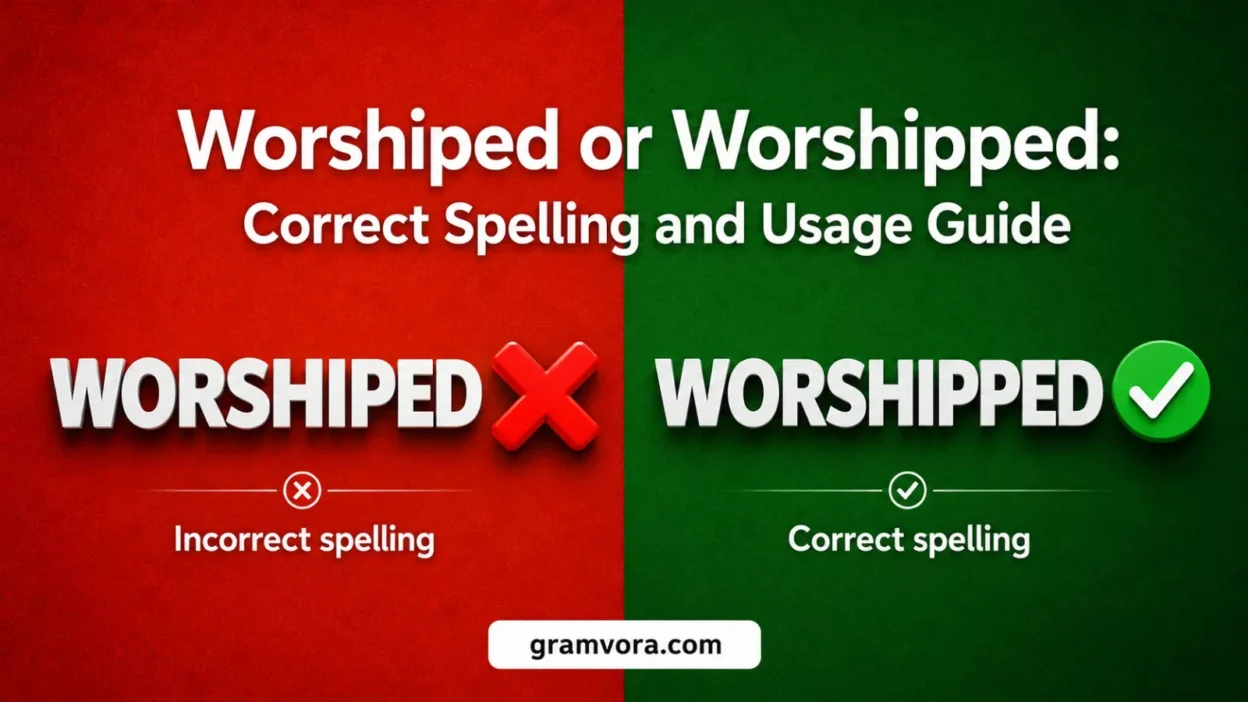
Both spellings appear in edited English, so seeing worshiped in one article and worshipped in another can make the word look uncertain. The difference is not about belief, intensity, tense, or meaning. It is a spelling choice in the past tense and past participle of worship.
For a US audience, the most useful answer is slightly more nuanced than “one p is American and two p’s are British.” Worshiped is widely recognized as a US spelling, but worshipped is also standard and common in American writing. British English strongly favors worshipped.
Quick Answer
Both worshiped and worshipped are correct past-tense and past-participle forms of worship. In US English, either spelling is acceptable, though worshiped clearly signals an American convention. In British English, worshipped is the standard choice.
Use the form required by your publication, school, workplace, or established house style, and stay consistent.
Why People Confuse Them
The confusion comes from the final p in worship. When English adds -ed, some spelling traditions double that consonant, while others allow the suffix to be added without doubling it.
Writers also hear no difference between the two forms. Both are pronounced roughly “WUR-shipt.” Because the extra p is silent, pronunciation does not help a writer choose the spelling.
Another source of uncertainty is mixed American usage. Many US references recognize worshiped as the American form, yet worshipped remains common in American books, journalism, religious writing, and general prose.
Key Differences At A Glance
| Context | Best Choice | Why |
|---|---|---|
| US writing with a single-p house style | worshiped | It is an established American spelling. |
| US writing that already uses the double-p form | worshipped | It is also accepted and common in American usage. |
| British English | worshipped | This is the standard British form. |
| International or mixed-audience writing | Keep one form consistently | Consistency matters more than switching between accepted variants. |
| A quotation, title, or official text | Preserve the original spelling | Changing an accepted spelling may misrepresent the source. |
Are They the Same Word?
Yes. Worshiped and worshipped are spelling variants of the same verb form. They have the same meaning, pronunciation, tense, and grammatical function.
- Worshiped: The one-p form, commonly identified with American English.
- Worshipped: The two-p form, standard in British English and also accepted in American English.
Either form can describe religious devotion: “The community worshiped together.” It can also describe extreme admiration: “Fans worshipped the singer during her early career.”
Both forms may also work as participial adjectives. For example, a person may be described as a “widely worshiped leader” or a “widely worshipped leader.” The spelling does not change the sense.
US vs UK Preference
British English has a clear preference: use worshipped. The related forms worshipping and worshipper also normally keep the double p.
US English is less uniform. Worshiped is an established American variant and is a sensible choice when a publication follows streamlined American spellings. However, worshipped is not an error in US writing. It is accepted and appears often in edited American prose.
This means the regional label is useful but not absolute. A simple classroom guide may present worshiped as American and worshipped as British. That guideline helps beginners, but it leaves out the continuing American use of worshipped.
Which Spelling Should You Use?
For general US writing, worshiped is a clear and defensible choice. It matches the form that many references specifically identify as American.
Still, worshipped may be the better choice when your organization, editor, denomination, publication, or existing document already uses two p’s. You do not need to replace it merely because your audience is American.
For British readers or a publication using British conventions, choose worshipped.
In every setting, consistency should guide the final decision. Do not move between worshiped and worshipped within the same article unless you are preserving a quotation or discussing the spelling difference itself.
When One Spelling Looks Wrong
Worshiped may look incomplete to readers who are used to British spelling or who regularly see worshipped in religious texts. That reaction is based on familiarity, not a difference in correctness.
Worshipped may look overly British to a US writer whose school or workplace uses one-p forms. Even so, the double-p spelling remains accepted in American English.
A spell-checker may flag one form when its language setting is tied to a particular region. Treat that warning as a style signal rather than proof that the other accepted spelling is universally wrong.
Common Mistakes (and Quick Fixes)
Mistake: Claiming that only worshiped is correct in the United States.
Quick fix: Say that worshiped is an established US form, while worshipped is also accepted and common.
Mistake: Giving the spellings different meanings.
Quick fix: Remember that both forms express the same past action or completed state.
Mistake: Switching spellings without a reason.
Quick fix: Select one form before drafting and use it throughout the document.
Mistake: Writing worshippped with three p’s.
Quick fix: Use either one p before -ed or two p’s before -ed: worshiped or worshipped.
Mistake: Treating worshipt as a standard past tense.
Quick fix: The accepted forms end in -ed, even though the final sound resembles a “t.”
Everyday Examples
The family worshiped at the same church for more than twenty years.
Several ancient cultures worshiped deities connected with the sun.
The congregation worshipped outdoors after the storm damaged its building.
As a child, Marcus worshipped his older brother and copied everything he did.
The actor was worshiped by fans who followed every new release.
Although the coach was widely worshipped, the article also examined his mistakes.
Each sentence would keep the same meaning if the other accepted spelling were used. The choice affects regional and editorial style, not the action being described.
Dictionary-Style Word Details
Verb
Worshiped and worshipped are both the simple past and past participle of the verb worship.
The verb can be transitive, as in “They worshiped the deity,” or intransitive, as in “They worshipped together on Sunday.” Both spellings perform the same grammatical work.
Noun
Neither worshiped nor worshipped is normally used as a noun in standard modern English. The related noun is worship, as in “a place of worship” or “morning worship.”
The spelling choice discussed here applies mainly to the verb’s inflected forms and their use as participial adjectives.
Synonyms
Meaning-matched alternatives for both spellings include revered, venerated, adored, idolized, and honored.
The best alternative depends on context. Venerated and revered often fit respectful or sacred contexts, while adored and idolized may fit figurative admiration.
There is no single exact antonym that works in every sentence.
Example Sentences
The villagers worshiped at a small temple near the river.
For generations, the figure was worshipped as a protector.
She had once worshiped the celebrity but later saw him more realistically.
The composer was worshipped by a devoted circle of young musicians.
Word History
The variation arose in the inflected form created from worship plus -ed.
One convention adds the suffix without doubling the final p, producing worshiped. Another doubles the p before the suffix, producing worshipped.
The difference became associated with regional and editorial preferences, but it did not create a new meaning or pronunciation.
Phrases Containing
Common combinations include worshiped at, worshiped by, worshiped as, widely worshiped, and once worshiped.
The same combinations occur with the double-p spelling: worshipped at, worshipped by, worshipped as, widely worshipped, and once worshipped.
Compounds such as hero-worshiped and hero-worshipped also follow the writer’s chosen spelling convention.
FAQs
Is worshiped or worshipped correct?
Both worshiped and worshipped are correct. They are accepted past-tense and past-participle forms of worship. The spelling difference does not change the word’s meaning, pronunciation, or grammatical role.
Which spelling is preferred in American English?
Worshiped is commonly identified as the American spelling. However, worshipped is also accepted and frequently appears in American books, articles, religious writing, and other edited content. US writers can use either form unless a style guide requires one.
Which spelling is standard in British English?
British English normally uses worshipped with two p’s. The related forms are usually spelled worshipping and worshipper. Writers following British conventions should use the double-p form consistently.
Do worshiped and worshipped have different meanings?
No. Both spellings have exactly the same meaning. They can describe religious devotion or strong admiration. For example, “They worshiped at the temple” and “They worshipped at the temple” communicate the same idea.
Why does worshipped have two p’s?
The double-p spelling follows a convention that doubles the final consonant before adding -ed. Another accepted convention adds -ed directly, producing worshiped. These spelling traditions created two standard forms rather than two different words.
Should I use worshiped or worshipped in US writing?
Use worshiped when you want a clearly American spelling. You may also use worshipped, especially when it matches your publication, organization, religious community, or existing document style. Whichever form you choose, keep the spelling consistent throughout the same piece of writing.
Conclusion
Worshiped and worshipped are both correct forms of the same word. They mean the same thing and sound the same. British English uses worshipped as its standard spelling. US English accepts both, although worshiped is commonly presented as the specifically American form.
Choose worshiped when you want an unmistakably American spelling and no house style says otherwise. Choose worshipped when British convention, established usage, or an editorial guide calls for two p’s.
Above all, use one spelling consistently throughout your writing.

[…] At first glance, these two spellings may look like different words. However, they have the same meaning, pronunciation, and grammatical function. The only real difference is the spelling convention used by different English-speaking regions and style guides. […]