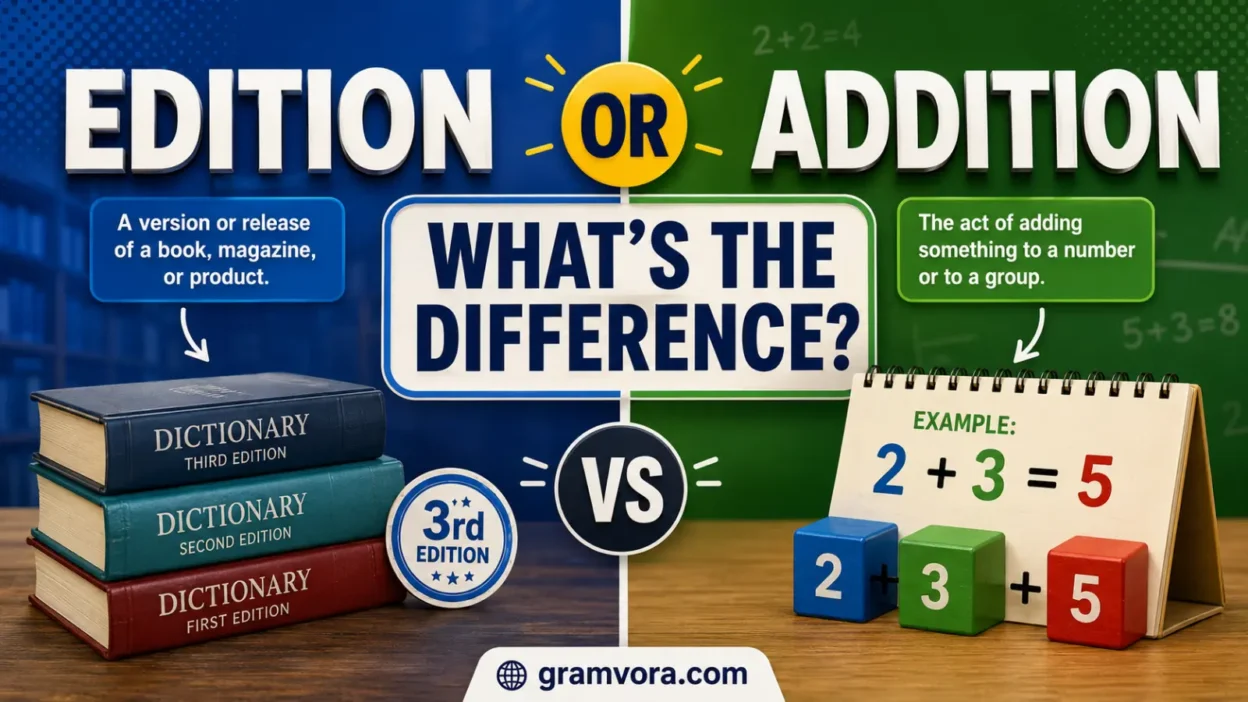
Edition and addition are both standard English nouns, but they are not interchangeable. Edition identifies a particular version, issue, or release. Addition refers to something added, the act of adding, or the math process used to find a total.
The words are easy to mix up because their spellings look similar and their pronunciations can sound nearly identical. Context, however, makes the correct choice clear.
Quick Answer
- Edition means a version, issue, or release, such as the second edition of a textbook.
- Addition means something added or the act of adding, such as a new addition to the team.
A simple test helps: ask “Which version?” If that question fits, choose edition. Ask “What was added?” If that question fits, choose addition.
Why People Confuse Them
Both words end with a similar “DISH-un” sound. In careful American pronunciation, edition may begin closer to “ih,” while addition may begin closer to “uh.” In fast speech, that small difference often becomes hard to hear.
Their spellings also share several letters. Still, the beginnings offer a useful clue. Addition starts like add, which points to putting something extra in. Edition is related to publishing and editing, which points to a particular version or release.
Key Differences At A Glance
| Context | Best Choice | Why |
|---|---|---|
| A particular version of a book | Edition | It identifies which published version you mean. |
| A new person joining a group | Addition | The person has been added to the group. |
| A room built onto a house | Addition | The room is a new part of the building. |
| A newspaper or magazine issue | Edition | It refers to a specific published issue. |
| Combining numbers to find a total | Addition | It names the mathematical operation. |
| A special release of a game or product | Edition | It identifies a distinct release or package. |
| A phrase meaning “also” or “as well as” | Addition | The correct expressions are “in addition” and “in addition to.” |
Meaning and Usage Difference
Edition is a countable noun. It commonly refers to a particular form of a book, newspaper, magazine, reference work, recording, game, or other released product. A first edition is the first published form. A revised edition is a later form that includes changes. A limited edition is produced in a restricted quantity.
The word does not always promise major changes. A publisher or manufacturer may use edition to distinguish a release by format, design, market, or included features.
Addition has several connected meanings. As a countable noun, it can name a person or thing that has been added: “Jordan is a strong addition to the sales team.” In American English, it can also mean a new section built onto a house or other building.
As an uncountable noun, addition can describe the process of adding: “The addition of fresh herbs improved the sauce.” It also names the mathematical operation used to combine numbers and find a total.
Tone, Context, and Formality
Neither word is especially formal or informal. Both appear naturally in conversation, schoolwork, business writing, publishing, and news.
Edition is more closely tied to versions, releases, and recurring issues. You may see it on book covers, product packaging, newspapers, event promotions, and updated reference materials. Phrases such as “collector’s edition” and “digital edition” often work as labels.
Addition has a wider range of everyday uses. It can describe a new employee, a baby joining a family, a feature added to an app, a new room, or an extra ingredient. The phrase in addition is a neutral transition meaning “also” or “furthermore.”
Which One Should You Use?
Choose edition when the sentence identifies one version among other possible versions. Number words and release labels often point to this choice: first edition, third edition, anniversary edition, print edition, or special edition.
Choose addition when something joins, expands, or increases what already exists. Common patterns include addition to the team, addition of a feature, home addition, and addition and subtraction.
The surrounding words usually settle the choice. After first, second, revised, limited, or collector’s, edition is normally correct. After new member, extra room, included feature, or mathematical, addition is normally correct.
When One Choice Sounds Wrong
Calling a new employee “the latest edition to the team” sounds wrong because the employee is not a published version. The person has joined the group, so addition is correct.
Writing “the second addition of the textbook” also changes the meaning. It suggests that something was added for a second time. When you mean the book’s second published version, write second edition.
Likewise, “a kitchen edition” would usually describe a kitchen-themed version of something, not a room built onto a house. The construction project is a kitchen addition.
Common Mistakes (and Quick Fixes)
Mistake: “The newest addition of the magazine is available now.”
Fix: Write edition because you mean the newest published issue.
Mistake: “The sunroom is a beautiful edition to the house.”
Fix: Write addition because the sunroom is a new part added to the building.
Mistake: “In edition to the main course, we ordered dessert.”
Fix: The fixed phrase is in addition to.
Mistake: “I bought the collector’s addition of the game.”
Fix: Write collector’s edition because you mean a specially released version.
A fast correction method is to replace the uncertain word. If version fits, use edition. If extra, inclusion, or something added fits, use addition.
Everyday Examples
Maya ordered the latest edition of her nursing textbook.
This edition includes updated diagrams and a new index.
The Sunday edition of the newspaper has a larger arts section.
A limited edition of the sneakers sold out within hours.
The company welcomed three new additions to its design team.
A covered patio would be a useful addition to the house.
The addition of a search feature made the website easier to use.
Students practiced addition before moving on to subtraction.
In addition to coffee, the café serves tea and fresh juice.
The anniversary edition includes bonus photographs, which are new additions to the original content.
Dictionary-Style Word Details
Verb
Edition: Not commonly used as a verb in standard US English. Use edit, publish, issue, or release, depending on the intended meaning.
Addition: Not commonly used as a verb in standard US English. Use add instead.
Noun
Edition: A countable noun meaning a particular version, issue, release, or group of copies produced in a specific form.
Addition: A countable noun when it means a person, object, room, or feature that has been added. It is uncountable when it means the process of adding or the mathematical operation.
Synonyms
Edition: Closest plain alternatives include version, issue, release, and form. The best choice depends on context. Edition has no single clear antonym.
Addition: Meaning-matched alternatives include extra, inclusion, supplement, extension, and increase. In mathematics, subtraction is its direct opposite. In general contexts, removal may serve as an opposite.
Example Sentences
Edition: “The instructor requires the fourth edition of the handbook.” “I read the online edition during my commute.” “The studio announced a deluxe edition of the album.”
Addition: “The new analyst is a valuable addition to the department.” “The addition of better lighting changed the room.” “Basic addition combines numbers to produce a total.”
Word History
Edition: The word came into English through French and Latin forms connected with bringing something forth or publishing it. That history matches its modern link to released versions.
Addition: The word came through French and Latin forms connected with adding or joining something. Its history directly supports its present meanings.
Although the words look and sound alike, they developed from different roots and have remained separate in meaning.
Phrases Containing
Edition: first edition, second edition, revised edition, updated edition, limited edition, special edition, collector’s edition, print edition, digital edition, and latest edition.
Addition: in addition, in addition to, addition and subtraction, new addition, welcome addition, home addition, addition of, and addition to.
FAQs
What is the difference between edition and addition?
Edition means a particular version, issue, or release of something, such as a book, newspaper, game, or product. Addition means something added, the act of adding, or the mathematical process of combining numbers.
Is it a new edition or a new addition?
Use new edition when referring to a new version or release. Use new addition when a person, object, feature, or part has been added. For example, a revised textbook is a new edition, while a new employee is a new addition to the team.
Is it the second edition or second addition of a book?
The correct phrase is second edition of a book. It refers to the book’s second published version. “Second addition” would suggest that something was added for the second time.
Which is correct: addition to the family or edition to the family?
Addition to the family is correct. It describes a new person, baby, or pet joining the family. Edition refers to a version or release, so it does not fit this meaning.
Is it limited edition or limited addition?
Limited edition is correct when describing a product released in a restricted number or special form. For example, a company may sell a limited-edition watch, book, or pair of sneakers.
Can edition and addition be used as verbs?
In standard US English, both words are mainly used as nouns. Use edit, publish, or release instead of using edition as a verb. Use add instead of using addition as a verb.
Is “in edition to” correct?
No. The correct expression is in addition to, which means “as well as” or “besides.” For example: “In addition to the report, she submitted a short presentation.”
How can I remember edition vs addition?
Connect addition with add because both relate to putting something extra in. Connect edition with edit because editions are versions or releases of books, publications, and products.
Conclusion
Use edition for a particular version, issue, or release. Use addition for something added, the act of adding, or the math operation.
Remember the simplest clue: edition answers “Which version?” while addition answers “What was added?” That distinction works for books, products, teams, homes, math, and most everyday sentences.