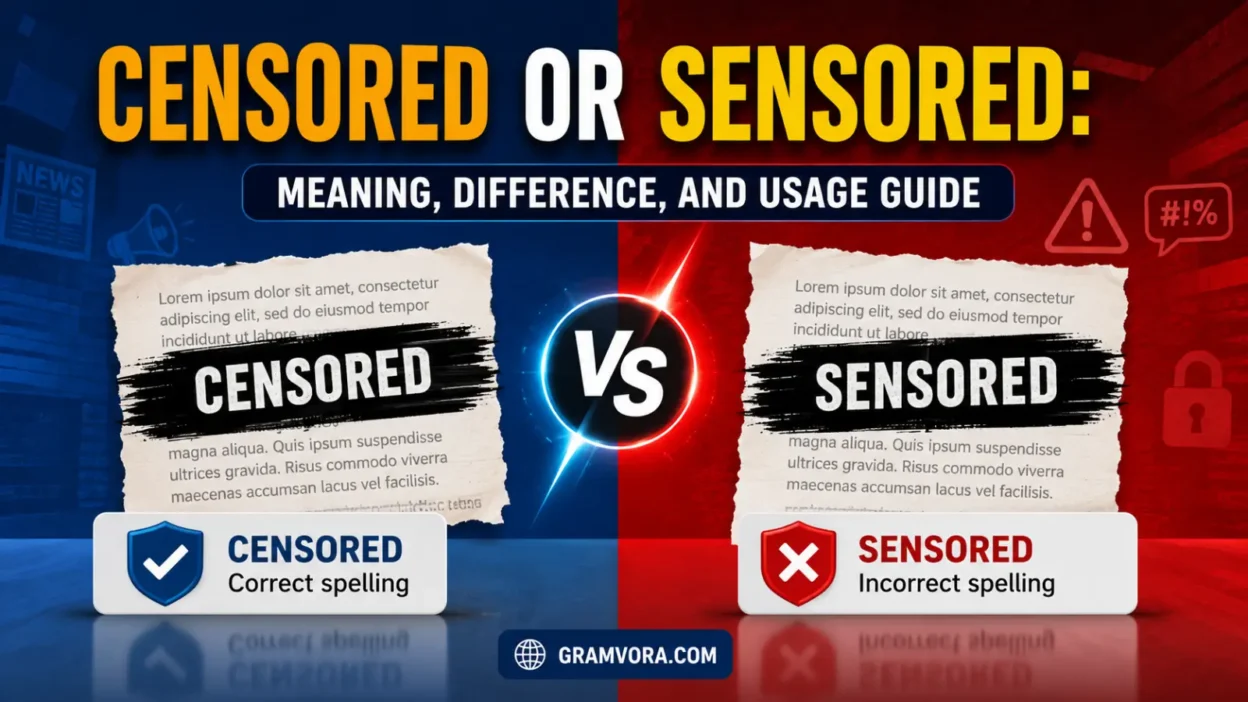
Censored and sensored sound the same in normal American speech, but they describe completely different actions or conditions.
Use censored when information, language, images, or other content has been hidden, removed, blocked, or restricted. Use sensored mainly in technical writing for equipment that contains or relies on sensors.
The right choice depends on whether your sentence concerns restricted content or sensor-based technology.
Quick Answer
Use censored for speech, books, movies, documents, images, broadcasts, websites, and other content that has been restricted or altered.
Use sensored for motors, machines, control systems, and other equipment that operates with sensors.
In most everyday sentences about blocked or removed material, censored is correct. Sensored is legitimate in specialized technical contexts, but it is often a spelling mistake when someone means censored.
Why People Confuse Them
The two forms are confusing because they look similar and usually sound alike.
Both are commonly pronounced “SEN-serd” in American English. When people hear the word without seeing its context, they may connect it with either censor or sensor.
Their endings also create confusion. Both appear to contain a base word followed by -ed. However, the base words carry different meanings.
Censor concerns controlling or restricting content. A sensor is a device that detects or measures a condition such as movement, light, heat, pressure, or position.
Key Differences At A Glance
| Feature | Censored | Sensored |
|---|---|---|
| Core meaning | Restricted, suppressed, removed, or altered | Equipped with or operated through sensors |
| Common subject | Content or information | Machinery or electronic equipment |
| Main role | Past-tense verb, past participle, or adjective | Mainly a technical adjective or participial form |
| Typical context | Media, publishing, communication, government, schools | Engineering, electronics, automation, motor control |
| Everyday frequency | Common | Uncommon outside technical fields |
| Example | The scene was censored. | The motor uses sensored control. |
The words are not interchangeable. Changing one to the other changes the meaning of the sentence.
Meaning and Usage Difference
Censored comes from the verb censor. It means that someone examined content and prevented part or all of it from being shown, heard, published, or shared.
Examples include a muted word in a broadcast, a covered image, a removed paragraph, or a restricted document.
- The station censored the offensive language.
- The public received a censored version of the report.
- Several scenes were censored before the movie aired.
The word may describe the action itself or the condition of the finished material.
Sensored relates to sensors. It is used mainly to describe a system, device, or operating method that uses physical sensors.
- The company tested a sensored motor.
- The vehicle uses a sensored control system.
- Sensored operation provides direct position feedback.
In general writing, equipped with sensors or sensor-equipped may sound clearer than sensored. In engineering and electronics, however, sensored is an established modifier, especially when contrasted with sensorless.
Tone, Context, and Formality
Censored is a standard, neutral word. It works naturally in conversation, journalism, school writing, business communication, legal discussions, and formal reports.
The word can sometimes carry a negative tone because censorship may involve limits on information or expression. That tone comes from the situation, not from the grammar of the word.
Sensored has a specialized technical tone. It appears most naturally in discussions of motors, electronics, robotics, automation, and measurement systems.
Outside those fields, it may look unusual or unclear. A sentence such as “The office is fully sensored” may leave readers wondering what kinds of sensors are installed. “The office is equipped with motion and temperature sensors” is usually more precise.
Therefore, choose sensored only when your readers understand the technical context or when it forms part of an established term.
Which One Should You Use?
Identify the thing being described.
If it is content that someone blocked, removed, covered, muted, or restricted, choose censored. If it is equipment that contains or relies on detection devices, sensored may be correct.
| Context | Best Choice | Why |
| A muted swear word on television | Censored | The audio content was restricted |
| A black bar covering part of an image | Censored | Visual material was hidden |
| A paragraph removed from a report | Censored | Written information was withheld |
| A motor using position detectors | Sensored | The motor relies on sensors |
| A control mode using Hall sensors | Sensored | The term describes the sensing method |
| A machine fitted with monitoring devices | Sensored | The equipment contains sensors |
| A social post removed by moderators | Censored | The communication was restricted |
| A temperature-monitoring production line | Sensored | Sensors measure operating conditions |
A useful memory check is to look for the base idea.
- Censored contains censor: restricted content.
- Sensored contains sensor: detection equipment.
When One Choice Sounds Wrong
Sensored sounds wrong when the sentence concerns speech, writing, images, or other material that has been blocked.
Incorrect: The offensive word was sensored.
Correct: The offensive word was censored.
Incorrect: The newspaper published a sensored report.
Correct: The newspaper published a censored report.
Incorrect: The scene was sensored before the broadcast.
Correct: The scene was censored before the broadcast.
Censored sounds wrong when the sentence is only describing the technology inside a machine.
Incorrect: The engineer installed a censored motor.
Correct: The engineer installed a sensored motor.
Incorrect: The vehicle switched to censored control.
Correct: The vehicle switched to sensored control.
There is one possible source of ambiguity. A report about a machine could itself be censored. In that case, censored describes the report, not the machine’s hardware.
Correct: The company released a censored report about the sensored motor.
Common Mistakes (and Quick Fixes)
The most common mistake is writing sensored for content that has been hidden or removed.
Incorrect: My comment was sensored.
Correct: My comment was censored.
The second mistake is assuming that sensored is never correct. Although uncommon in everyday prose, it is used in established technical phrases.
Correct: The controller supports both sensored and sensorless operation.
Another mistake is using sensored too broadly.
Unclear: The smart building is sensored.
Clearer: The smart building is equipped with motion, smoke, and temperature sensors.
Writers may also confuse censored with censured. These are different words. Censored means restricted or suppressed, while censured means formally criticized. That distinction does not change the choice between censored and sensored, but checking the intended meaning can prevent another common error.
Everyday Examples
Here are natural examples of censored:
- The network censored the caller’s offensive language.
- A censored image appeared in the news report.
- The school received a censored copy of the document.
- Several names were censored before publication.
- The platform censored content that violated its rules.
- Viewers complained that the interview had been heavily censored.
- The editor censored one sentence but kept the rest of the article.
- The uncensored version became available later.
Here are correct technical examples of sensored:
- The new sensored motor starts smoothly at low speed.
- The controller can run in sensored or sensorless mode.
- Engineers compared sensored and sensorless operation.
- A sensored system receives direct position feedback.
- The team installed a sensored drive for better control.
- This model requires a compatible sensored controller.
- The sensored setup uses Hall effect sensors.
- The machine’s sensored operation improves monitoring.
Dictionary-Style Word Details
Verb
- Censored: The simple past and past participle of censor. It means examined and restricted, removed, suppressed, or altered content.
Example: The station censored the interview before airing it. - Sensored: Not commonly used as an independent verb in general American English. In specialized writing, it may function as a participial form meaning fitted with sensors or operated through them.
Example: The system was sensored to collect position feedback.
In general prose, “equipped with sensors” is often clearer.
Noun
- Censored: Not normally used as a noun. The related noun censor refers to a person or authority that examines and restricts content.
- Sensored: Not normally used as a noun. The related noun sensor refers to a device that detects or measures a physical condition.
Synonyms
- Censored: Meaning-matched alternatives depend on the action. They include suppressed, redacted, restricted, blocked, edited, muted, and removed. Possible opposites include uncensored, unrestricted, and unedited.
- Sensored: Closest plain alternatives include sensor-equipped, sensor-based, instrumented, and fitted with sensors. In motor and control discussions, the standard technical opposite is sensorless.
Not every alternative works in every sentence. For example, redacted usually applies to hidden written or visual information, while muted applies more naturally to sound.
Example Sentences
- Censored: The television station censored the language during the live broadcast.
- Censored: Employees received a censored version of the investigation report.
- Censored: The photograph was censored to protect the child’s identity.
- Censored: The editor censored information that could reveal the confidential source.
- Sensored: The robot uses a sensored motor for accurate position control.
- Sensored: Technicians tested the drive in both sensored and sensorless modes.
- Sensored: A sensored control system can use direct feedback from the motor.
- Sensored: The manufacturer recommends a sensored setup for smooth low-speed operation.
Word History
- Censored: Formed from the verb censor with the standard -ed ending. Its meaning remains connected to examining and restricting material.
- Sensored: A transparent technical formation based on sensor plus -ed. It developed as a practical way to describe equipment or operation involving sensors.
The similarity between the two forms is accidental from a modern usage standpoint. Their meanings follow their different base words.
Phrases Containing
Common phrases with censored include:
- censored content
- censored version
- censored document
- censored image
- heavily censored
- censored material
- censored broadcast
- censored report
Common technical phrases with sensored include:
- sensored motor
- sensored control
- sensored system
- sensored operation
- sensored drive
- sensored mode
- sensored setup
- sensored brushless motor
FAQs
Is “sensored” a real word?
Yes, sensored is a valid but specialized word. It usually describes a motor, machine, or control system that uses sensors. However, it is incorrect when referring to restricted speech, images, documents, or media.
Should I write “censored” or “sensored content”?
Write censored content. The phrase means that part of the content has been blocked, removed, muted, hidden, or restricted. Sensored content would incorrectly suggest that the content contains sensors.
What does “censored” mean?
Censored means examined and restricted because certain material was considered inappropriate, confidential, harmful, or unacceptable. For example, a television station may censor offensive language before broadcasting a program.
What does “sensored” mean?
Sensored means equipped with sensors or operated through sensor feedback. The term commonly appears in engineering, electronics, robotics, and motor-control discussions, such as sensored motor or sensored operation.
Are “censored” and “sensored” pronounced differently?
They are usually pronounced the same way in American English: SEN-serd. Because they sound alike and differ by only one letter, writers often confuse them. Their meanings, however, are completely different.
What is the easiest way to remember the difference?
Connect each word to its base noun. A censor restricts information, so use censored for blocked or altered content. A sensor detects movement, heat, light, or another condition, so use sensored for sensor-equipped technology.
Conclusion
Use censored when words, images, documents, broadcasts, or other content have been hidden, removed, altered, or restricted.
Use sensored mainly when machinery or electronic equipment contains sensors or operates with sensor feedback.
For most everyday sentences about blocked content, censored is the correct choice. Sensored is valid in specialized technical writing, especially in phrases such as sensored motor and sensored control.
Remember the base words: a censor restricts content, while a sensor detects or measures something.