
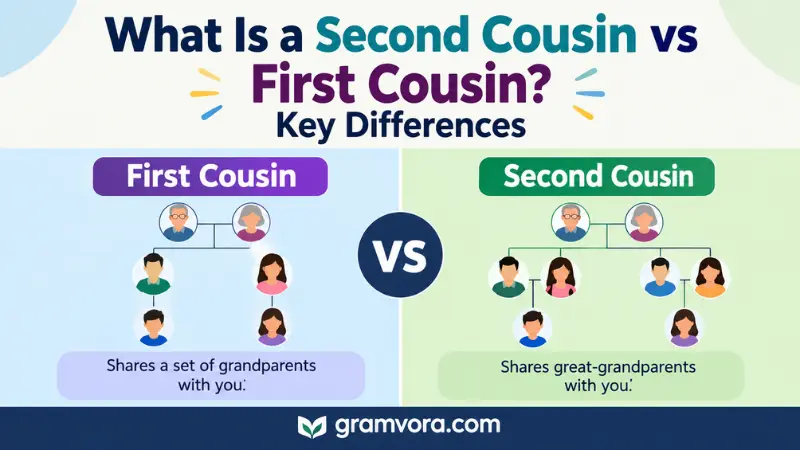
If you are trying to understand what is a second cousin vs first cousin, the main difference is the shared ancestor.
A first cousin is generally the child of your aunt or uncle. You and a first cousin share grandparents.
A second cousin is generally the child of your parent’s first cousin. You and a second cousin share great-grandparents.
Both terms are correct. They do not describe the same relationship, though. The number tells you how far back the closest shared ancestor is when both people are in the same generation.
Quick Answer
A first cousin shares grandparents with you.
A second cousin shares great-grandparents with you.
Here is the easiest way to remember the difference:
- First cousin → shared grandparent
- Second cousin → shared great-grandparent
For example, your mother’s sister’s son is your first cousin. Your mother’s cousin’s daughter is your second cousin.
The important point is that “second” does not mean the relationship is incorrect or that the person is a first cousin in a different form. It identifies a different degree of cousin relationship.
Why People Confuse Them
The terms can be confusing because both relatives are simply called “cousins” in everyday conversation.
You might say, “I’m visiting my cousin this weekend,” without explaining whether that person is a first cousin or a second cousin. In casual conversation, that is completely natural.
The confusion usually appears when someone is building a family tree or trying to describe a specific relationship.
Another reason is that the numbers do not simply describe age. A second cousin is not necessarily younger or older than a first cousin. The labels describe the family connection.
A first cousin and a second cousin can even be close in age.
Key Differences At A Glance
| Context | Best Choice | Why |
|---|---|---|
| Your aunt’s or uncle’s child | first cousin | You share grandparents |
| Your parent’s first cousin’s child | second cousin | You share great-grandparents |
| Same generation, shared grandparents | first cousin | The closest shared ancestor is a grandparent |
| Same generation, shared great-grandparents | second cousin | The closest shared ancestor is a great-grandparent |
| Casual conversation | cousin | The shorter term is often enough when the exact degree is not important |
The basic distinction is based on the closest shared ancestor.
| Feature | Second cousin | First cousin |
|---|---|---|
| Shared ancestor | Great-grandparent | Grandparent |
| Typical relationship | Child of your parent’s first cousin | Child of your aunt or uncle |
| Same-generation relationship | Yes | Yes |
| Relative closeness | More distant | Closer |
Meaning and Usage Difference
First cousin and second cousin are both countable noun phrases used for family relationships.
A first cousin is the child of your aunt or uncle. If your mother and another person’s mother are sisters, their children are first cousins.
A second cousin is the child of your parent’s first cousin. In a typical family tree, you and that person share great-grandparents.
The simplest method is to look upward in the family tree.
If you and the other person have the same grandparents, you are first cousins.
If you have the same great-grandparents but different grandparents, you are second cousins.
This distinction assumes you and the other person are in the same generation. If there is a generation difference, terms such as “once removed” may be needed.
For example, your first cousin’s child is your first cousin once removed, not your second cousin. The word “removed” describes the generation difference.
Tone, Context, and Formality
There is no important difference in tone or formality between first cousin and second cousin.
Both are standard family-relationship terms in American English.
The difference is factual rather than stylistic. You choose the term according to the actual relationship.
In casual conversation, you may simply say:
“She’s my cousin.”
If the exact relationship matters, you can say:
“She’s my first cousin.”
or
“He’s my second cousin.”
Family reunions, family trees, legal records, genealogy discussions, and family-history conversations are situations where the more precise term can be useful.
Which One Should You Use?
Use first cousin when the person is the child of your aunt or uncle.
For example:
My uncle’s daughter is my first cousin.
Use second cousin when the person is the child of your parent’s first cousin.
For example:
My dad’s cousin has a daughter who is my second cousin.
A quick family-tree test can help:
- Find the closest ancestor you both share.
- If that person is a grandparent, you are first cousins.
- If that person is a great-grandparent, you are second cousins.
- If you are different generations apart, check whether “once removed” applies.
Do not choose the term based on age, how often you see the person, or how close you feel to them.
When One Choice Sounds Wrong
Calling a first cousin a second cousin is incorrect when you know that the person is the child of your aunt or uncle.
For example:
❌ My aunt’s daughter is my second cousin.
✅ My aunt’s daughter is my first cousin.
Likewise, if someone is your parent’s first cousin’s child, calling that person your first cousin would normally be incorrect.
❌ My mom’s cousin’s son is my first cousin.
✅ My mom’s cousin’s son is my second cousin.
Another common mistake is confusing second cousin with first cousin once removed.
These are not the same relationship.
Your first cousin’s child is your first cousin once removed. Your parent’s first cousin is also your first cousin once removed. A second cousin is normally in the same generation as you and shares great-grandparents with you.
Common Mistakes (and Quick Fixes)
Mistake 1: Thinking “second cousin” means your cousin’s cousin.
Not necessarily. The term is based on the shared ancestor, not simply on whether someone is another person’s cousin.
Fix: Identify the closest shared ancestor.
Mistake 2: Thinking second cousins share grandparents.
They normally share great-grandparents when they are in the same generation.
Fix: Grandparents point to first cousins; great-grandparents point to second cousins.
Mistake 3: Treating “second cousin” as another name for “first cousin once removed.”
They describe different relationships.
Fix: “Second” identifies the cousin degree, while “once removed” identifies a one-generation difference.
Mistake 4: Choosing the term based on age.
Age does not determine whether someone is a first or second cousin.
Fix: Follow the family tree rather than the ages of the relatives.
Mistake 5: Assuming both terms have different levels of formality.
They do not.
Fix: Both are standard terms. The correct choice depends on the family connection.
Everyday Examples
Here are some simple examples using common US family relationships.
Example 1: Your uncle’s son
Your father’s brother has a son named Daniel.
Daniel is your first cousin because your father and Daniel’s father are siblings, so you and Daniel share grandparents.
Example 2: Your mother’s cousin’s daughter
Your mother’s cousin has a daughter named Sarah.
Sarah is your second cousin because your mother and Sarah’s parent are first cousins, and you and Sarah share great-grandparents.
Example 3: A family reunion
You meet someone at a family reunion and discover that your grandparents were siblings.
That person is your second cousin, assuming you are in the same generation.
Example 4: Talking casually
You might say:
“I’m going to my cousin’s graduation.”
If the exact relationship is not important, “cousin” is perfectly natural.
Example 5: Explaining a family tree
For a family tree, greater precision is helpful:
“Maria is my first cousin, while her cousin’s daughter is my second cousin.”
The exact label helps other people understand where each person belongs in the family.
Dictionary-Style Word Details
Verb
Second cousin: Not commonly used as a verb in standard US English. It functions primarily as a noun phrase for a family relationship.
First cousin: Also functions primarily as a noun phrase when referring to a family relationship. It is not normally used as a verb in this sense.
Noun
Second cousin: A countable noun phrase referring to a person who is typically the child of one of your parent’s first cousins.
First cousin: A countable noun phrase referring to the child of your aunt or uncle.
Both can be singular or plural:
- one first cousin
- two first cousins
- one second cousin
- several second cousins
Synonyms
Second cousin: There is no exact everyday synonym that preserves the same degree of family relationship. Cousin is a broader, less specific alternative.
First cousin: Cousin is the common broader alternative. In some dictionary contexts, “full cousin” can refer to a first cousin, but “first cousin” is the clearest term when precision matters.
Neither term has a simple antonym. They identify different positions in a family relationship rather than opposite concepts.
Example Sentences
Second cousin:
- “My second cousin lives in California.”
- “I met my second cousin at a family reunion.”
- “We discovered that we were second cousins after comparing our family trees.”
First cousin:
- “My first cousin lives across town.”
- “She invited all her first cousins to the wedding.”
- “My first cousin and I grew up together.”
Word History
Both expressions are established English family-relationship terms.
Dictionary records place second cousin in the mid-17th century, although historical dictionaries can give slightly different dates for individual expressions. The exact historical development is less important to modern usage than the relationship each term identifies.
There is no useful modern distinction in formality based on their history. Today, both first cousin and second cousin are ordinary standard terms for family relationships.
Phrases Containing
Second cousin:
- second cousin
- second cousins
- second cousin once removed
- second cousin twice removed
First cousin:
- first cousin
- first cousins
- first cousin once removed
- first cousin twice removed
The phrase once removed should not be confused with the number in first or second cousin. It indicates that the two people are separated by one generation.
FAQs
What is the difference between a first cousin and a second cousin?
A first cousin is usually the child of your aunt or uncle, so you share grandparents. A second cousin is usually the child of your parent’s first cousin, so you share great-grandparents.
Do first cousins share the same grandparents?
Yes. First cousins typically have at least one grandparent in common. Their parents are siblings.
Do second cousins share the same great-grandparents?
Yes. Second cousins in the same generation typically share one or more great-grandparents. Their parents are first cousins.
Is a second cousin closer than a first cousin?
No. A first cousin is a closer family relationship than a second cousin because the closest shared ancestor is one generation nearer.
Is my cousin’s child my second cousin?
Usually, no. Your first cousin’s child is your first cousin once removed, not your second cousin. “Once removed” refers to the generation difference.
Is my parent’s cousin my second cousin?
No. Your parent’s first cousin is generally your first cousin once removed. Your second cousin is normally in your generation and is the child of your parent’s first cousin.
What is my aunt’s daughter to me?
Your aunt’s daughter is your first cousin. You share grandparents because your parent and your aunt are siblings.
What is my mom’s cousin’s daughter to me?
Your mom’s cousin’s daughter is generally your second cousin. Your mom and her cousin are first cousins, making their children second cousins.
Are first cousin and second cousin the same thing?
No. They are different family relationships. First cousins share grandparents, while second cousins typically share great-grandparents.
How can I tell if someone is my first or second cousin?
Look at your closest shared ancestor. If you share grandparents, you are generally first cousins. If you share great-grandparents, you are generally second cousins, assuming you are in the same generation.
Conclusion
The difference between second cousin vs first cousin is straightforward once you identify the shared ancestor.
A first cousin is generally the child of your aunt or uncle, and you share grandparents.
A second cousin is generally the child of your parent’s first cousin, and you share great-grandparents.
So, both terms are correct, but they describe different family relationships. When in doubt, trace both people back to their closest shared ancestor. Grandparents usually mean first cousins; great-grandparents usually mean second cousins.


