
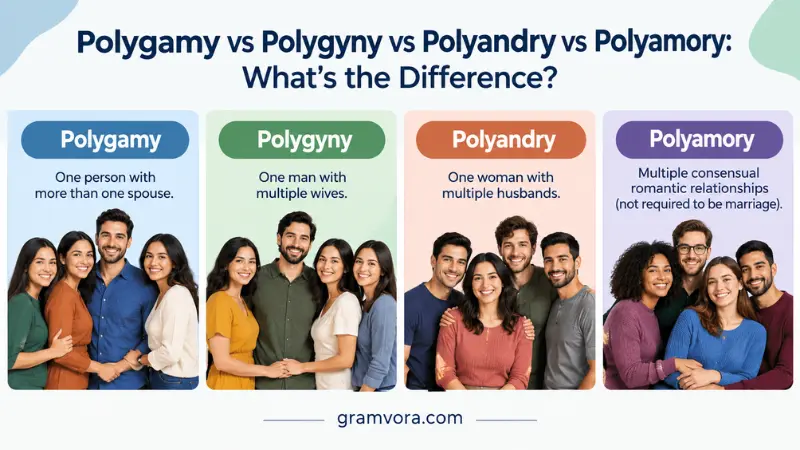
The terms polygamy, polygyny, polyandry, and polyamory are often used as if they mean the same thing. They are related, but each term describes a different relationship structure or concept.
The biggest difference is what the word focuses on. Polygamy generally refers to marriage involving more than one spouse at the same time. Polygyny describes one man married to multiple women, while polyandry describes one woman married to multiple men. Polyamory is broader and refers to having multiple romantic or sexual relationships at the same time, usually with the knowledge of the people involved.
These terms can appear in dictionaries, anthropology, sociology, relationship discussions, books, news articles, and online conversations. Understanding the differences makes it easier to use each word correctly.
This guide explains the four terms in plain English, including their meanings, pronunciation, examples, common mistakes, and frequently asked questions.
Quick Answer
Polygamy vs polygyny vs polyandry vs polyamory describes four related but different concepts.
- Polygamy means marriage to more than one person at the same time.
- Polygyny means one man has multiple wives or female partners.
- Polyandry means one woman has multiple husbands or male partners.
- Polyamory means having multiple romantic or sexual relationships at the same time.
The key point is that polygyny and polyandry are forms of polygamy, while polyamory does not necessarily involve marriage.
TL;DR
- Polygamy involves more than one spouse at the same time.
- Polygyny means one husband with multiple wives.
- Polyandry means one wife with multiple husbands.
- Polyamory involves multiple romantic or sexual relationships.
- Polyamory does not require marriage.
- Polygyny and polyandry are specific marriage structures.
What Does Polygamy Mean?
Polygamy is a noun meaning the practice or condition of being married to more than one person at the same time.
Cambridge Dictionary defines it as being married to more than one person simultaneously. In anthropology, the term can describe a marriage arrangement involving more than two spouses.
For example:
The anthropologist studied polygamy in several societies.
Here, polygamy refers to a marriage system rather than a specific arrangement between men and women.
The word is a broad category. It can include different forms of multiple-spouse marriage.
The two commonly discussed forms are polygyny and polyandry.
Simple example
Imagine a marriage involving:
One man + three wives
That is a form of polygamy.
More specifically, it is polygyny.
Now imagine:
One woman + three husbands
That is also a form of polygamy.
More specifically, it is polyandry.
This is why polygamy is often treated as the broader term.What Does Polygyny Mean?
Polygyny is a noun describing a marriage or relationship structure in which one man has more than one wife or permanent female partner at the same time.
In simple English:
Polygyny = one man + multiple women
For example:
The book describes a society where polygyny was traditionally practiced.
The term can also appear in biology. In that context, a polygynous male animal has more than one female mate.
Polygyny example
Suppose a man is married to three women at the same time.
The broad term is:
Polygamy
The more specific term is:
Polygyny
That distinction is important when writing about anthropology, sociology, marriage, or social structures.
Pronunciation
Polygyny is pronounced approximately:
puh-LIJ-uh-nee
The Cambridge pronunciation is /pəˈlɪdʒ.ə.ni/ in US English.
What Does Polyandry Mean?
Polyandry is a noun describing a marriage or relationship structure in which one woman has more than one husband or permanent male partner at the same time.
In simple English:
Polyandry = one woman + multiple men
For example:
The anthropologist examined the history of polyandry in several communities.
Polyandry is the opposite gender arrangement from polygyny.
In polygyny, one man has multiple wives.
In polyandry, one woman has multiple husbands.
Fraternal polyandry
One form is called fraternal polyandry.
This occurs when brothers share a wife in a marriage arrangement. OpenStax describes fraternal polyandry as a form in which biological brothers marry one woman.
The arrangement has appeared in some societies for social, economic, or inheritance-related reasons.
Pronunciation
In US English, polyandry is pronounced approximately:
pol-ee-AN-dree
Cambridge gives the US pronunciation as /ˌpɑː.liˈæn.dri/.
What Does Polyamory Mean?
Polyamory is a noun referring to the practice of having multiple romantic or sexual relationships at the same time.
The important difference is that polyamory does not require marriage.
For example:
Alex describes their relationship as polyamorous.
That statement does not tell us that Alex is married to multiple people.
Instead, it indicates that Alex has multiple romantic or sexual relationships within a polyamorous relationship structure.
The people involved generally know about the relationships and agree to the arrangement. This is one reason polyamory is commonly discussed as a form of consensual non-monogamy.
Simple example
A person might have:
- a romantic partner
- another romantic partner
- both relationships openly acknowledged by everyone involved
That can be described as polyamory.
The relationships do not have to involve marriage.
Polygamy vs Polygyny
The difference between polygamy and polygyny is mainly one of scope.
| Context | Best Choice | Why |
|---|---|---|
| More than one spouse | Polygamy | Broad marriage term |
| One man with multiple wives | Polygyny | Specific arrangement |
| One woman with multiple husbands | Polyandry | Specific arrangement |
Think of polygamy as the larger category.
Polygyny is one specific type of polygamy.
For example:
Polygyny is a form of polygamy.
That sentence is correct.
However:
All polygamy is polygyny.
That statement is too broad because polygamy can also refer to polyandrous arrangements.
Polygamy vs Polyandry
Polygamy is the general term.
Polyandry is a specific form involving one woman and multiple husbands.
Consider these examples:
The society permits polygamy.
This gives general information about multiple-spouse marriage.
The society practices polyandry.
This provides more specific information about the marriage structure.
Therefore, polyandry can be described as a type of polygamy, but the two words are not interchangeable.
Polygyny vs Polyandry
These terms are easier to remember because they describe opposite spouse arrangements.
Polygyny:
One man → multiple wives
Polyandry:
One woman → multiple husbands
Both terms can describe human marriage systems. Both can also be used in biology to describe mating patterns among animals.
For example:
The species has a polygynous mating system.
This means a male may mate with multiple females.
A biological example of polyandry describes a female animal mating with multiple males.
Polygamy vs Polyamory
This is one of the most common sources of confusion.
Polygamy focuses on marriage.
Polyamory focuses on multiple romantic or sexual relationships.
Someone can therefore practice polyamory without being married to multiple people.
The terms can overlap in some situations, but they are not synonyms.
For example:
Jordan has two romantic partners and everyone knows about the relationships.
This can fit polyamory.
If Jordan is legally or socially married to both partners, the situation may also involve polygamy, depending on the marriage structure and definition being used.
The key distinction is the role of marriage.
Polyandry vs Polyamory
The words look similar because they both begin with poly-, meaning “many.”
However, the rest of the words point to different ideas.
Polyandry specifically describes one woman having multiple husbands or permanent male partners.
Polyamory is broader and describes multiple romantic or sexual relationships.
Therefore, a polyandrous marriage can also involve relationships that people describe as consensual non-monogamy, but polyamory does not automatically mean polyandry.
A polyamorous relationship can involve people of different genders and does not require a particular spouse arrangement.
How These Four Terms Relate
A simple way to understand the relationship is:
Polygamy
→ marriage involving multiple spouses
Polygyny
→ one man + multiple wives
Polyandry
→ one woman + multiple husbands
Polyamory
→ multiple romantic or sexual relationships
The first three terms are especially connected to marriage and anthropology.
Polyamory is more commonly used in modern discussions about relationship structures and consensual non-monogamy. Cambridge defines it around having sexual or romantic relationships with two or more people simultaneously.
Are Polygyny and Polyandry Forms of Polygamy?
Yes.
In the broad anthropological sense, polygyny and polyandry are forms of polygamy.
OpenStax explains polygamy as a marriage involving more than two adults. It then identifies polygyny as one man married to multiple women and polyandry as one woman married to multiple men.
This gives you a useful hierarchy:
Polygamy
- Polygyny
- Polyandry
- Other less common multiple-spouse arrangements
Not every source uses these terms in exactly the same way, though. Everyday English can use polygamy more loosely, so context matters.
Are Polygamy and Polyamory the Same?
No.
The words describe related ideas, but they are not identical.
Polygamy specifically concerns having more than one spouse through marriage.
Polyamory concerns having multiple romantic or sexual relationships.
Marriage is therefore central to the usual definition of polygamy, while marriage is not required for polyamory.
For example:
She is in a polyamorous relationship.
This does not mean:
She is married to several people.
The second statement requires information about marriage.
Common Contexts Where You May See These Words
These terms appear in several types of writing.
Anthropology
Anthropologists use these words when studying marriage, family, kinship, and social organization.
For example:
The study examines polygyny as a traditional marriage system.
Sociology
Sociologists may discuss these terms when examining relationships and family structures.
Biology
Polygyny and polyandry can describe animal mating systems.
For example:
The bird species has a polyandrous mating pattern.
Everyday relationship discussions
Polyamory is more common in modern discussions about consensual non-monogamous relationships.
History and religion
The term polygamy may appear in historical or religious discussions involving marriage customs.
The exact meaning should always be understood from the surrounding context.
Common Mistakes With These Terms
Mistake 1: Using polygamy and polygyny as perfect synonyms
They can overlap, but polygyny is more specific.
Better:
Polygyny is a form of polygamy.
Mistake 2: Assuming polyamory means multiple marriages
It does not necessarily mean that.
Polyamory can involve multiple romantic or sexual relationships without multiple marriages.
Mistake 3: Calling polyandry “one man with many wives”
That describes polygyny, not polyandry.
Remember:
-gyn- → woman or female
-andr- → man or male
Mistake 4: Assuming all non-monogamous relationships are polyamory
Non-monogamy is a broader category.
Polyamory is one form of relationship structure involving multiple romantic or sexual relationships.
Part of Speech
All four main terms are primarily nouns.
Polygamy
Noun: the practice or condition of being married to more than one person.
Polygyny
Noun: marriage or mating involving one male with multiple females.
Polyandry
Noun: marriage or mating involving one female with multiple males.
Polyamory
Noun: having multiple romantic or sexual relationships at the same time.
Related adjective forms include:
- polygamous
- polygynous
- polyandrous
- polyamorous
For example:
They studied a polygynous society.
She described her relationship as polyamorous.
Synonyms and Related Terms
These words do not have perfect synonyms.
Polygamy may sometimes be explained as multiple-spouse marriage, but that is a description rather than an exact synonym.
Polygyny can be described as one-man, multiple-wife marriage.
Polyandry can be described as one-woman, multiple-husband marriage.
Polyamory is sometimes grouped under non-monogamy, but non-monogamy is a broader term. Cambridge lists polyamory and non-monogamy as related concepts.
Monogamy is a useful contrasting term. It refers to having one spouse or sexual partner at a time, depending on context.
What Does “Poly” Mean in These Words?
The prefix poly- generally carries the meaning of many.
You can see this pattern in:
- polygamy
- polygyny
- polyandry
- polyamory
However, the second part of each word changes its meaning.
Polygamy focuses on marriage with multiple spouses.
Polygyny identifies multiple female spouses or mates for one male.
Polyandry identifies multiple male spouses or mates for one female.
Polyamory focuses on multiple romantic or sexual relationships.
This makes the word parts useful memory clues.
Mini Quiz
1. One man is married to three women. Which term is most specific?
Answer: Polygyny
2. One woman is married to two men. Which term is most specific?
Answer: Polyandry
3. Someone has multiple romantic partners with everyone’s knowledge. Which term may describe this?
Answer: Polyamory
4. What broad term can describe marriage involving more than one spouse?
Answer: Polygamy
5. Does polyamory always require marriage?
Answer: No.
FAQs
Polygamy is the broader term for marriage involving more than one spouse. Polygyny is a specific form in which one man has multiple wives or female partners.
Polygyny involves one man with multiple wives. Polyandry involves one woman with multiple husbands.
Yes. In the broad anthropological classification, polyandry is a form of polygamy involving one woman and multiple husbands.
No. Polygamy usually refers specifically to multiple-spouse marriage, while polyamory refers to multiple romantic or sexual relationships.
Yes. Polyamory describes the relationship structure, not a requirement that everyone remain unmarried. A particular polyamorous relationship may or may not involve marriage.
In the specific gender arrangement, polyandry is the corresponding opposite: one woman with multiple husbands rather than one man with multiple wives.
Non-monogamy is a broad category covering relationship structures that do not follow exclusive two-person monogamy. Polyamory is one relationship structure within that broader area. Cambridge lists polyamory as a related term to non-monogamy.
Conclusion
Polygamy vs polygyny vs polyandry vs polyamory becomes much easier when you focus on what each term describes.
Polygamy is the broad marriage term. Polygyny means one man with multiple wives, while polyandry means one woman with multiple husbands. Polyamory describes multiple romantic or sexual relationships and does not require marriage.
When you see these words in a book, article, or conversation, check whether the discussion is about marriage, gender-specific spouse arrangements, or romantic relationships. That context usually tells you which term fits.


