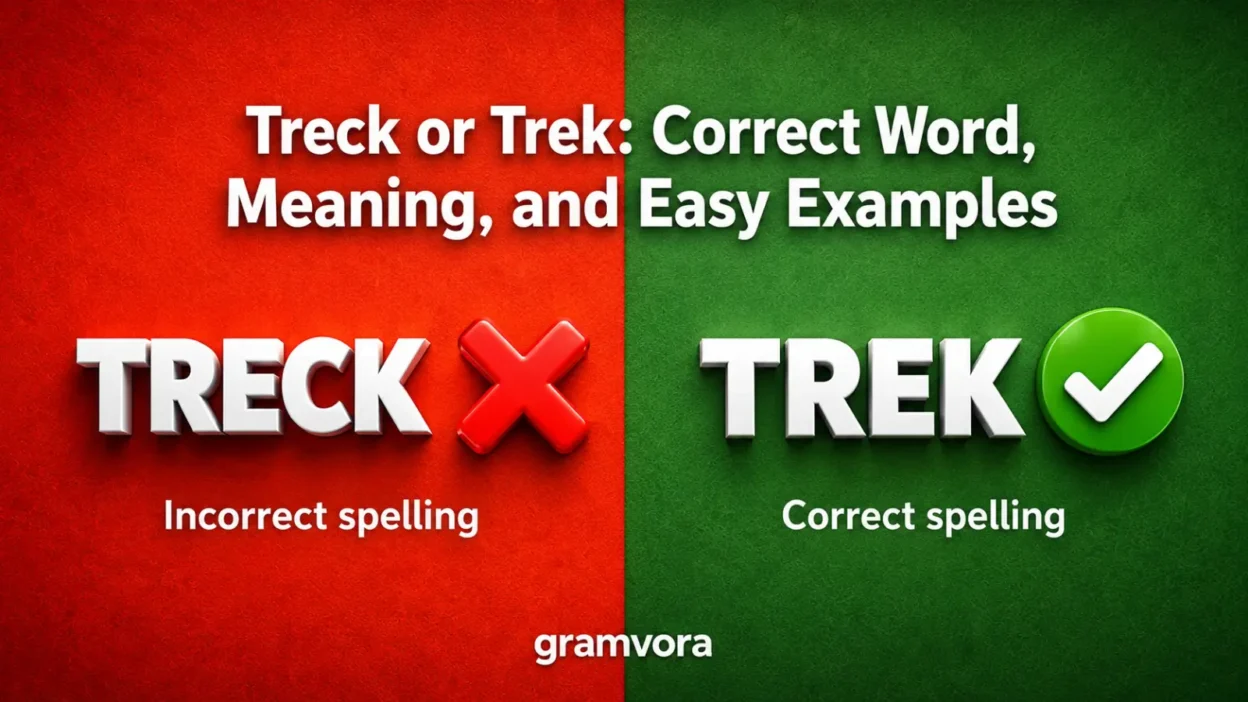
Treck or trek is a common confusion because the wrong form looks believable. Many English words use ck after a short vowel, so treck may seem natural at first glance.
However, the correct standard word is trek. Use it when you mean a long, difficult, or tiring journey, especially on foot. Treck is usually a misspelling, not a separate word with its own meaning in standard American English.
Quick Answer
Use trek. It is the correct word for a long or difficult journey and can work as both a noun and a verb. Avoid treck in normal writing because it is usually treated as a spelling error. Write trek, treks, trekked, and trekking.
Why People Confuse Them
People often write treck because it looks like words such as check, deck, neck, and wreck. That pattern is common in English, but it does not apply here.
The correct base word is short and simple: trek. When you add endings, the spelling changes only as needed: trekked and trekking use double k, but the base word still has no c.
Another reason is pronunciation. Trek rhymes with deck, so some writers expect the spelling to end in ck. Sound alone can mislead you here.
Key Differences At A Glance
| Context | Best Choice | Why |
|---|---|---|
| A long hike | trek | Standard noun for a long or hard journey |
| Traveling through mountains | trek | Common in outdoor and travel writing |
| A difficult walk across town | trek | Works in casual, figurative use |
| A verb meaning “to make a long journey” | trek | Standard verb form |
| Professional writing | trek | Correct and expected spelling |
| Writing “treck” for a journey | trek | Treck is usually a misspelling |
Meaning and Usage Difference
Trek means a long, difficult, or tiring journey. It often refers to walking through mountains, forests, deserts, or rough land. It can also describe any trip that feels harder or longer than expected.
Example:
“We took a three-day trek through the mountains.”
In everyday speech, trek can also be less dramatic. A person might say, “It was a trek from the parking lot to the stadium,” even if the walk was not a real wilderness journey.
Treck does not have a standard meaning for this use. If you write treck when you mean a journey, most readers will see it as an error.
Compact comparison:
- Trek: Correct standard word; noun and verb.
- Treck: Usually incorrect when used to mean a journey.
- Trek: Sounds like “trek,” rhyming with deck.
- Treck: Same intended sound, but not the accepted spelling.
Tone, Context, and Formality
Trek works in casual, academic, travel, business, and creative writing. It can sound adventurous when used for hiking or outdoor travel. It can also sound slightly playful when used for an annoying everyday trip.
Examples:
“The trek to the cabin took six hours.”
“The trek across campus in the rain was miserable.”
Treck does not have a formal or informal role in standard writing. It is not a casual version of trek. It is also not a British spelling or an American spelling difference.
The only time Treck may be acceptable is when it is part of a proper name, brand name, username, fictional name, or deliberate stylized spelling. In normal sentences, use trek.
Which One Should You Use?
Use trek every time you mean a long journey, a hard walk, or the act of traveling with effort.
Correct:
“We planned a weekend trek through the canyon.”
Correct:
“They will trek across the island with a local guide.”
Correct:
“The walk to the new office is a trek.”
Do not use treck unless you are copying a proper name exactly. For regular writing, treck will look unedited.
When One Choice Sounds Wrong
Treck sounds wrong when it appears in travel writing, school assignments, captions, business writing, or everyday messages.
Wrong:
“We went on a mountain treck last summer.”
Better:
“We went on a mountain trek last summer.”
Wrong:
“She loves trecking through national parks.”
Better:
“She loves trekking through national parks.”
Wrong:
“The explorers trecked for miles.”
Better:
“The explorers trekked for miles.”
Notice that trekked and trekking double the k. They do not add c.
Common Mistakes (and Quick Fixes)
Mistake: Writing treck as the base word.
Fix: Use trek.
Mistake: Writing trecking.
Fix: Use trekking.
Mistake: Writing trecked.
Fix: Use trekked.
Mistake: Thinking treck is a regional spelling.
Fix: Use trek in standard American English.
Mistake: Using trek for any short, easy trip.
Fix: Use trek when the trip feels long, hard, tiring, or adventurous.
Everyday Examples
“We started the trek before sunrise.”
“The trek through the forest took all afternoon.”
“My grandparents still talk about their trek across the country.”
“The trail is beautiful, but the final mile is a tough trek.”
“We had to trek up four flights of stairs with heavy boxes.”
“The team trekked through snow to reach the site.”
“She is trekking in Peru this summer.”
“Getting through airport security felt like a trek.”
“The kids complained about the trek from the beach to the car.”
“Our guide said the trek would be steep but safe.”
Dictionary-Style Word Details
Verb
treck: Not commonly used as a verb in standard American English. If you mean to make a long or difficult journey, use trek.
trek: A verb meaning to travel, walk, or make a long journey, often with effort.
Example:
“They plan to trek through the desert next spring.”
Common forms:
trek, treks, trekked, trekking
Noun
treck: Not a standard noun for a journey in American English.
trek: A noun meaning a long, difficult, or tiring journey.
Example:
“The trek to the summit took two days.”
Synonyms
treck: No reliable standard synonyms apply because it is usually a misspelling.
trek: Closest plain alternatives include journey, trip, hike, expedition, walk, and march.
Use these carefully. Trip is broader. Hike is usually recreational. Expedition sounds more planned or serious. Trek often suggests effort, distance, or difficulty.
A clear opposite is hard to give in every context. In some sentences, stay or remain can work as the opposite of traveling.
Example Sentences
treck:
“Treck” should not be used for the standard word meaning a long journey.
trek:
“The trek through the canyon was harder than we expected.”
trek:
“We had to trek across town to find an open pharmacy.”
trek:
“She trekked for hours before reaching the village.”
trek:
“They enjoy trekking in the mountains during summer.”
Word History
treck: There is no separate standard word history for treck as the normal English word for a journey.
trek: The word comes into English through Afrikaans and Dutch forms connected with traveling, pulling, hauling, or migrating. Its older South African use was linked with travel by ox wagon. In modern English, it usually means a long or difficult journey, especially on foot.
Phrases Containing
treck: No common standard phrases use treck for this meaning.
trek: Common phrases include:
- mountain trek
- long trek
- difficult trek
- weekend trek
- trek through the woods
- trek across town
- go trekking
- trekking trail
- trekking guide
- trekking boots
FAQs
Is treck or trek correct?
Trek is correct. Use trek when you mean a long, difficult, or tiring journey. Treck is usually a misspelling and should be avoided in standard American English.
Is treck a real word?
Treck is not the standard spelling for the word that means a long journey. You may see it as a name, brand, username, or typo, but the correct spelling in normal writing is trek.
What does trek mean?
Trek means a long or difficult journey, especially on foot. It can describe a real outdoor hike or a tiring everyday trip.
Example:
“The trek to the top of the hill took two hours.”
Can trek be used as a verb?
Yes. Trek can be a verb. It means to travel or walk a long distance, often with effort.
Example:
“They trekked through the forest before sunset.”
What is the correct spelling: trekking or trecking?
The correct spelling is trekking. Do not write trecking. The base word is trek, and the k doubles when you add -ing.
Correct:
“She enjoys trekking in the mountains.”
What is the past tense of trek?
The past tense of trek is trekked. Do not write trecked.
Correct:
“We trekked across the desert with a guide.”
Why is trek not spelled treck?
English spelling does not always follow the same pattern. Although words like deck, neck, and check end in ck, the accepted spelling here is trek. When adding endings, write trekked and trekking.
Is trek only used for hiking?
No. Trek often describes hiking or outdoor travel, but it can also describe any trip that feels long, difficult, or tiring.
Example:
“The walk from the parking lot to the stadium was a trek.”
Is trek formal or informal?
Trek works in both formal and informal writing. It is common in travel writing, school writing, everyday speech, and professional contexts. The tone depends on the sentence.
Should I ever use treck?
Use treck only if it is part of an exact proper name, brand name, username, or stylized title. For the normal word meaning a journey, always use trek.
Conclusion
The correct choice is trek, not treck. Use trek as a noun for a long or difficult journey and as a verb for making that journey.
Although treck may appear online or in quick typing, it is usually a misspelling. For clear American English, write trek, trekked, and trekking.