
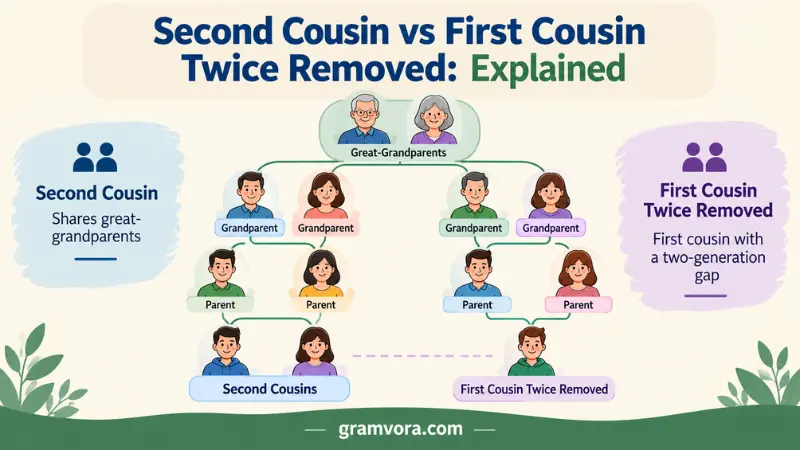
“Second cousin” and “first cousin twice removed” describe two different family relationships. They can sound similar because both use the word “cousin,” but the terms measure different things.
A second cousin is normally in your same generation and shares your great-grandparents.
A first cousin twice removed is two generations above or below you on the first-cousin line. That person may be your grandparent’s first cousin or your first cousin’s grandchild.
The easiest way to understand the difference is to separate two ideas: cousin degree and generation gap.
Quick Answer
A second cousin shares your great-grandparents with you. You are normally in the same generation.
A first cousin twice removed has a first-cousin relationship with someone in your family, but the two of you are separated by two generations.
For example:
- Your parent’s cousin is your first cousin once removed.
- Your grandparent’s cousin is your first cousin twice removed.
- Your first cousin’s child is your first cousin once removed.
- Your first cousin’s grandchild is your first cousin twice removed.
- Your parent’s cousin’s child can be your second cousin.
- Your second cousin is normally in your generation and shares your great-grandparents.
So neither term replaces the other. The correct label depends on the actual family-tree connection.
Why People Confuse Them
The confusion comes from the fact that “second” and “twice removed” describe different parts of the relationship.
The word second identifies the cousin degree. A second cousin is connected through a set of great-grandparents.
The phrase twice removed identifies the generation difference between two people. Two generations separate the people in the relationship.
That means you cannot treat “second cousin” and “twice removed” as two ways of saying the same thing.
Think of the terms as answering two separate questions:
- How far back is the shared ancestor?
- How many generations apart are the two people?
A second cousin answers the first question. A first cousin twice removed answers both questions.
Key Differences At A Glance
| Context | Best Choice | Why |
|---|---|---|
| You share great-grandparents and are in the same generation | Second cousin | The cousin degree is second, with no generation gap |
| Your grandparent’s first cousin | First cousin twice removed | You are two generations below your grandparent |
| Your first cousin’s grandchild | First cousin twice removed | The person is two generations below your first cousin |
| You are describing two people in the same generation with shared great-grandparents | Second cousin | The relationship has no removal |
| Two people are two generations apart on a first-cousin line | First cousin twice removed | “Twice removed” identifies the two-generation difference |
The simplest comparison
- Second cousin: same generation + shared great-grandparents.
- First cousin twice removed: first-cousin line + two-generation difference.
Meaning and Usage Difference
What “second cousin” means
A second cousin is someone who shares your great-grandparents, assuming the standard full-cousin relationship.
For example, imagine that your grandmother and another person’s grandmother are sisters. Their children are first cousins. Their grandchildren are second cousins.
You and that other person would therefore be second cousins if you are both grandchildren of those two siblings.
The key point is that second cousins are normally on the same generational level.
What “first cousin twice removed” means
A first cousin twice removed is connected to you through a first-cousin relationship, but there is a two-generation difference.
One example is your grandparent’s first cousin.
Suppose your grandfather and Linda are first cousins. Your grandfather is two generations above you. Linda is therefore your first cousin twice removed.
The term can also work in the other direction. If your first cousin has a grandchild, that grandchild is your first cousin twice removed.
The relationship works upward or downward. “Twice removed” does not specify whether the person is older or younger. It only describes the two-generation difference.
A useful family-tree rule
The cousin number and removal number have different jobs:
- First, second, third, and so on identify the cousin degree.
- Once, twice, three times removed identify the generation gap.
That distinction is the key to the entire comparison.
Tone, Context, and Formality
Both expressions are standard family-relationship terms. They are especially useful when people need to describe a family connection precisely.
In everyday conversation, people may simply say “cousin” because detailed cousin terminology can be unfamiliar. In genealogy and family-history discussions, however, the exact labels are useful because they distinguish different branches and generations.
“Second cousin” is relatively easy to understand because it describes a familiar cousin degree.
“First cousin twice removed” is more detailed. It tells the listener not only the cousin degree but also that the people are two generations apart.
Neither expression is inherently more formal in grammar. The difference is mainly one of relationship precision.
A family-tree researcher might write:
“She is my second cousin.”
Another person might need the more specific description:
“He is my first cousin twice removed.”
The second statement carries more information about the generation gap.
Which One Should You Use?
Use second cousin when the two people share great-grandparents and are on the same generation level.
Use first cousin twice removed when the two people are separated by two generations on a first-cousin line.
A quick way to decide is to start with the family connection rather than the label.
Ask:
Who is this person related to in my family?
Your grandparent’s first cousin is your first cousin twice removed.
The same label applies to the grandchild of your first cousin.
By contrast, the child of your parent’s first cousin is your second cousin.
That last example shows why generation counting matters. A relationship can move from the first-cousin line to the second-cousin line when both branches move down to the next generation.
When One Choice Sounds Wrong
Calling your grandparent’s first cousin your second cousin is not the standard relationship label.
Why? The person is not on your same generation level. Your grandparent and that person are first cousins, so you are two generations removed from that first-cousin relationship.
Likewise, calling your first cousin’s grandchild your second cousin misses the generation relationship.
The standard label is first cousin twice removed.
On the other hand, calling a person your first cousin twice removed simply because they are a distant relative is also incorrect. “Twice removed” has a specific meaning. There must be a two-generation difference.
A person does not become “twice removed” merely because you rarely see them or because they feel like a distant relative.
Common Mistakes (and Quick Fixes)
Mistake 1: Thinking “twice removed” means twice as distant
It does not.
Fix: “Twice removed” means two generations apart.
Mistake 2: Calling every distant cousin a second cousin
Not every distant cousin is a second cousin.
Fix: Find the shared ancestor first.
Mistake 3: Assuming “second cousin” means two generations apart
It does not.
Fix: The word “second” identifies the cousin degree. It does not describe the generation gap.
Mistake 4: Assuming “removed” means the relationship is weaker
The word describes generations, not an emotional or social distance.
Fix: Treat “removed” as a family-tree measurement.
Mistake 5: Forgetting that the relationship can go upward or downward
A first cousin twice removed can be older or younger than you.
Fix: Look at the direction of the generation difference.
Everyday Examples
Consider these examples:
Example 1: Your grandparent’s first cousin
Your grandfather and Maria are first cousins. You are two generations below your grandfather.
Maria is your first cousin twice removed.
Example 2: Your first cousin’s grandchild
Your first cousin has a grandchild named Alex.
Alex is two generations below your first cousin and is therefore your first cousin twice removed.
Example 3: Your parent’s first cousin’s child
Your mother has a first cousin. That person’s child is in your generation.
That person is your second cousin.
Example 4: Family reunion conversation
Someone says, “That’s my second cousin.”
You should expect a relationship involving shared great-grandparents and, under the standard definition, the same generation level.
Example 5: Looking at an old family tree
You discover that your grandmother and another person were first cousins. You are two generations below your grandmother.
That person is your first cousin twice removed.
These examples show why the family-tree position matters more than the apparent closeness of the wording.
Dictionary-Style Word Details
Verb
- Second cousin: Not used as a verb in standard US English. It is a noun phrase describing a family relationship.
- First cousin twice removed: Not used as a verb in standard US English. It is also a noun phrase describing a family relationship.
Noun
- Second cousin: A person who shares great-grandparents with you and is normally in the same generation.
- First cousin twice removed: A person who is on your first-cousin line but is two generations above or below you.
Both expressions function primarily as family-relationship noun phrases.
Synonyms
Exact synonyms are not available because each label identifies a specific genealogical relationship.
- Second cousin: The closest plain description is “a relative who shares your great-grandparents.”
- First cousin twice removed: A plain description depends on the direction of the relationship, such as “my grandparent’s first cousin” or “my first cousin’s grandchild.”
These descriptions explain the relationship but are not exact replacements for the formal labels.
Example Sentences
- “Jordan is my second cousin; our great-grandparents were siblings.”
- “My grandfather’s cousin is my first cousin twice removed.”
- “My first cousin’s granddaughter is my first cousin twice removed.”
- “Her mother’s first cousin’s daughter is her second cousin.”
- “The family tree helped me identify him as a second cousin rather than a first cousin twice removed.”
Word History
The terms belong to the traditional system of family-relationship terminology used to describe cousin degrees and generation differences.
The important distinction is structural: the cousin number identifies the relationship degree, while “removed” identifies the difference in generations.
There is no need to assign a separate special meaning to “removed” beyond that family-tree function.
Phrases Containing
- second cousin
- second cousin once removed
- second cousin twice removed
- first cousin once removed
- first cousin twice removed
- first cousin three times removed
These expressions follow the same general pattern. The cousin number identifies the cousin degree, while the removal indicates how many generations separate the two people.
FAQs
A second cousin usually shares your great-grandparents and is in the same generation as you. A first cousin twice removed is two generations above or below you on a first-cousin line.
Yes. Your grandparent and that person are first cousins. Since you are two generations below your grandparent, that person is your first cousin twice removed.
Yes. Your first cousin’s grandchild is two generations below your first cousin. Therefore, that person is your first cousin twice removed.
A second cousin is generally someone who shares your great-grandparents. You and your second cousin are normally in the same generation.
No. “Twice removed” refers to a two-generation difference. It does not mean the person is twice as distant from you.
No. These terms describe different family relationships. A second cousin normally shares your great-grandparents and is in your generation, while a first cousin twice removed has a two-generation gap on a first-cousin relationship.
Your parent’s first cousin is your first cousin once removed, not twice removed. The generation gap between you and your parent’s cousin is one generation.
Yes. Your parent’s first cousin is one generation above you, but that person’s child is generally in your generation. You and that child are second cousins.
Conclusion
Second cousin and first cousin twice removed are not interchangeable.
A second cousin normally shares your great-grandparents and is in your same generation.
A first cousin twice removed is connected through a first-cousin relationship but is two generations above or below you.
The easiest method is to separate the two measurements. First identify the shared ancestor and the cousin degree. Then determine whether the two people are in the same generation or separated by one, two, or more generations.
Once you understand that “second” describes the cousin degree and “twice removed” describes the generation gap, the difference becomes much easier to identify.


